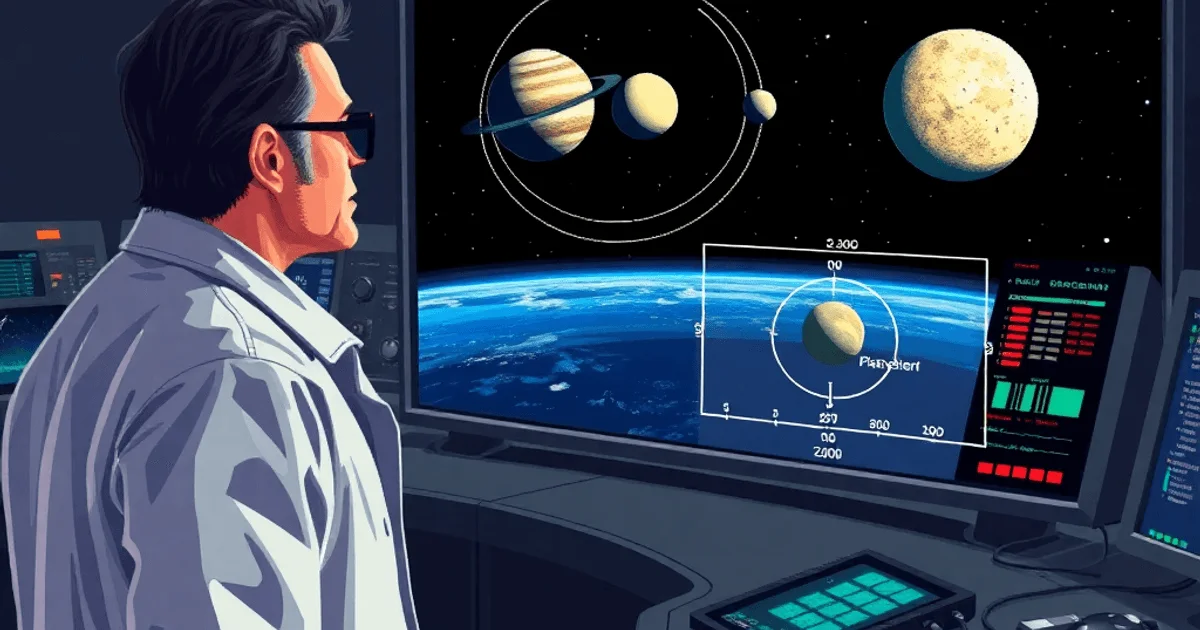
Binary Planets: From Asimov's Theory to Webb Telescope Discoveries
The idea of binary planets—two worlds of comparable mass orbiting a shared center of gravity—long remained purely theoretical. But today's astronomical observations and computer simulations show these systems aren't just possible; they could be common across the galaxy. Advanced tools like the James Webb Space Telescope have spotted real candidates, from paired gas giants in deep space to rocky worlds in habitable zones.
Criteria for Distinction: Moon or Binary Planet?
The key factor in classification is the barycenter—the system's common center of mass. If it's inside the larger body, the smaller one counts as a moon. If it's in the space between them, it might qualify as a binary planet. In our Solar System, Pluto and Charon are a classic example, with their barycenter outside both bodies. For Earth-Moon, the barycenter sits inside Earth, so the Moon is officially a satellite despite its hefty size.
Main astronomical criteria for binary planets include:
- Mass ratio: Both bodies must be planetary in mass, with neither dominating.
- Barycenter dynamics: The center of mass must lie in open space.
- Origin: Both should form as planets, not captured objects.
Modeling and Hunting Rocky Binary Worlds
Theoretical models suggest paired rocky planets can form, especially from massive collisions in the early stages of planetary systems. Computer simulations by teams at Caltech and Charles University in Prague show that under certain conditions, protoplanet smash-ups don't merge but create tight pairs.
Potential traits of such systems:
- Close proximity: Separation could be just a few planetary radii.
- Tidal locking: Each world likely shows the same face to the other.
- Climate stability: Mutual gravity could steady rotation axes and weather patterns.
- Habitability potential: In a star's habitable zone, they might swap atmospheric gases or even microbes.
A real-world example is a planetary pair in Cygnus spotted by the Kepler telescope. Both orbit in their star's habitable zone, just 0.1 AU apart.
Observed Binary Gas Giants and JUMBOs
Unlike rocky binaries, paired gas giants have already been observed. In 2025, the TOI-4504 system revealed a trio including two hot Jupiters in a 2:1 orbital resonance, letting them tug tides on each other strongly.
The most exciting recent finds are JUMBOs (Jupiter-Mass Binary Objects)—rogue gas giants drifting through space without a host star. The James Webb Space Telescope has detected dozens in the Orion Nebula.
Key facts about JUMBOs:
- Mass: Each clocks in from 0.7 to 13 Jupiter masses.
- Separation: Vast gaps of 28 to 384 AU.
- Origin: Likely ejected from young planetary systems by gravitational chaos.
- Evolution: They might have their own dust disks or rocky moons, but could eventually drift apart or merge.
Key Takeaways
- Core criterion for binary planets: barycenter outside both bodies.
- Rocky binary planets are theoretically viable in habitable zones, offering wild prospects for life.
- Paired gas giants confirmed in systems like TOI-4504 and as free-floaters (JUMBOs).
- James Webb Space Telescope is revolutionizing detection, especially for starless pairs.
- Dynamic evolution of binaries is tricky: stable for billions of years or slowly unraveling.
— Editorial Team










No comments yet.