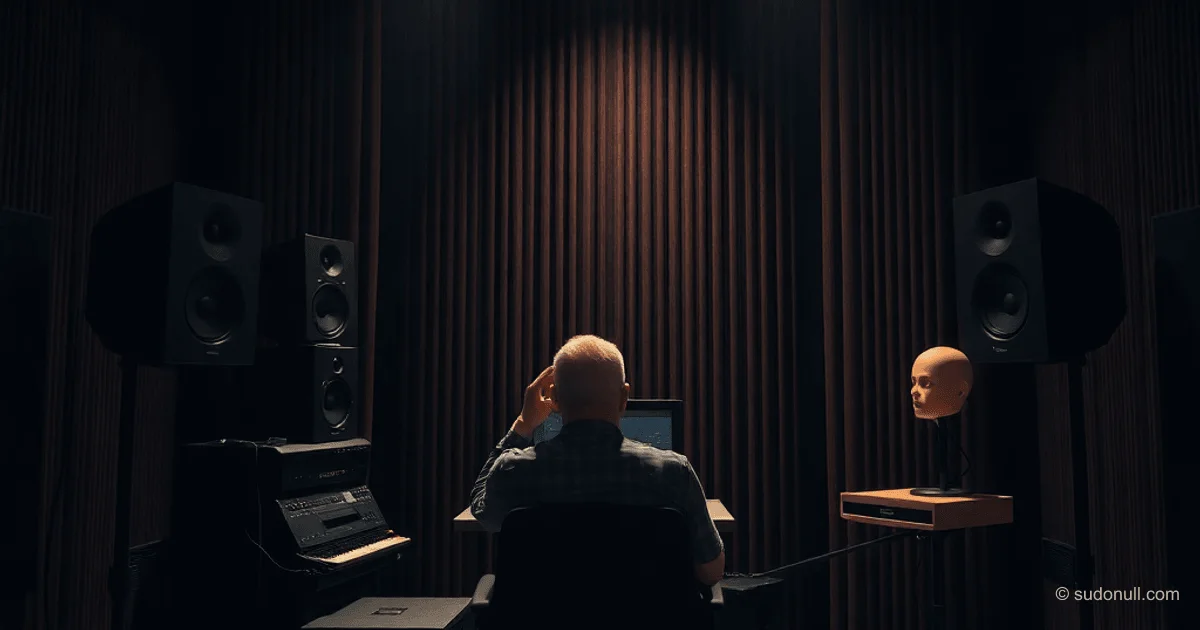
Binaural Audio Through Stereo Speakers: Simple Immersive Playback Setup
A stereo system with full-range speakers positioned at right angles to the listener's head can reproduce binaural recordings with precise spatial positioning. Place the subwoofer in a room corner. Use recordings at no less than 16-bit/44.1 kHz quality, as MP3 compression at 320 kbps degrades localization accuracy.
The setup includes:
- Right full-range speaker.
- Left full-range speaker.
- Subwoofer.
- Signal source (amplifier or receiver).
- Listener position.
- Acoustic focus point.
This configuration delivers a headphone-like experience, enhanced by room acoustics.
Methods for Creating Binaural Recordings
Binaural audio mimics human hearing through two channels. Two main approaches:
- Natural recording: Uses dummy heads with microphones in the "ears." A torso is recommended for realistic acoustics, with ear canal entrances damped using fibers (wool or aramid) to reduce resonances. Sensitive mics like PUI Audio AOM-5024L or pro-grade MK-233 (-10 dB sensitivity, flat frequency response) capture subtle reflections that create depth.
- Synthetic recording: Software-based processing, common in games, but less natural than real-world measurements.
These sensitive capsules pick up reverb tails but need ear coverings with flock material to minimize unwanted resonances.
Equipment Requirements
Hi-Fi stereo systems with full-range speakers work best. Key specs:
- Wide stereo base with speakers placed to the sides at head level.
- Matching frequency response and phase characteristics across channels.
- Angled at 90° toward the listener for sharp focus.
P.S. additions: Standard WM-61 capsules with flat response are sufficient; positioning holds up even with imperfect curves if channels are in phase. Expand the sweet spot with extra speakers in a row (4 for home, arrays for larger venues).
Adapting for Movie Theaters
In cinema-style rooms, narrow the seating rows, embed side-firing speakers into walls at head height, and skip rears. The Haas effect boosts the nearest sources. Calculate speaker spacing and driver sizes to balance frequency and phase response across channels.
Experiments fine-tune height and position to eliminate dead zones.
Key Takeaways
- Binaural with stereo demands side-placed full-range speakers at head level for spot-on positioning.
- Natural recordings with damped mics (MK-233 or WM-61) outperform synthetics in depth and realism.
- Stick to CD quality or better; compression hurts localization.
- For theaters: Wall-embedded speakers, tighter rows, leverage Haas effect.
- Expand coverage: Add matching speakers in arrays.
— Editorial Team










No comments yet.