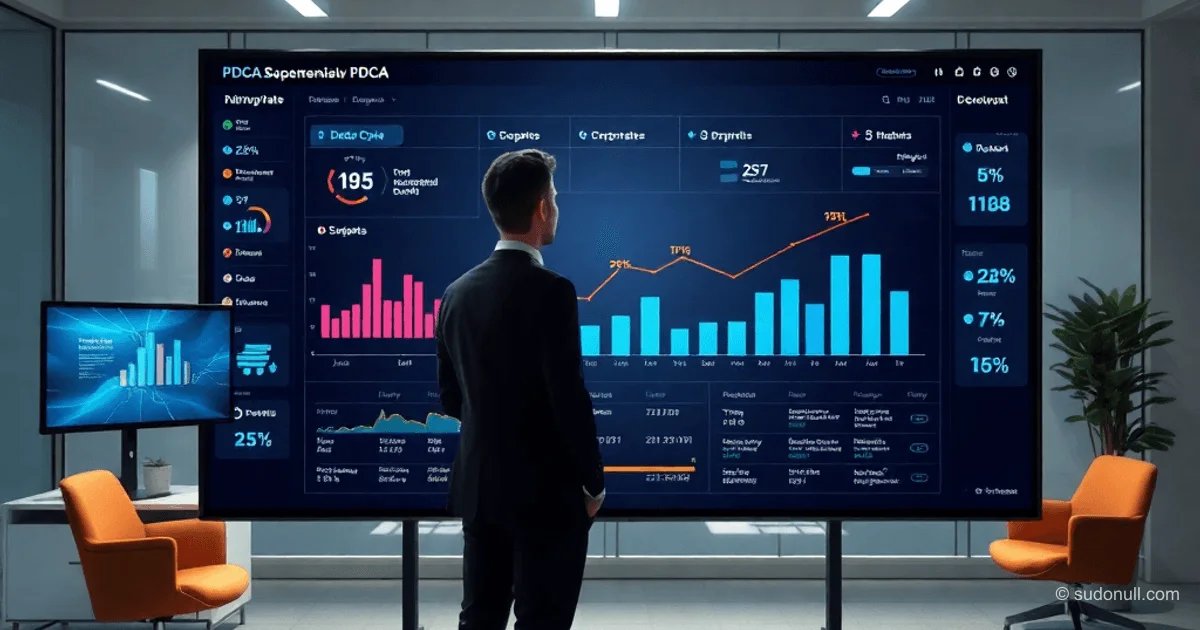
Business Automation via ERP: Integrating into the PDCA Cycle, Not Just Replacing Systems
At Revolut, company operations are entirely driven by metrics and KPIs. Decisions are made based on data, minimizing subjectivity. This approach enables scalability across 40 countries, accelerates response times, and ensures full transparency for all employees.
Access to performance data at every level helps individuals understand how their tasks impact overall business goals. Here, the IT system isn’t just an accounting tool—it’s the backbone of business management.
The Pitfalls of 1C Implementation: Accounting Over Management
The slogan "management and accounting" from 1C is, in practice, mostly about accounting. Around 95% of 1C:ERP implementations involve only a technical upgrade—replacing legacy systems (like UPP) with ERP—without changing core processes. The result? A loss of 90% of automation potential despite high costs.
Typical implementation goals are purely technical: upgrading to a new version, complying with the "Honest Mark" certification, or avoiding end-of-support scenarios. These can be achieved more affordably without a full ERP rollout.
System Implementation vs. True Business Automation
System implementation often ends with signed acceptance documents—but no real business transformation. Processes remain unchanged, now just slower due to new support requirements.
Real automation focuses on business outcomes:
- Integrating IT into the management framework.
- Improving speed and quality of processes.
- Shifting from recording facts to enabling decision-making.
Consider Goldratt’s Theory of Constraints: Without a system, creating a production plan takes a month; with it, minutes. But if planning frequency doesn’t increase, the benefit vanishes. Real value comes from faster response to market demand.
PDCA as the Foundation of Automation
Management follows the Shewhart-Deming cycle (Plan-Do-Check-Act). Automation should support this loop by delivering timely data for process evaluation.
Key evaluation criteria: Does the process bring the organization closer to its strategic goals? To answer this, you need:
- A clear, measurable goal (not vague ambitions like "market leader").
- A defined strategy to achieve it.
- Process alignment with that goal.
- A KPI system for continuous monitoring.
Process modeling is mandatory during ERP implementations. Include KPIs that the system will collect and analyze.
Limitations of Standard 1C:ERP for Dynamic Management
The core of effective management is analyzing metric trends. Example: target defect rate is 1%, current rate is 5%. A static number looks like failure—but a trend showing 20% → 15% → 12% → 5% reveals real progress.
Standard 1C reports show snapshots in time, rarely displaying trends. In projects, customizing these reports is even less common—leading to flawed decisions.
| Metric | January | February | March | April |
|--------|---------|----------|-------|-------|
| Defect Rate (%) | 20 | 15 | 12 | 5 |
Without trend analysis, management becomes subjective and ineffective.
Key Takeaways
- Numbers eliminate bias and scale management.
- Business automation transforms processes—not just copies old ones.
- ERP must support PDCA with a focus on KPI dynamics.
- Process modeling with embedded KPIs is non-negotiable.
- Standard 1C reports lack dynamic insights—customization is essential.
— Editorial Team










No comments yet.