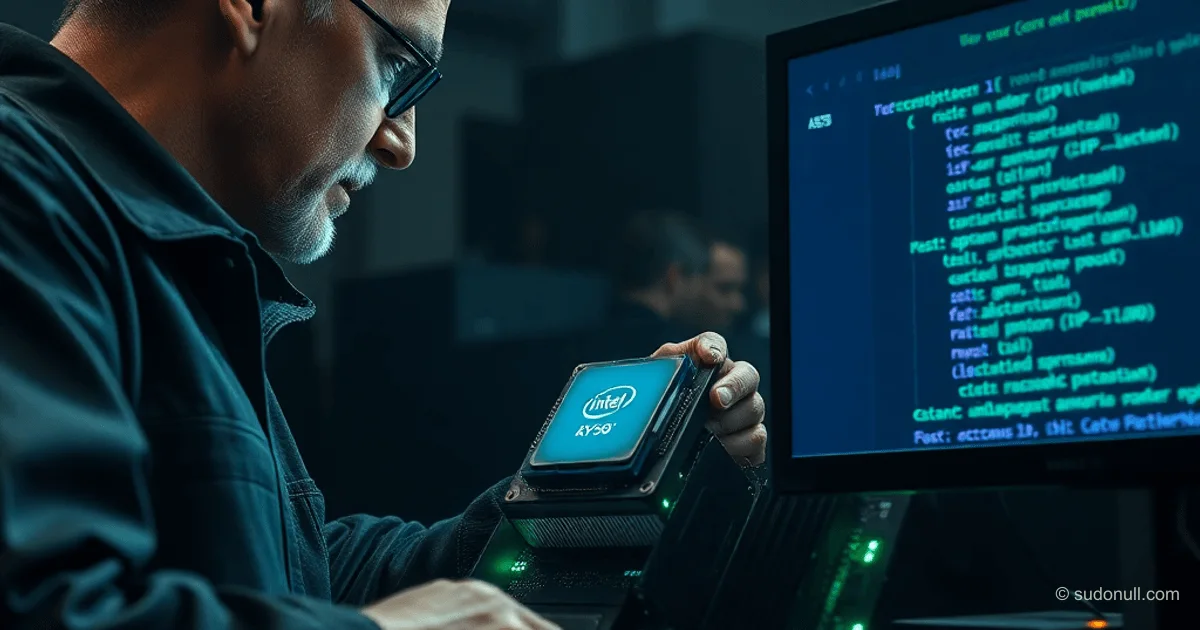
# Claude Rewrites BIOS to Run Server-Grade Intel Bartlett Lake on Desktop Motherboard
Modder kryptonfly used AI Claude to completely overhaul the BIOS on an ASUS Z790 motherboard, enabling Windows 11 to boot on the 12-core Intel Core 9 273PQE processor from the Bartlett Lake lineup. This chip, designed exclusively for embedded and edge systems, is physically compatible with the LGA1700 socket but locked at the firmware level for consumer boards.
Bartlett Lake Core 9 273PQE Specifications
The Bartlett Lake lineup was unveiled in March 2026 at Embedded World. The flagship Core 9 273PQE stands out with this architecture:
- 12 P-cores without E-cores;
- 24 threads with Hyper-Threading;
- Boost up to 5.9 GHz;
- 36 MB L3 cache;
- 125 W TDP.
Compared to the desktop Core i9-14900KS (8 P-cores + 16 E-cores), Bartlett Lake offers more performance cores, but Intel restricts it via firmware that blocks initialization on consumer boards.
The processor fits into the LGA1700 socket on the ASUS Z790-AYW OC Wi-Fi board, which matches the pinout but requires firmware mods for recognition and operation.
BIOS Modification Process with Claude
kryptonfly used Claude to edit 100% of the BIOS firmware. The AI integrated the missing Bartlett Lake microcode without touching existing modules. The first iteration reached the POST screen with correct CPU detection but hung during memory initialization.
Critical issue: FSP-M (Firmware Support Package - Memory) doesn't support the Bartlett Lake system agent, throwing error 5F. The fix—swap in system agent and PCIe initialization routines from Raptor Lake (13th/14th gen). This let FSP-M treat the chip as familiar, set up memory, and boot Windows 11.
Technical modification details:
- Extract and analyze the original BIOS;
- Generate Bartlett Lake microcode via Claude;
- Patch FSP-M to emulate Raptor Lake;
- Assemble and flash the updated BIOS;
- Test POST and boot process.
Current Limitations and Future Plans
The system boots into Windows 11, but BIOS Setup access is impossible with Bartlett Lake installed—you need to swap in a compatible CPU for settings. Everyday task performance is stable, but full PCIe and other subsystem optimization needs more work.
kryptonfly plans to adapt the firmware for other LGA1700 boards, including ASUS Apex and Encore. This shows the barrier between server and desktop Intel CPUs is in the firmware, not hardware incompatibility.
Key Takeaways
- Claude can fully rewrite BIOS, integrating new CPU microcode without breaking the modular structure.
- Bypassing FSP-M via Raptor Lake emulation solves the key memory initialization issue for locked chips.
- Bartlett Lake Core 9 273PQE beats desktop counterparts in P-core count, unlocking high-end desktop potential.
- AI-assisted firmware modding speeds up testing unofficial configs.
- In the LGA1700 ecosystem, the server/desktop divide is software-defined, not hardware.
This experiment highlights AI's growing role in low-level hardware hacking: from BIOS dump analysis to patch generation. For mid/senior devs, it's a tool for experimenting with embedded and server CPUs on desktops—just watch out for the risk of bricking your board.
— Editorial Team










No comments yet.