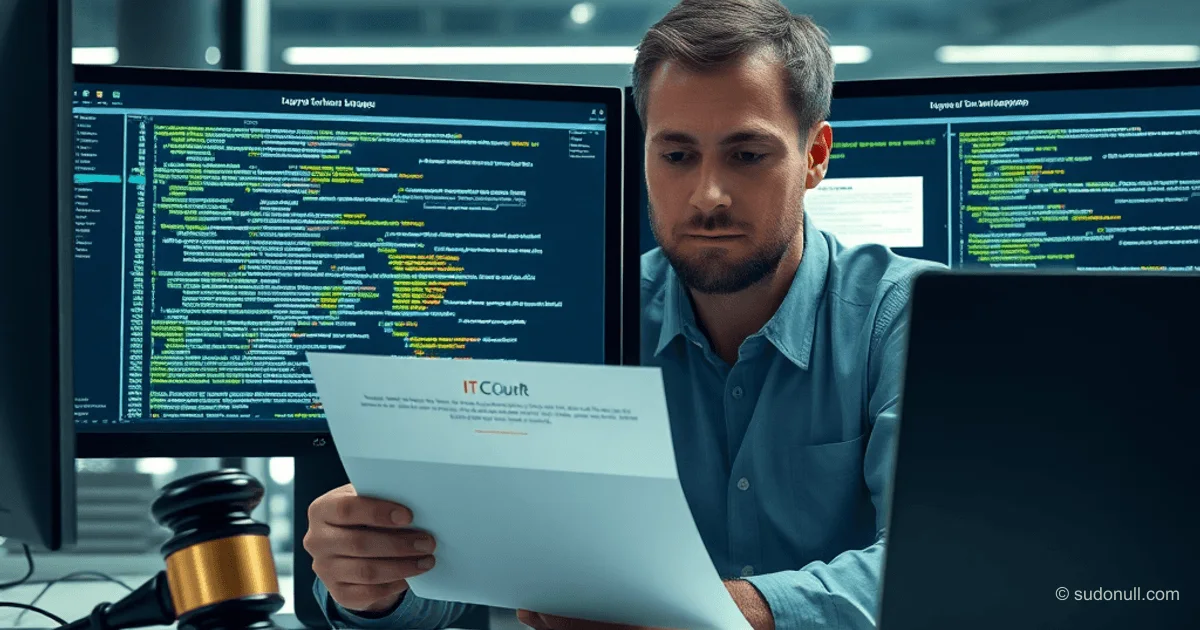
Compliance Risks in Software Operation: Analysis for IT Companies
A study of 495 IT companies in the Tomsk region identified 170 universal risks across phases from requirements gathering to operational documentation. Compliance risks account for 27% of the total, with average damage of 277 thousand rubles per incident. Two risks double the losses to 554 thousand rubles, three to 831 thousand rubles. These risks stem from violations of legislation, standards, and codes, resulting in legal sanctions.
Compliance risks are highly relevant for operating IT products on the market, including deployment and maintenance. Court practice confirms: violations of software rights lead to claims ranging from 50 thousand to 4.7 million rubles, and in extreme cases, to criminal liability.
Civil Risks Related to Quality and Intellectual Property
Operating IT products carries two key types of compliance risks: quality defects and violations of rights to intellectual property. Under Article 1261 of the Civil Code of the RF, an IT product qualifies as intellectual property.
Shortcomings of IT Products
A shortcoming is a failure to meet laws, standards, or contract terms. A defective product triggers demands for refunds or rework. An expert review in case No. A45-15497/2020 confirmed defects in the Boom Boom mobile app: the contractor paid 133.7 thousand rubles.
An IT product combines services and intellectual property, heightening risks for both parties to the contract.
Copyright Infringement
Unlicensed software (counterfeit) is prohibited. Consequences include bans on use, recovery of damages or compensation (10 thousand to 5 million rubles). Administrative fines under Article 7.12 of the RF Code of Administrative Offenses for selling counterfeit goods can lead to confiscation.
Example: In case No. 5-1637/2021, a fine of 15 thousand rubles was imposed for using pirated software on Sony PlayStation 4 Pro. Plagiarism causing damage over 545 thousand rubles is prosecuted under Article 146 of the RF Criminal Code.
Bans and Claims Related to Intellectual Property
Under Article 1252 of the Civil Code of the RF, the rights holder can prohibit use of intellectual property. In case No. A53-23110/22, the court denied a ban on LabWagon: the product was created under a work assignment, but the author had not transferred rights to the employer.
Compensation claims are standard. A sole proprietor in case No. A50-17729/2022 paid 400 thousand rubles for unlicensed 1C software. License violations, as in No. A67-8506/2018, result in debts up to 3.5 million rubles.
Key civil risks in operation:
- Detection of defects requiring rework or refunds.
- Counterfeit software leading to bans and fines.
- Bans on using intellectual property without permission.
- Compensation claims up to 5 million rubles.
- Breaches of license agreements.
Risks of Proving Rights and Derivative Products
Inability to Confirm Exclusive Rights
Under Article 1295 of the Civil Code of the RF, work-related software belongs to the employer, but without an assignment, rights are not secured. In case No. A40-90889/21-134-529, the court denied JSC "VIST Group" protection for ALTAN: lack of documentation meant it was not work-related.
Document work assignments to avoid disputes.
Derivative Works
Modifying software under Article 1270 of the Civil Code of the RF creates a new copyrighted object. This can trigger lawsuits over unwanted derivative works.
Key Takeaways
- Average damage from a compliance risk is 277 thousand rubles, increasing linearly with the number of incidents.
- 27% of risks are compliance-related, with focus on development and operation phases.
- Courts award 50 thousand to 4.7 million rubles for software rights violations.
- Lack of a work assignment deprives the employer of rights to work-related software.
- Counterfeit goods trigger civil, administrative, and criminal sanctions.
Operation requires strict adherence to the Civil Code of the RF, Code of Administrative Offenses, and Criminal Code to minimize losses. Analysis of case law highlights the need for quality and intellectual property audits before market launch.
— Editorial Team










No comments yet.