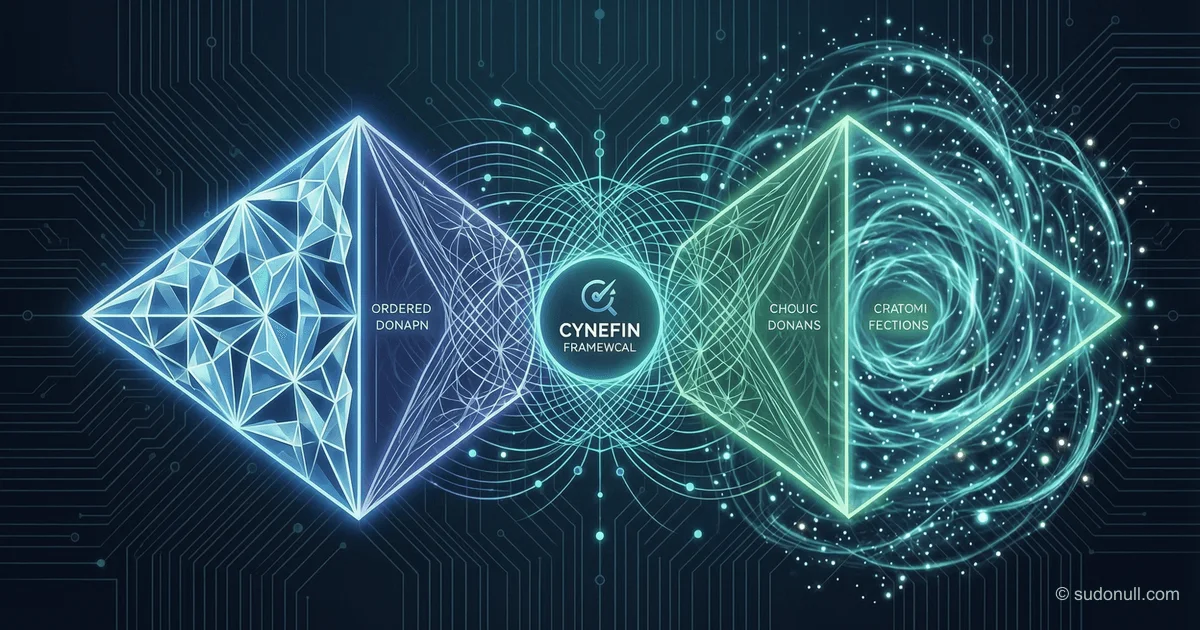
Cynefin Framework: Strategic Decision-Making in IT Projects by Complexity Domains
The Cynefin framework classifies systems by complexity level and recommends tailored decision-making models. Developed by Dave Snowden, it’s designed for IT leaders and professionals. The model divides reality into five domains: ordered simple, ordered complex, complex, chaotic, and disorder at the center. The key is quickly identifying your current domain and applying the appropriate approach—while accounting for transitions between them.
Cynefin accounts for interactions among agents—people, processes, events—that shape system complexity. It’s not a rigid classification but a tool for contextual analysis.
Ordered Simple Domains: Best Practice
In these systems, cause-and-effect relationships are clear, and behavior is predictable. Linear constraints ensure repeatability.
Decision-making model:
- Gather data.
- Categorize.
- Apply best practice.
IT examples: standard software updates with clear instructions, routine server administration. Long-term planning works well here—but risks tipping into chaos if threats are underestimated.
Ordered Complex Domains: Expert Role
Cause-and-effect relationships require expertise to uncover. Experts analyze subtle, non-obvious factors.
Decision-making model:
- Gather data.
- Analyze by expert.
- Select good practice.
In IT: customizing legacy systems or optimizing database performance. Leaders without deep knowledge should bring in specialists—clients shouldn’t demand best practices, as they don’t apply here.
Complex Domains: Iterations and Experiments
Multiple interdependencies, unknown constraints. Forecasting is impossible without testing.
Decision-making model: experiments → data → insights → new practices. An iterative cycle.
In IT:
- Agile methodologies (Scrum as optimal for software).
- HADI cycles for hypothesis validation.
- Building unique products with feedback loops.
Most mid-to-large projects fall here—iterations reduce risk significantly.
Chaotic Domains: Immediate Action
No known constraints—or no awareness of them. Goal: stabilization.
Decision-making model: act → gather data → next decision → emerging practices.
In IT: production outages, intentional chaos for innovation. A random incident triggers a crisis; resolution comes through rapid response.
Disorder and Transitions
The central zone lacks clarity about the domain. Task: diagnose to choose the right path (expert, experiment, etc.). Systems shift over time—simple → chaos, complex → complex.
Practical Recommendations for IT Development
- Analyze reality, not reports: use best practice for simple tasks, experts for complex ones.
- Plan long-term only in ordered domains.
- Avoid best practices in complex settings: focus on iterations and HADI.
- Manage chaos: intentionally for innovation, reactively for crises.
- Use Scrum in complex environments: ideal for software development.
Large-scale projects are mostly in ordered complex and complex domains; routine work is the exception.
Key Takeaways
- Cynefin is for diagnosing the domain before selecting a decision model.
- Ordered: best/good practice; complex: experimentation; chaotic: action.
- Most IT tasks aren’t simple—iterations drive success.
- Domain shifts require ongoing monitoring.
- Apply it in product management and DevOps.
— Editorial Team










No comments yet.