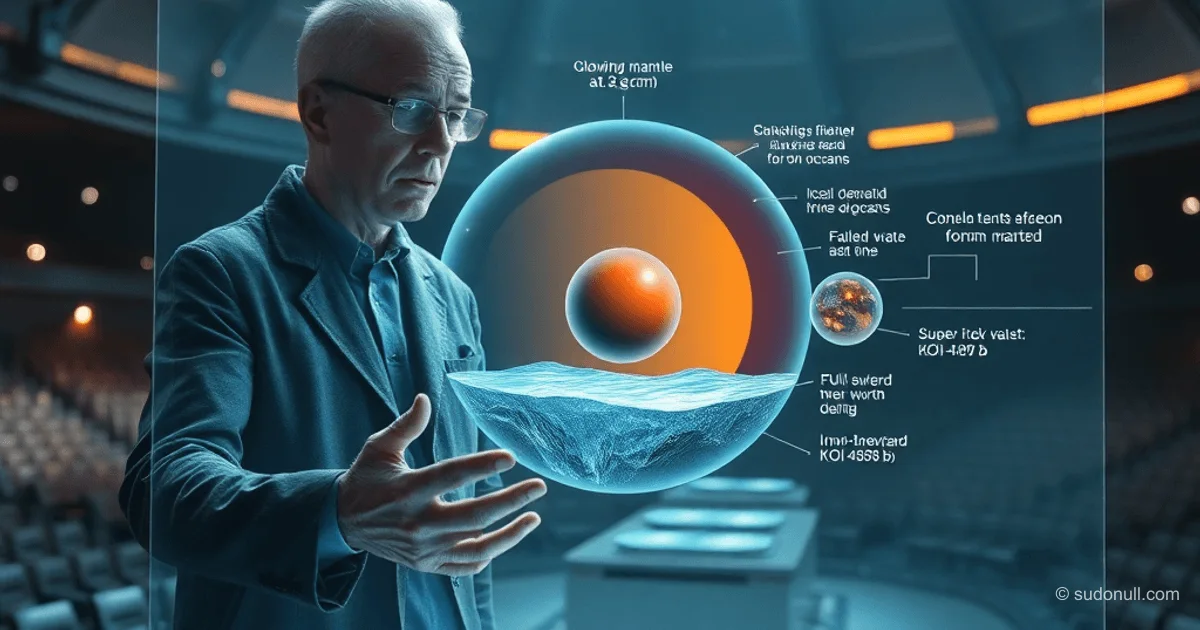
The Critical Density Law: A New Filter for Finding Habitable Exoplanets
ExoLogica AI has identified a narrow density window of 4.8–7.8 g/cm³ where a stable Earth-like biosphere is possible. The traditional ESI index ignores phase transitions of matter, leading to false candidates. This new principle reshuffles the priority list for the JWST.
Analysis of thousands of exoplanets shows that habitability is determined not just by size and insolation, but by the balance of internal structure. Density directly influences mantle convection, magnetic field, and the geochemical cycle. Exceeding critical limits leads to sterile worlds.
The ESI Failure: Why Earth Similarity is Deceptive
ESI is calculated as the geometric mean of parameter deviations from Earth's values:
ESI = \prod_{i=1}^{n} \left( 1 - \left| \frac{x_i - x_{i0}}{x_i + x_{i0}} \right| \right)^{\frac{w_i}{n}}The formula assumes linear influence of factors, but reality is governed by phase transitions. Planets with high ESI (>0.9) are often unsuitable:
- KOI-4878 b (ESI=0.978): Low density (4.1 g/cm³) creates a global ocean with ice VII at the bottom, blocking silicates.
- Kepler-438 b (ESI=0.905): High density (8.2 g/cm³) suppresses convection, stripping the planet of a magnetosphere.
Promising candidates are TOI-700 d, TRAPPIST-1 e, and Kepler-442 b, with densities within the 4.8–7.8 g/cm³ window and a PRI >0.6.
The ExoLogica Law: The Density Window for Life
The Critical Density Window Principle: An Earth-like biosphere is possible at an effective density ρ_eff of 4.8–7.8 g/cm³. This ensures:
- Active mantle convection for plate tectonics.
- A liquid outer core for a magnetic dynamo.
- An open carbon-silicate cycle without ice blockage.
Lower Limit: The Ocean Trap (ρ < 4.8 g/cm³)
Hycean worlds with excess water have oceans hundreds of km deep. Pressure P = ρ_water · g · h > 2–3 GPa triggers a transition to ice VII:
P = \rho_{water} \cdot g \cdot h- No mineral weathering.
- The carbon cycle is interrupted.
- A chemically sterile environment.
Upper Limit: The Iron Vault (ρ > 7.8 g/cm³)
Planets like an iron-rich Mercury, with a core comprising 70–80% of the volume:
- A thin mantle without convection (stagnant lid).
- Absence of a magnetic dynamo.
- Atmosphere stripped by XUV radiation in <1 billion years.
Optimum: ρ ≈ 6.2 g/cm³
Ideal balance:
- A massive core generates a magnetosphere.
- A plastic mantle supports tectonics.
- Oceans remain open for geochemistry without global flooding.
The Mathematics of Habitability: A Probability Gaussian
Phab(ρ) is the product of two functions:
- Geochemical Openness (lower limit):
P_{geo}(\rho) \propto \frac{1}{1 + e^{-k_1 (\rho - \rho_{min})}}ρ_min ≈ 4.8 g/cm³ — the ice VII threshold.
- Magnetic Dynamo (upper limit): A logistic decay function for ρ > 7.8 g/cm³ due to suppressed convection.
The result is a bell-shaped curve peaking at 6.2 g/cm³. ExoLogica AI applies this filter to rank JWST candidates.
List of ESI-Reassessed Planets:
- Kepler-438 b: PRI=0.172.
- KIC 5522786 b: Low AI confidence.
Confirmed Candidates:
- TOI-700 d.
- TRAPPIST-1 e.
- Kepler-442 b.
Key Takeaways
- The critical window of 4.8–7.8 g/cm³ excludes 70% of high-ESI candidates.
- PRI >0.6 — a new metric replacing ESI for JWST targeting.
- Phase transitions (ice VII, stagnant lid) determine habitability.
- ExoLogica AI automates classification with confidence indicators.
- Application: Prioritizing observations for red dwarf systems.
— Editorial Team










No comments yet.