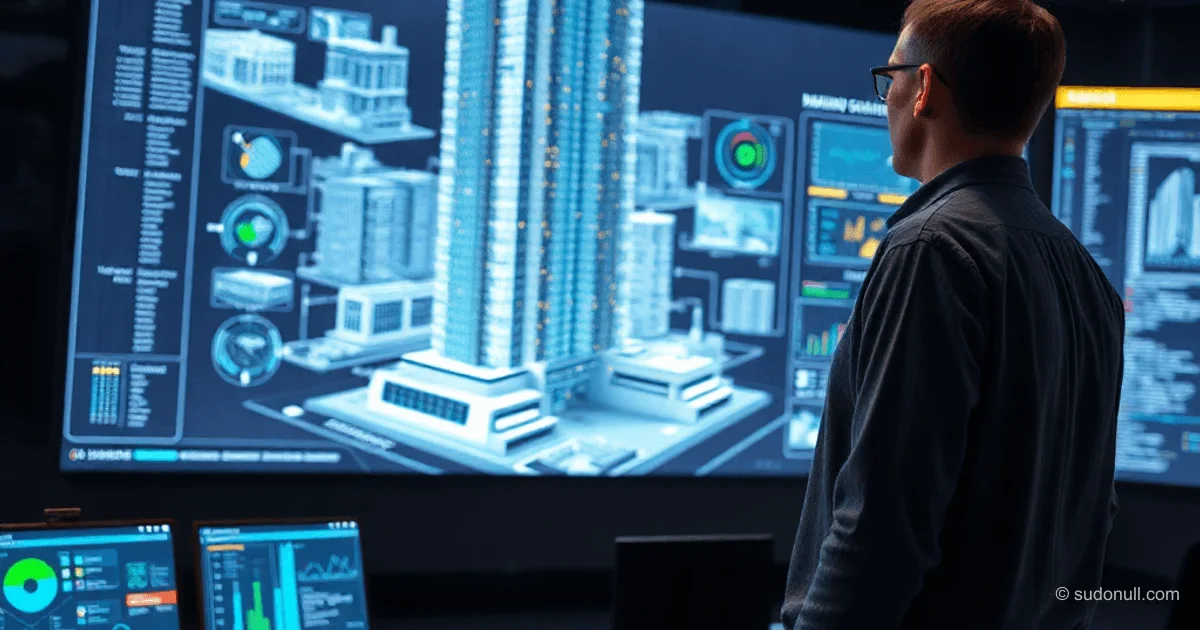
Digital Twin in Construction: How It Differs from BIM and Its Role in Operations
BIM (Building Information Modeling) and TIM (Technology of Information Modeling) are methodologies and technologies for creating a digital representation of a capital construction project. This model integrates geometry, materials, MEP systems, and construction processes. Per ISO/DIS 19650-1 and GOST R 10.00.00.00-2023, BIM/TIM serves as the single source of truth across design, construction, and handover.
A Digital Twin is a dynamic, real-time virtual replica of a physical asset, aligned with it per ISO 23247-1:2021. Data flows continuously from IoT sensors, Building Management Systems (BMS), monitoring platforms, and security systems. Unlike the static BIM/TIM model, the Digital Twin reflects the asset’s live condition and behavior.
Key Differences Across the Asset Lifecycle
BIM/TIM focuses on pre-handover phases:
- Design development and interdisciplinary coordination
- Construction execution and clash detection
- Cost and schedule estimation
The Digital Twin delivers value during operations:
- Real-time monitoring of MEP systems
- Energy consumption analytics
- Predictive failure detection
- Operational mode optimization
BIM/TIM provides the static foundation—geometry and structure—while the Digital Twin layers on dynamic, real-world data via IoT/BMS to enable actionable insights.
Digital Twin Architecture
A Digital Twin system is multi-layered and embeds BIM/TIM as its foundational layer:
- Data Sources: IoT sensors, BMS, facility management and security systems
- Integration Layer: APIs, IoT hubs, ETL pipelines
- BIM/TIM Model: Geometry, spatial relationships, and object attributes
- Data Platform: Common Data Environment (CDE) or equivalent data lake
- Digital Twin Layer: Logic for state synchronization, behavioral modeling, and bidirectional control
- Analytics & Interfaces: Dashboards, predictive models, alerting, and user-facing applications
This architecture enables the shift from descriptive modeling to real-time, responsive asset management.
Maturity Levels per ISO/IEC 30186:2025
Maturity is assessed across five dimensions: Convergence, Capabilities, Integrated Representation, Time, and Trust/Reliability—each with five progressive levels.
For the Convergence dimension:
| Level | Description | Relationship to BIM/TIM |
|-------|-------------|--------------------------|
| 1 (Static) | Static, non-updating model | BIM/TIM used in design only |
| 2 (Paired) | Sensor-based monitoring enabled | Initial Digital Twin implementation |
| 3 (Synchronized) | Bidirectional data flow and control | Full real-time synchronization |
| 4 (Coordinated) | Integration with external systems and environment | System-level interoperability |
| 5 (Unified) | Autonomous, self-optimizing behavior | System-of-systems intelligence |
Russia’s GOST R 57700.37-2021 further clarifies terminology: BIM/TIM aligns with Level 1; the Digital Twin begins at Level 2 and beyond.
Evolution Through Industrial Revolutions
BIM/TIM emerged from 2D drafting during the Third Industrial Revolution—introducing parametric modeling and process automation. The Fourth Industrial Revolution brings cyber-physical systems: IoT, AI, and cloud-native platforms. The Digital Twin embodies this leap—bridging the digital model and physical asset to enable predictive, adaptive operations.
Key Takeaways
- BIM/TIM is the static backbone for design and construction; the Digital Twin is the dynamic engine for operations.
- DT architecture builds on BIM/TIM by integrating IoT and BMS data streams.
- ISO/IEC 30186:2025 maturity levels define the progression—from Level 1 (BIM-only) to Level 2+ (true Digital Twin).
- In operations, DT reduces unplanned downtime, cuts energy waste, and forecasts failures before they occur.
- Standards (ISO, GOST) ensure interoperability, scalability, and long-term data integrity.
— Editorial Team










No comments yet.