Economic Model for Producing Rocket Fuel from Lunar Resources
This model evaluates the long-term cost of producing rocket fuel from lunar water ice to compare it with Earth-based fuel. Key factors are the cost transfer ratio for transporting capital equipment (G) and the production mass coefficient (𝜙 = product mass / equipment mass). These parameters determine when lunar fuel becomes cheaper than delivering it from Earth to orbits like LEO, GEO, or Lagrange points.
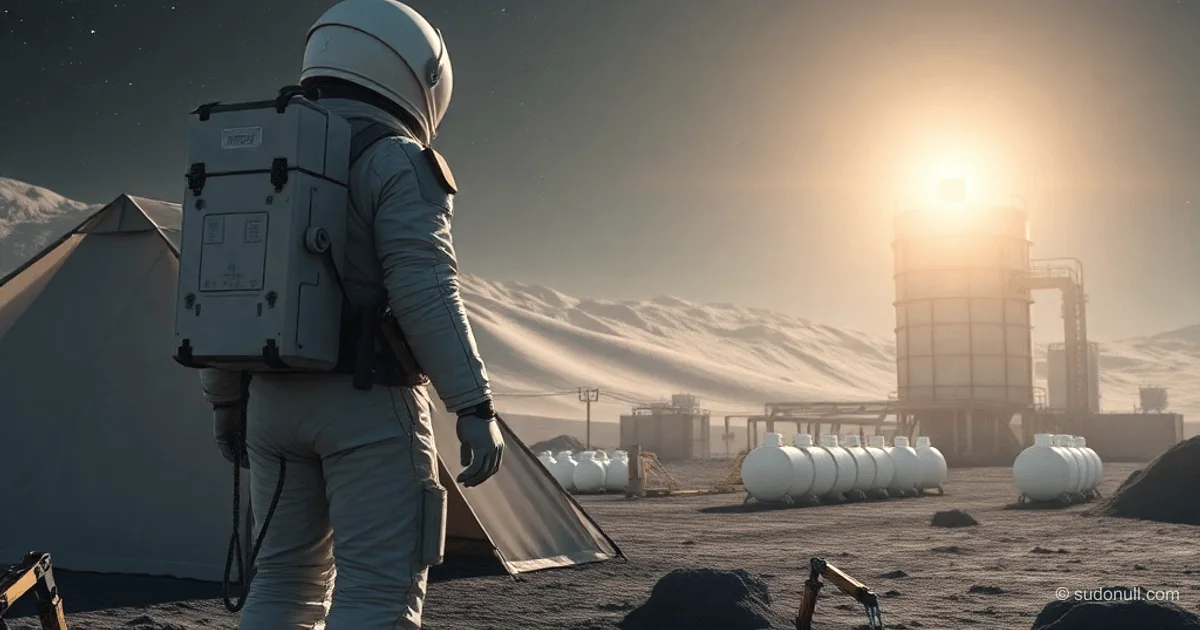
Tent sublimation technology achieves 𝜙 > 100, exceeding the profitability threshold even for LEO. Open-pit mining is closer to the threshold, but improvements and operational experience will make it competitive.
Key Model Notation
| Symbol | Definition |
|--------|-------------|
| C_fin | Financing cost |
| C_K | Capital development and manufacturing costs |
| C_ops | Operational expenses over lifespan |
| c_R | Reliability cost coefficient |
| C_tr | Cost of transporting capital to the Moon |
| c_X | Cost of 1 kg of lunar fuel at point X |
| G | Cost transfer ratio for lunar capital |
| 𝜙 | Production mass coefficient |
| ψ_X | Ratio of lunar to Earth fuel cost at X |
Additional: Δv_{Y-X} — characteristic velocity from Y to X; IMF — inert mass fraction; I_sp — specific impulse.
Orbits: LEO (160–2000 km), GEO (35,786 km), GTO (geostationary transfer orbit), LS (lunar surface), EML1 (Earth-Moon Lagrange point 1), DRO (distant retrograde orbit around the Moon).
Analysis of Previous TEA
Previous techno-economic analyses have varied: some predicted profitability, others a negative outcome. Critical errors include:
- Choosing architectures with high G (expensive equipment delivery).
- Ignoring capital with high 𝜙.
For example, Charania and DePascuale noted the high cost of delivery from LS to GEO but overlooked the long-term effects of production scale. Jones et al. estimated ISRU as 97% more expensive than Earth fuel, underestimating the potential of 𝜙.
This model introduces:
- x = normalized per-launch equipment cost.
- τ = specific cost of transporting capital per kg of product.
- χ = normalized capital cost.
Competitiveness condition: ψ_X < 1, where ψ_X = f(𝜙, G, other parameters).
Reliability and Operational Factors
Reliability R influences through c_R = E_R * (1 - R) / R, where E_R is the scale of effort to increase R from R_0 to R_max.
For lunar conditions:
- Low gravity (1/6 g).
- No atmosphere.
- Temperature extremes.
Technologies must account for these factors. Tent sublimation minimizes equipment wear, ensuring high 𝜙.
Calculation for LEO: with L_p = cost of launching fuel from Earth, lunar fuel wins if c_{LEO} < L_p * Γ_{LEO}.
Application in Space Economy
Production on LS for clients in GEO: satellite tugs use fuel for orbit circularization. The scale of consumer markets (e.g., Starlink-like constellations) drives demand.
- ISRU Advantages: Reduced Δv for missions; scalability akin to Earth.
- Risks: Initial capital investments; achieving R > 0.9.
The model predicts cost reductions for all space tasks due to cheaper fuel.
Key Takeaways
- Cost transfer ratio G and coefficient 𝜙 determine profitability: target G < 10, 𝜙 > 50 for LEO.
- Tent sublimation technology is already competitive; open-pit mining will be after optimization.
- Reliability R critically affects c_R; requires E_R ~ 10–100 for lunar conditions.
- ISRU reduces costs for GEO, EML1, DRO tasks.
- Long-term effect: accelerated space exploration through scale.
— Editorial Team










No comments yet.