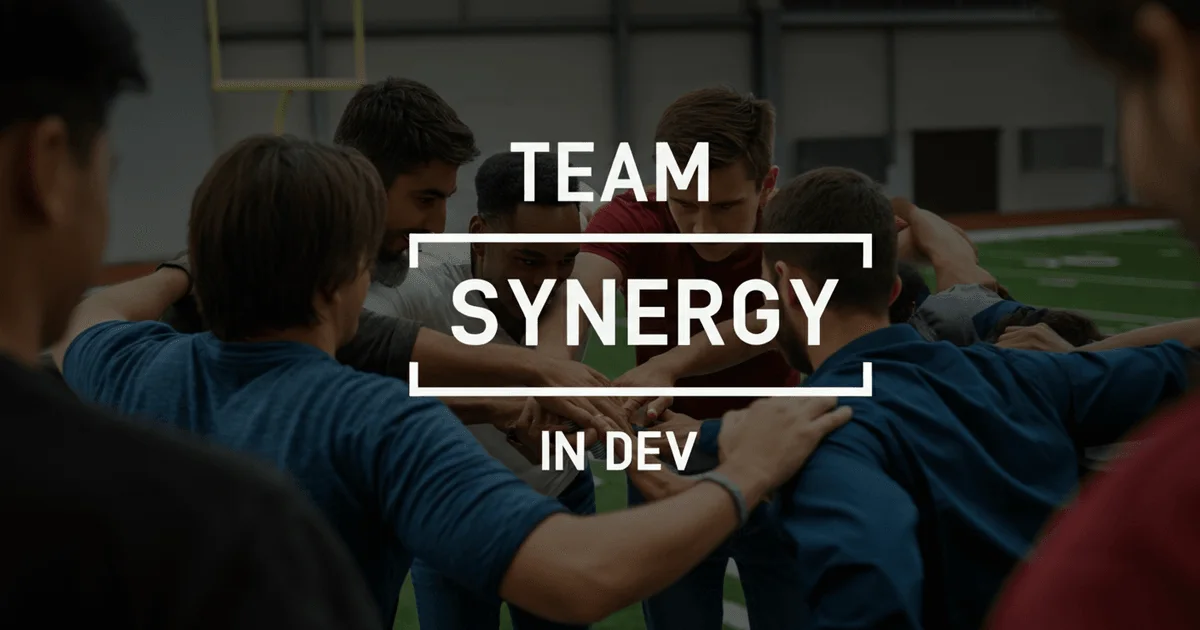
Beyond the Relay Race: Adopting a Football Approach to IT Teamwork
The effectiveness of an IT team often hinges on its chosen interaction model. While many projects adhere to an assembly line or "relay race" principle, where each participant performs a narrow, isolated task, a more productive approach can be found in team sports like football. This article explores why a model built on mutual support, shared vision, and cross-functionality outperforms isolated task execution, and how this impacts product quality and specialist motivation.
Sports Metaphors in IT Management: From Assembly Line to Synergy
In the world of IT development, where projects are increasingly complex and requirements more dynamic, finding optimal models for team interaction is paramount. Project management approaches are often unconsciously shaped by personal experiences, including sports. If someone participated in individual sports or disciplines with clearly defined stages during childhood, this can influence their perspective on IT teamwork. This often leads to a situation where true "teamwork" is replaced by sequential task execution, which is far from always effective.
Consider a typical Project N, where the Software Development Life Cycle (SDLC) follows a classic scheme: analysts hand off an epic to designers, who then pass it to developers who break down tasks, and finally, testers verify the result. This is followed by deployment and operation. At first glance, this appears to be a logical and structured scheme, resembling a diagram for investors. However, the problem doesn't lie in the stages themselves, but in the nature of interaction between them. In practice, such a model often devolves into an assembly line, where each participant works in their own "vacuum," without seeing the full picture or understanding the context of related tasks. Specialists perceive this as their personal domain of responsibility, preferring to "just pick up tasks from Jira and execute them sequentially," without delving into the project's overarching goal. This is a classic example of the waterfall model, even if management attempts to label it "agile" and "iterative," implying only constant rework.
If we seek a sports analogy, it's a relay race. Each runner completes their leg, passing the "baton" to the next. Responsibility is confined to one's own segment of the race. If someone makes a mistake, perhaps the next participant will "pull through" and salvage the situation. But if a leg is poorly executed, and the team still wins, everyone receives the same medal. In such a model, the competitive element is absent, and each participant runs at their own pace, not striving for maximum results if it doesn't impact an administrative deadline. The bespoke nature of software development makes this approach even less effective than in mass production.
From Individualism to Synergy: Lessons from Team Sports
For those accustomed to individual sports like wrestling, a "relay race" might seem like teamwork. After all, in wrestling, you're on your own: you either win the bout or you don't. Victory depends solely on your personal effort and ability to "snatch" it at any cost. The team is only remembered based on the overall ranking. When such "wrestlers" come together in a team, the relay becomes merely a chain of individual efforts, where everyone plays for themselves.
Football, however, demonstrates a completely different approach. It's not just "22 people chasing a ball," but a complex system of interaction where each player has a specific role (goalkeeper, defender, midfielder, forward) yet is capable of acting outside their formal duties. In football, what's valued is:
- Shared Field Vision: Every player must understand the team's formation, the positions of teammates and opponents, to make optimal decisions.
- Mutual Support and Cover: A defender might join the attack, or a forward might help with defense if the situation demands it. Roles are flexible and interchangeable when needed.
- Effective Communication: Passing the ball isn't just a formal transfer; it's a conscious choice to increase the team's chances of success, even if it means foregoing personal glory.
- Proactive Thinking: A footballer must anticipate how the situation will unfold, understand teammates' intentions and opponents' actions, to contribute to the common goal – scoring a goal or defending their own. This requires deep immersion in the game's context, not just executing a "task."
The "Football" Approach in IT: Cross-Functionality and Ownership
Applying the "football" model to IT development means forming teams where specialists not only possess deep expertise in their own area but also understand related disciplines. Programmers should understand analytics and testing, but crucially, they must grasp the business context – understanding what problem they are solving, for whom, and why. Similarly, analysts must be aware of technical capabilities and limitations, as well as the cost of implementing their requirements.
The absence of such comprehensive understanding in the "relay race" model often leads to a "Chinese whispers" effect. Each participant interprets the task in their own way, literally following the wording but missing the original intent. By the time testing occurs, the initial idea can be significantly distorted. For instance, a developer tasked with displaying user transactions might implement it in a way that the user sees all transactions in the system, not just their own, citing "it wasn't specified in the task." Such formal adherence to specifications without critical consideration of context and potential consequences demonstrates a lack of ownership and can lead to serious reputational and financial losses.
The job market shows a trend towards shifting from narrowly specialized "assembly line" roles to multi-competency. Modern IT specialists must not only master their core competency but also develop critical thinking in related areas. This enables them not just to execute tasks, but to contribute to the project with an understanding of its overall goal. Working in and leading such teams is more comfortable, as each participant demonstrates a reasonable degree of ownership.
The argument that "we just need programmers to churn out volume" often proves misguided. By hiring "cheap" executors, companies face an increasing burden on other team members – those who must "spoon-feed" the task and then conduct a detailed review. The project risks turning into a "Frankenstein," where the reviewer is forced either to accept poor-quality code or miss deadlines. Ultimately, "cheap" programmers end up being very expensive.
The core problem is that software development is often perceived as a PROCESS – a linear sequence of functions, especially when complex Jira workflows reinforce this misconception. In reality, development is a PROJECT, requiring entirely different types of connections between participants. These connections are not sequential, like in a relay, but combinatorial, like in football. For project success, every participant must feel and demonstrate active ownership, which should become a crucial element of internal motivation.
What's Important:
- The assembly line approach (relay race) in IT development leads to specialist isolation, loss of context, and distortion of the project's original intent.
- The team sports model (football) fosters cross-functionality, mutual support, and a shared vision of the goal, enhancing team effectiveness.
- The principle of ownership (responsibility for the outcome) is critically important: specialists must not just execute tasks, but also understand their business context and potential consequences.
- "Cheap" executor programmers prove more expensive in the long run due to increased burden on other team members and risks to project quality.
- Software development is a project, not a process: it requires combinatorial connections and proactive interaction, not linear task handoffs.
— Editorial Team










No comments yet.