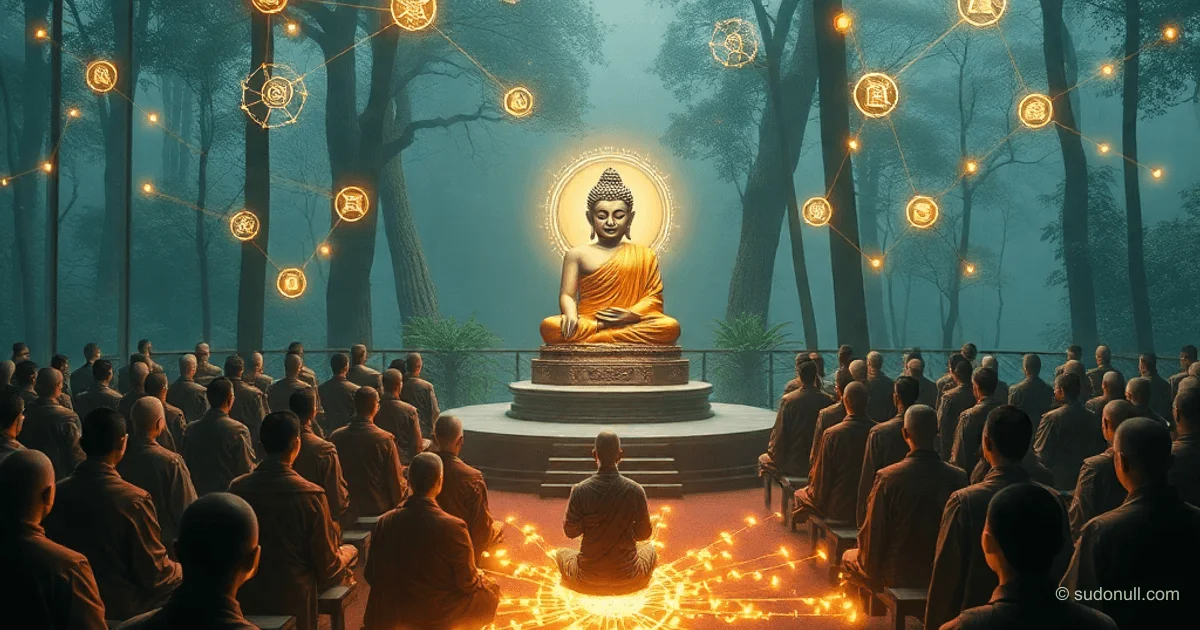
Ego as a Vulnerability in Decentralized Systems: Lessons from the Buddhist Sangha
In decentralized autonomous organizations (DAOs), dominant whales with outsized influence, core developers with privileges, and voting coalitions inevitably emerge, leading to oligarchy or expertocracy. Conflicts often end in forks and battles over legitimacy. While blockchain provides trust in transaction records, it overlooks trust in participants' intentions. Ego acts as a systemic vulnerability, distorting governance.
The Sangha—the Buddhist social structure—offers a protocol that has remained resilient for 2,500 years. It decentralizes governance without a single center, relying on the Dhamma as the unchanging teacher after the Buddha.
Attack Vector: The Mechanisms of Ego
Ego in governance systems functions as an anthropological attack vector:
- Distorts proposal evaluation in favor of personal gain.
- Creates hidden channels through informal agreements.
- Manipulates consensus in governance.
- Self-replicates, pushing out neutral participants.
This is the thermodynamics of social systems: structures created by selfish actors reproduce dominance. An example is the influence of key figures in Ethereum, despite its formal decentralization.
Quantum Analogy for Understanding Ego
Classical ego operates on binary logic: "self/not-self," resource appropriation. A qubit in superposition reflects a state before collapse. Ego causes decoherence—collapsing possibilities into a point of ownership, stripping the system of flexibility.
Meditation maintains coherence, preserving the superposition of intentions. This is a computational mode for optimal decisions in distributed systems.
Sangha Architecture: Key Components
Siddhartha Gautama designed a protocol against ego:
- No Central Authority: No successor; the Dhamma is the teacher.
- Vinaya: Protocols for dispute resolution, preventing forks.
- Behavior Verification: Meditation changes patterns, verified by the community.
- Skin in the Game: Complete material dependence on the Sangha.
Pratītyasamutpāda (dependent origination) is a coordination protocol without an oracle, akin to quantum entanglement.
Limitations and Protocol Comparison
The Sangha is susceptible to forks: Tibetan Buddhism with the Dalai Lama, hierarchies in Zen. Scaling is vertical, requiring installation through practice.
| Parameter | DAO | Sangha |
|-----------------------|-------------------------|-------------------------|
| Target of Influence | Behavior rules | Actor intention |
| Compliance | Enforcement | Internal motivation |
| Verification | On-chain | Behavioral patterns |
| Scaling | Horizontal | Vertical |
| Sybil Resistance | Tokens/PoW | Verifiable behavior |
| Time to Compromise | Months–years | Generations |
Key Takeaways
- Blockchain decentralizes data, not intentions—ego remains an attack vector.
- The Sangha demonstrates resilience through behavior verification and lack of a center.
- The quantum model explains ego as decoherence, meditation as coherence.
- DAOs need protocols to address ego for true decentralization.
- Sangha scaling is limited by the need for personal transformation.
Decentralization requires operators capable of holding the superposition of intentions without collapsing into personal gain. The Buddhist approach offers a realistic patch for the ego vulnerability in distributed systems.
— Editorial Team










No comments yet.