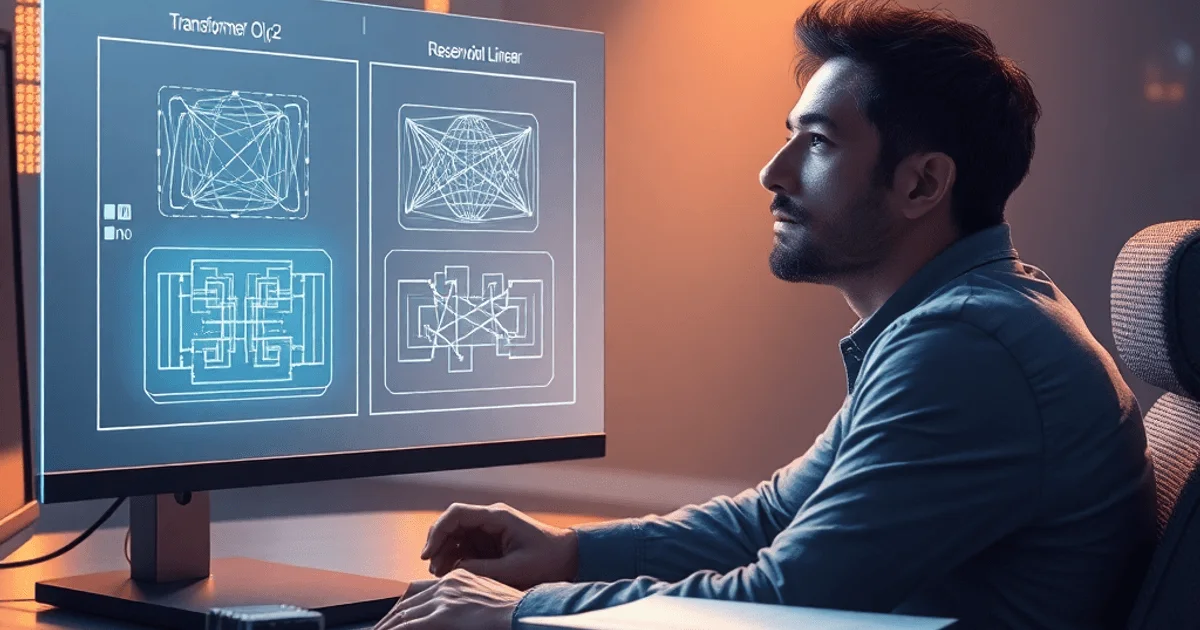
Beyond Transformers: How Alternative AI Architectures Are Reshaping Language Modeling
The era of transformer dominance in language modeling is drawing to a close. Research shows that attention-based models have hit a performance plateau. Quadratic computational complexity, shaky compositional reasoning, and no true recursion are holding back further progress. While industry tinkers with incremental tweaks, researchers are exploring radically different approaches.
Fundamental Limits of the Transformer Architecture
Transformers, introduced in 2017, revolutionized natural language processing. But nine years on, three key architectural flaws are glaringly obvious:
- Quadratic computational demands: Self-attention scales at O(n²) with sequence length, making long-context processing prohibitively expensive.
- Weak compositional reasoning: A single attention layer can't reliably compose functions—the building block of logical thought.
- No recursive processing: The feedforward design can't model the deep hierarchical structures central to human language.
These aren't just theoretical issues—they directly cause model hallucinations and block systematic logical inference. Models guess statistically likely next tokens without grasping meaning.
The Scaling Crisis and Data Crunch
Training massive language models is becoming economically untenable. GPT-4 took 55 times more compute than GPT-3, with diminishing returns on quality. Post-breakthrough, performance curves on standard benchmarks have flattened.
Key scaling headaches:
- Training costs for GPT-4-level models top $100 million.
- High-quality web text is finite and running dry fast.
- Training on synthetic data from other models degrades performance.
Big industry players are quietly pivoting to specialized models, router-based systems, and product integrations instead of chasing leaderboard scores.
Alternative Architectures: From Theory to Real-World Results
While industry fine-tunes transformers, academia is delivering peer-reviewed alternatives that actually work.
Reservoir Computing as a Language Model
Köster and Uchida's 2026 study offered the first rigorous evaluation of Reservoir Computing (RC) for language modeling. Key findings:
- Attention-Enhanced Reservoir Computer (AERC) hits test loss of 1.73 vs. transformer's 1.67.
- Linear—not quadratic—computational complexity.
- LAERC shows power-law scaling like transformers.
- Reservoirs can run on photonic, neuromorphic, or analog hardware.
Brain-Inspired Computing
Reviews in Nature Communications (2024) and Nature (2025) highlight how brain-like adaptive reservoir computing outperforms CNNs, LSTMs, and transformers on time-series tasks. Their compact design and fast training pair perfectly with FPGAs and neuromorphic chips.
Associative Memory with Modern Hopfield Networks
Content-addressable memory (Ramsauer et al., 2021) retrieves info by semantic similarity without context window limits—unlike transformer KV-caches.
The Knowledge Donor Paradigm: Breaking Architectural Chains
Traditional knowledge distillation in the LLM era has shifted to knowledge elicitation—pulling out reasoning chains and structured outputs. But the 'student' is still a smaller transformer, inheriting all the flaws.
The new paradigm cuts the cord entirely: massive LLMs (70B+) become knowledge donors, not teachers. We extract what they know, ditching how they process it. The target architecture? Anything but a transformer.
Think of it like university: you absorb knowledge but think with your own brain, applying it through your unique cognitive style. The goal is giving AI a 'higher education' and letting it think differently.
Open Research Questions
Shifting to post-transformer architectures raises tough technical challenges:
- Knowledge format: What's the best way to represent extracted knowledge? Embeddings, knowledge graphs, or hybrids?
- Attention alternatives: What paradigm matches quality at linear complexity? Reservoir computing is a top contender.
- Output generation: How to produce natural language without probabilistic token prediction?
- Hardware flexibility: Can it run on neuromorphic or analog chips?
Key Takeaways
- Transformers have peaked due to core architectural limits.
- Alternatives like Reservoir Computing match performance with linear scaling.
- Treat giant LLMs as knowledge sources, not blueprints, to escape architectural lock-in.
- Brain-inspired and associative memory research paves the way for efficient cognition.
- The architectural shift is underway—transformers will linger in production, but evolution is inevitable.
Transformers won't vanish overnight, but AI's architectural evolution is unstoppable. Like cars gradually replacing horses, new paradigms are reshaping machine learning.
— Editorial Team










No comments yet.