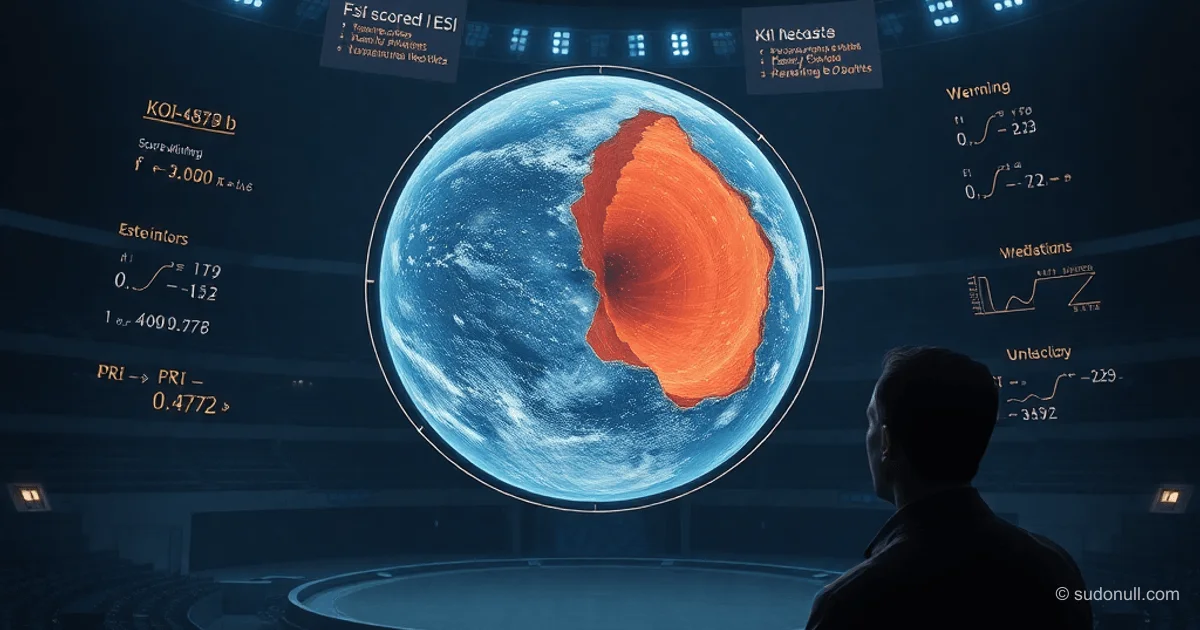
The ESI Paradox: How Physics-Informed ML Exposed Thousands of Fake Exoplanets
The Earth Similarity Index (ESI) evaluates exoplanets based solely on radius and equilibrium temperature. The formula ignores material composition, leading to errors: a planet with an ESI of 0.97 might have a density of 8.4 g/cm³ — higher than iron. Developers of ExoLogica AI v2.0 integrated Physics-Informed ML, predicting mass via XGBoost with confidence intervals, and calculated density using ρ = M/V. This revealed a paradox: worlds geometrically similar to Earth are physically unsuitable for life due to anomalous gravity.
Example KOI-4878 b: radius 1.04 R⊕, Teq 246 K, ESI 0.972. Predicted mass 1.71 M⊕ gives ρ = 8.40 g/cm³, surface gravity 15.56 m/s².
New Filter: The PRI Index
PRI (Physical Realizability Index) checks compositional feasibility. Reference density for rocky planets: ρ_rocky = 5.51 × R_p^{0.3} (accounting for compression per Seager et al.).
PRI = 1 - |ρ - ρ_rocky| / 5.0
A threshold of PRI ≥ 0.50 disqualifies anomalies regardless of ESI. For KOI-4878 b, reference ρ_rocky = 5.58 g/cm³, PRI = 0.435 — the object is marked [Anomaly].
The pipeline architecture enforces inductive bias: ML predictions are validated by physics, preventing overfitting on rocky data.
Catalog Analysis: From 9600 to 37 Candidates
The catalog (NASA Exoplanet Archive + ESA + ExoKyoto) underwent a double filter: ESI ≥ 0.75 and PRI ≥ 0.50.
- Traditional ESI ≥ 0.75: 127 planets.
- After PRI: 37 feasible worlds.
- 71% of candidates were physical anomalies with ρ > 8 g/cm³.
The model blindly confirmed top NASA/JWST targets.
| Planet | ESI | PRI | Density, g/cm³ | Verdict |
|-------------|------|------|-------------------|------------------|
| KOI-4878 b | 0.972| 0.435| 8.40 | ❌ Iron Core |
| TOI-700 d | 0.959| 0.504| 8.11 | ❌ Borderline |
| Kepler-442 b|0.888|0.517| 8.43 | ❌ Borderline |
| Proxima b | 0.923| 0.981| 5.72 | ✅ Ideal |
| TRAPPIST-1 e|0.919|0.905| 4.90 | ✅ Earth-like |
Breakdown of Top Anomalies
TOI-700 d and Kepler-442 b are often called "Second Earths" in the media. Neuro-Physical Synthesis predicts super-dense cores: future RV measurements will confirm or refute this. Hypothesis: A dominant iron core excludes oceans and a biosphere.
The PRI filter saves JWST resources: one hour of observation ~$60,000. Excluding fake targets based on density increases search efficiency.
Key Takeaways
- ESI Paradox: High ESI does not guarantee habitability without density verification.
- PRI ≥ 0.50: A strict threshold eliminates 71% of false candidates.
- Physics-Informed ML: XGBoost + physical equations eliminate epistemic uncertainty.
- 37 Priority Worlds: Include Proxima b and TRAPPIST-1 e as realistic targets.
- Testable Hypothesis: TOI-700 d is an iron trap, requiring RV confirmation.
— Editorial Team










No comments yet.