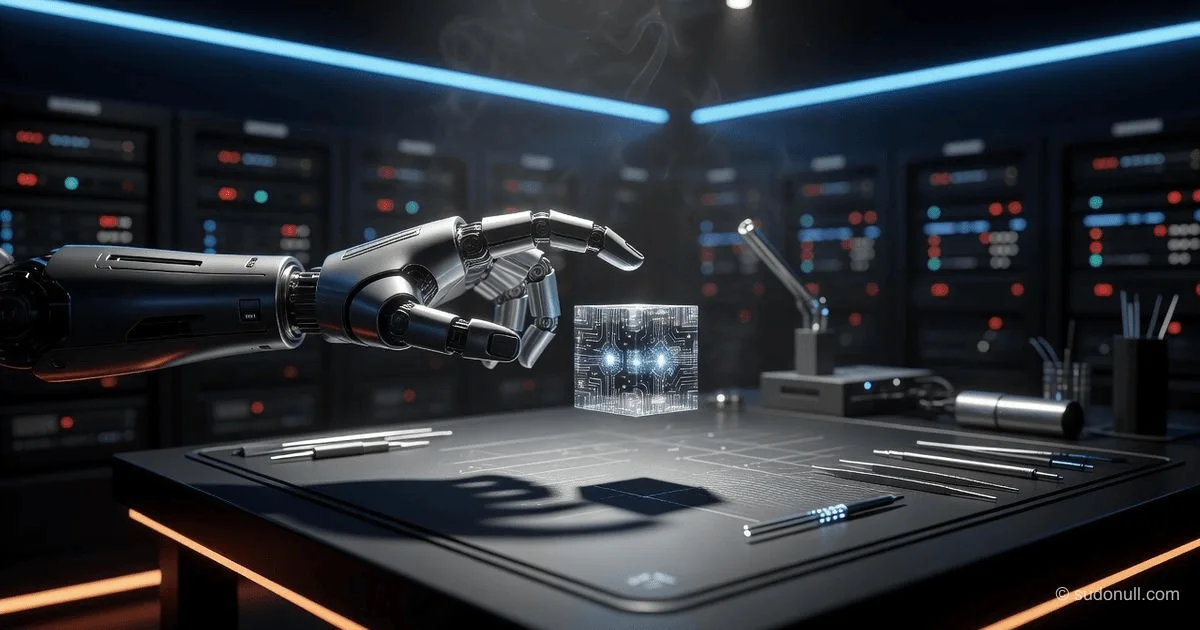
70 Years of AI Evolution: From Theory to Embodiment in Robots
Tracing AI's journey from Turing's ideas and the first Dartmouth conference to modern large language models and robotics. Noting that today AI is moving from text processing to multimodality and reasoning capabilities.
70 Years Later: Why AI Has Finally 'Outgrown' Text but Still Isn't Human
Anniversary articles always stretch the truth a bit. It seems as if AI's evolution from the 1956 Dartmouth Conference to today's multimodal models has been a smooth, progressive march where each stage logically follows the previous one. In reality, AI's history is one of catastrophic disappointments, 'winters,' and random breakthroughs that happened when least expected. And today's shift from text processing to multimodality and 'reasoning' is not just another step—it's a tectonic shift that the industry doesn't know how to properly assess.
The key non-obvious insight lost amid the pomp of 'evolution' is this: For 70 years we tried to make AI human-like, but now we've discovered that the real value lies in AI being not human, but a perfect engineering tool. Dartmouth's dreams of human-like thinking led us to LLMs that hallucinate, deceive, and spawn lawsuits. Meanwhile, a parallel track—physical AI, agentic systems, AI for science—has suddenly proven far more practical and profitable. We just didn't realize it at first.
The Core: What's Really Happening
Today's AI is not a 'superintelligence' but a giant engineering compromise. Yes, modern models have moved from text to images, video, and even planning actions in the physical world. Reka and Moonvalley are joining forces to develop a World Language Action Model trained on egocentric data and simulating physics so robots can 'understand consequences before acting.' ABB Robotics announced the Physical AI Toolchain—a software stack from simulation to industrial execution that lets robots learn from synthetic data and transfer that learning to the real world with 'industrial precision.' This sounds like a breakthrough.
But behind this facade lies a harsh reality. Physical AI today is an expensive, complex, and highly specialized tool. ABB has been in robotics for years, and their Physical AI Toolchain is an evolution of their own platform, not a revolution you can buy 'off the shelf.' Reka recruited a team from DeepMind, but their model only promises to 'reason and act'—no industrial deployments yet. And according to a Mayfield survey, 58% of enterprises cite 'data readiness' as the main bottleneck for adopting agentic AI. Data, not algorithms, is where the real battle is now.
The second major trend: AI is no longer a game for giants only. Chinese startup DeepSeek showed that a competitive model can be built for significantly less money. Meanwhile, molecular protein design company Molecule-Mind (China) raised over $100 million in investment and demonstrates that AI for Science (AI4S) is becoming an independent industry, separate from the LLM race. Their model MMFold, according to the company, surpasses Google's AlphaFold 3 in predicting antibody structures. This means China is seriously targeting a niche where the US currently leads (Google DeepMind), but where China has state programs and a huge biotech market.
Timeline and Context
How did we get here? Let's look at key milestones from the last two years that changed the game:
2024: Europe passes the AI Act—the world's first strict regulator. Everyone laughs that it's too slow for such a dynamic technology. Turns out it was too fast—by 2026, companies are panicking and disabling features for Europeans.
2025: Trump's return and the repeal of Biden's AI safety executive orders. The US bets on deregulation and private investment—$500 billion for infrastructure. Meanwhile, China launches the 'Eastern Data, Western Computing' program—a national network of data centers operating as a single supercomputer. Two completely different approaches to the same problem.
Early 2026: OpenAI files a confidential S-1 with the SEC for an IPO valued at perhaps $1 trillion. Anthropic does the same a week earlier. The AI market hits peak hype. But at the same time, TrendForce warns: NVIDIA's Rubin chip shipments may be delayed due to issues with HBM4 memory, cooling, and network interconnects, and Rubin's share of shipments drops from 29% to 22%. This means even NVIDIA can't overcome physics—cooling, power, and interconnects become limiting factors.
March 2026: The Nippon Life vs. OpenAI case. A judge considers a $10 million lawsuit alleging that ChatGPT 'practiced law'—helping a former client draft 44 court documents after the case was closed. One document contained a fabricated legal precedent, 'Carr v. Gateway.' This is the first time an AI developer is accused of unauthorized practice of law through a consumer product. If the suit survives a motion to dismiss, it will change the game for all AI companies.
June 2026: ABB Robotics presents the Physical AI Toolchain at Automate 2026. Reka and Moonvalley announce a merger for physical AI. Japan launches the ARiSE program (AI to Redesign Scientific Exploration) with a budget yet undisclosed, but it's a flagship initiative. These are the very 70 years of evolution that have brought us to a point where AI is beginning to truly interact with the world.
Who Wins and Who Loses
Winners—companies with vertical integration and data:
- Google DeepMind still leads in fundamental research, especially AlphaFold and multimodality. Their integration with Android and Chrome gives them 27.7% of the LLM market—a structural advantage that can't simply be 'caught up' technologically.
- ABB Robotics—a unique example of an industrial giant turning physical AI into a real product. Their Physical AI Toolchain and partnership with NVIDIA (March 2026) bridge the gap between simulation and reality. They have 7,000 employees and real factories—not a startup.
- Chinese players in AI4S—Molecule-Mind raised over $100 million from a consortium of investors, including state funds. Their MMFold model outperforms AlphaFold 3 on specific tasks. This shows China has bet on applied biology and could win in the long run because they have data (clinical trials, genomic databases) and state support.
Losers—startups without data or distribution channels:
- 75% of enterprises claim to be adopting agentic AI, but only 42% have it in production, and only a few have scaled multi-agent systems. This means most 'AI platforms' will remain in pilots and die when investors demand ROI.
- Pure text LLM startups (besides OpenAI, Anthropic, and Google) are losing the market. Models are becoming commodities, and the quality gap between them is shrinking. Users choose based on price, integration, and trust—not 'smartness.'
Special category—'regulatory losers':
- Any AI company that cannot prove the safety and impartiality of its models will suffer from lawsuits. The Nippon Life vs. OpenAI case is just the beginning. If the court decides that developers are liable for chatbot actions, insurance premiums for AI companies will skyrocket, killing margins.
What the Media Isn't Saying
Three things you won't find in anniversary articles about 'evolution':
First: physical AI is not 'AI in robots,' it's 'robots that can break and kill.' When an LLM hallucinates, it's just a wrong answer. When physical AI makes a mistake on a factory floor, it's millions in scrap or a human injury. ABB emphasizes that their system ensures 'industrial precision'—but that means they limit AI, not enhance it. They don't give the robot full freedom; they give it a strictly controlled set of actions. This isn't 'reasoning,' it's 'conditioned reflex with correction.' And as long as that's the case, we're far from the AI we could call 'intelligence.'
Second: energy consumption is not a 'problem,' it's a 'death sentence.' The 2026 forecast is 1,050 TWh for data centers, comparable to the consumption of all of Japan or Russia. By 2028, individual AI tasks could consume up to 326 TWh—more than all US data centers today. This means countries without cheap energy (Europe) or without the ability to quickly build generation (UK) will lose the race. China builds data centers in provinces with cheap hydro and coal power. The US builds in Texas, where the grid is already overloaded. And this isn't a 'challenge' that 'more efficient models' will solve—it's a fundamental constraint that will determine where the next 10,000 data centers are located.
Third: 'evolution' is actually the 'death' of old paradigms. We pride ourselves that AI has gone from logical inference to neural networks. But in reality, neural networks killed symbolic AI, deep learning killed classical machine learning, and transformers killed RNNs. Now agentic AI is killing 'dumb chatbots,' and physical AI may kill cloud AI services as the dominant model. This isn't evolution; it's a series of mass extinctions. And those who don't adapt in the next 12 months will become another layer in the geological record of technology.
Forecast: Next 30 Days and 90 Days
Next 30 days (mid-June to mid-July 2026):
The first wave of lawsuits over agentic AI. After the Nippon Life vs. OpenAI case, law firms worldwide will start hunting AI companies whose chatbots gave 'advice' in regulated fields (law, medicine, finance). This will cause a 5-10% drop in the stocks of OpenAI (if they've gone public by then) and other public AI companies within days of initial court rulings. At the same time, ABB Robotics will start collecting first contracts for the Physical AI Toolchain from automakers and aerospace—this could be a catalyst for industrial robotics stocks on US and German exchanges.
Next 90 days (July to September 2026):
A structural shift in funding will begin. Venture investors, seeing Mayfield data that 60% of companies lack a formal AI governance system and that data remains the main bottleneck, will start investing not in 'yet another AI startup' but in companies solving the data problem: cleaning, labeling, synthesis, access management. This will kill dozens of 'AI platforms' built on others' models and data.
Simultaneously, Japan's ARiSE program will announce its first grant recipients in September, signaling to the global market that Japan is making a serious bet on AI for science. This could attract talent from the US and Europe, where AI salaries are already overheated, while Japan offers unique data in materials science, robotics, and medical imaging.
And crucially—by the end of September, we'll see the first industrial deployments of physical AI that fail. There will be an incident at a factory where a robot using ABB's Physical AI Toolchain makes a simulation error, leading to scrap or downtime. The media will blow it up as an 'AI failure.' But insiders will understand: this is normal. This is the 'trough of disillusionment' that trend reports for 2026 predicted. Those who survive this shock and implement monitoring and rollback systems will survive. The rest will leave. It's always been this way, and it will be again. Because 70 years of evolution is really 70 years of learning from mistakes. And we're still learning.
— Editorial Team










No comments yet.