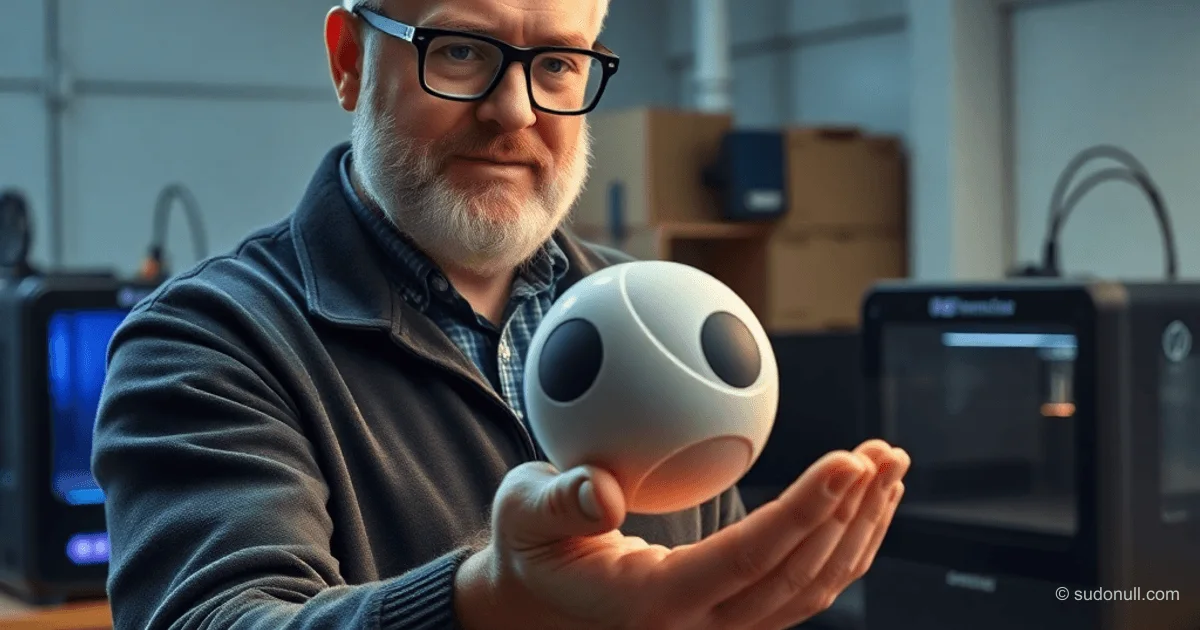
Hybrid FDM and SLA for Ergonomic 3D Models: A Trackball Case Study
Developing the ergonomic Trackball Royale revealed the limitations of FDM printing. The housing requires precise replication of palm anatomy with multi-axis curvature. FDM builds parts layer by layer with a Z-axis step: first layer 0.2 mm, subsequent layers 0.16 mm. On simple geometries, this is unnoticeable, but on organic surfaces, stair-stepping appears—a visual defect and tactile roughness. During prolonged contact (8 hours a day), this causes discomfort.
SLA printing cures resin with UV light layer by layer, creating a monolithic smooth surface without visible layers. A prototype on the Anycubic Photon Mono M7 with ABS-Like Resin Pro 2 showed perfect detail for the palm relief without post-processing.
Advantages and Disadvantages of SLA in Practice
SLA provides high accuracy for complex shapes, but material brittleness leads to easy scratching. Surface smoothness causes slipping, especially with sweaty hands.
A hybrid approach solved the problems:
- SLA for the main housing—organic geometry and precise trackball fit.
- FDM for TPU inserts (75A Shore hardness, 1.5 mm thickness)—anti-slip pads, pleasant to the touch, washable.
- Polyurethane varnish—protection from scratches, improved tactile properties.
This method combines SLA smoothness with TPU grip, maintaining strength.
Technology Comparison on a Real Project
| Parameter | FDM (PLA) | SLA (ABS-Like Resin) | Hybrid |
|-----------|-----------|----------------------|--------|
| Surface | Stepped, rough | Smooth, monolithic | Smooth + grip |
| Organic Geometry | Curvature limitations | High accuracy | Optimal |
| Tactility | Slippery-rough | Slippery | Pleasant, non-slip |
| Strength | High | Brittle | Reinforced with varnish |
| Post-processing | Minimal | Requires cleaning | Varnish + inserts |
FDM is suitable for keyboard housings with angled planes. SLA excels in detail but requires refinement. Hybrid minimizes the drawbacks of both.
Recommendations for Method Selection
- Analyze geometry: for straight forms—FDM (Bambu Lab A1).
- For organic shapes—SLA (Anycubic Photon Mono M7/M7 Max).
- Add TPU inserts for ergonomics.
- Apply polyurethane varnish for protection.
- Test on prototypes: tactile sensations are critical for peripherals.
In the Trackball Royale project, pure FDM yielded an unusable prototype, SLA was slippery, and hybrid was the final solution.
Key Takeaways
- FDM struggles with multi-axis curvature: stair-stepping is visible and felt.
- SLA provides monolithic smoothness: ideal for anatomical forms.
- Hybrid SLA+TPU+FDM is optimal: combines accuracy, grip, and strength.
- Post-processing is essential: varnish solves scratching and slipping issues.
- Choose based on the task: not FDM vs SLA, but a combination tailored to geometry.
— Editorial Team










No comments yet.