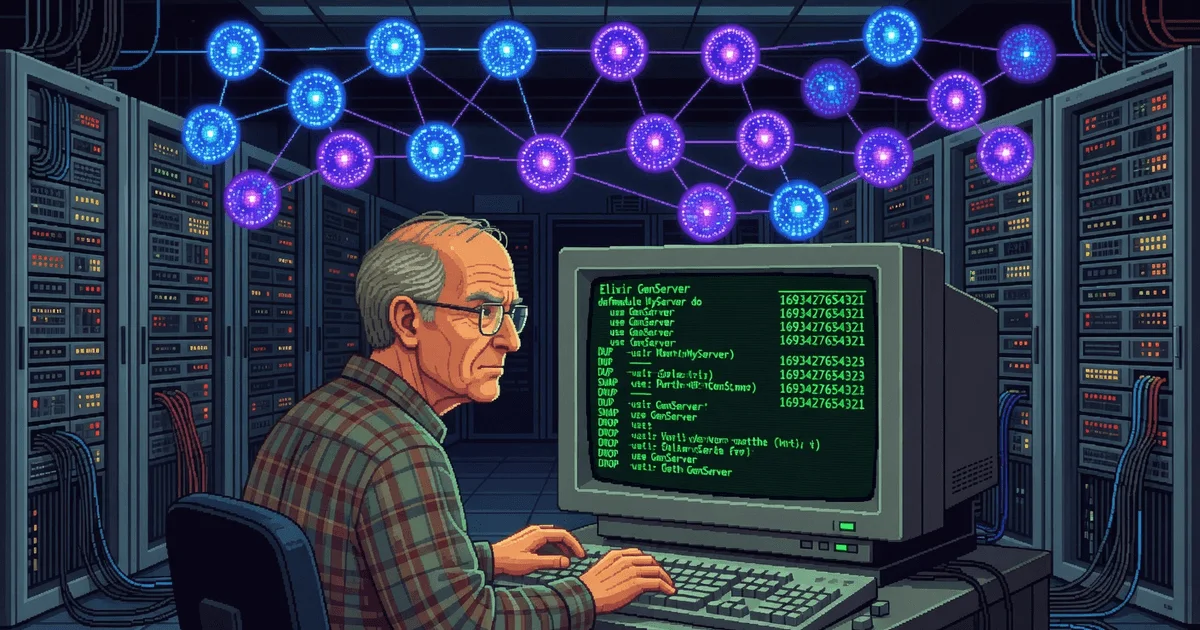
Prototyping Clock Generators in Forth on Elixir: Implementation and Synchronization
Development of a distributed Forth engine system on Elixir kicked off with building an API for message exchange instead of terminal I/O. Core functions: execute(words) to run Forth words, add_var(name, value) and get_var(name) for direct variable access. This streamlines debugging and integration without loading full source code.
The API is built on GenServer OTP, with each Forth engine as a lightweight BEAM process. Ditching load(source) makes sense: initial setup happens via managers like supervisors handling data streams.
The term "actor" highlights the engines' independence in a distributed setup.
Scaling Challenges and Why Forth
Past attempts to embed interpreters in Elixir via external ports (Python/Ruby) hit OS process limits—around 500 per machine. For Elixir's millions of processes, we needed a lean interpreter. Forth nailed it: tiny footprint and efficient.
The Forth-in-BEAM (Forth in-built Elixir) implementation nests inside GenServer. Focus is low-level: clock generators for syncing data streams in control systems.
Time Synchronization: From UTC to BEAM
Computer systems demand precise timing. On the academic side:
- UT1 (IERS)
- TAI (BIPM)
- UTC (coordinated universal)
Issues: Leap seconds cause 1-second drifts, critical for GPS/GLONASS, telecom, and networks. Unix time ignores them, duplicating seconds.
Big tech adapts:
- Google: smears over 24 hours backward
- Facebook: over 18 hours forward
- Microsoft: 2 seconds backward
- Alibaba: over 24 hours centered on the second
Erlang/Elixir handles it with BEAM's monotonic time. We built a central GenServer generator with 1ms precision: Unix timestamps aligned to monotonic. Good enough for clusters without global UTC headaches.
Implementing the GenServer Clock Generator
The generator is a stateless OTP GenServer using system monotonic time. No internal state: time comes straight from BEAM.
defmodule ClockGenServer do
  use GenServer

  def start_link(_opts) do
    GenServer.start_link(__MODULE__, %{}, name: __MODULE__)
  end

  def init(state) do
    {:ok, state}
  end

  def handle_call(:timestamp, _from, state) do
    ts = System.monotonic_time(:millisecond) |> adjust_to_unix()
    {:reply, ts, state}
  end
end
(Note: Code simplified; full version includes Unix-time adjustment.)
This server wraps hardware sources: NTP, GPS, quartz. Application engines layer on Forth scripts for data processing.
Multitasking Forth in Distributed Environments
Classic Forth supports control tasks sans terminal: stacks, variables, no dictionary/buffer. In Elixir, these are cluster-node processes with messages.
Goal: parallel distributed programming. Each actor is a Forth engine with API, synced by a central clock generator.
Key takeaways:
execute/add_var/get_varAPI replaces terminals, cutting overhead.- Central 1ms generator syncs clusters without UTC issues.
- Stateless GenServer leverages BEAM time, scaling to millions of actors.
- Forth scripts integrate into Elixir for stream processing.
- Approach bypasses external process limits while keeping performance high.
Future Directions
Next up: full Forth actors with clock cycles, pools for load balancing, external data integration. Cluster testing will reveal limits.
— Editorial Team










No comments yet.