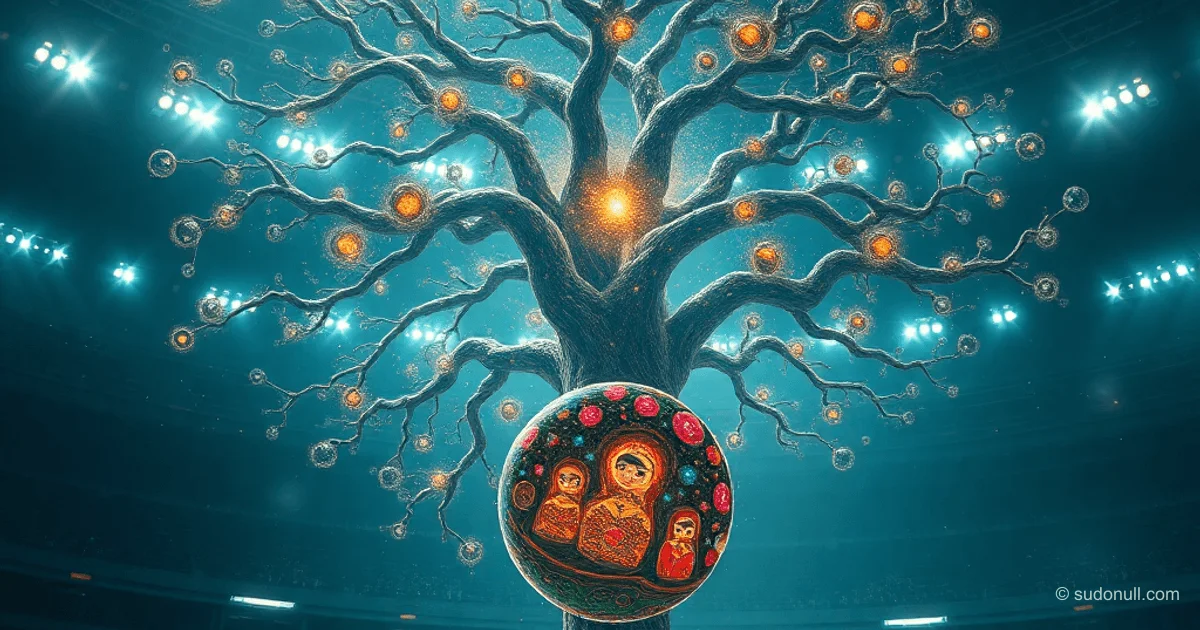
The Fractal Architecture of Reality: From Elementary Particles to the Multiverse
The universe reveals itself as a fractal hierarchy of nested systems, where each level mirrors the previous one. From quarks to galaxies and multiverses, a recursive architecture emerges, described by the principle of self-similarity. This allows us to uncover universal laws that operate across all scales.
Fundamentals of Fractal Geometry
Fractals are characterized by self-similarity: a part resembles the whole at different scales. Benoit Mandelbrot coined the term from the Latin 'fractus,' meaning broken. His work 'How Long Is the Coast of Britain?' illustrates the paradox: the coastline's length increases as the measurement scale decreases. With 100 km segments, the length is 2,800 km; with 50 km segments, it's 3,400 km—a 21% increase.
The Mandelbrot set, computed recursively on the complex plane, displays infinite patterns. Each iteration z_{n+1} = z_n^2 + c determines whether a point belongs to the set. Coloring based on the number of iterations before exceeding a boundary creates self-similar structures.
In nature, fractals are visible in tree canopies, Romanesco broccoli, snowflakes, and blood vessels. Iterative-recursive structures form their basis. Stephen Wolfram models physics as a cellular automaton with recursive rules.
Hierarchy of Nested Levels
The universe can be envisioned as a fractal matryoshka doll—akin to the World Tree Yggdrasil from mythology. One branch of the hierarchy includes:
- Elementary particles: quarks, photons, electrons, muons, gluons, Higgs bosons.
- Composite particles: protons and neutrons made of quarks.
- Atoms from protons, neutrons, and electrons.
- Molecules from atoms.
- Cells from molecules.
- Tissues from cells.
- Organs from tissues.
- Organisms from organs.
- Communities from organisms.
- Ecosystems from communities.
- Biosphere from ecosystems.
- Planet from biosphere, lithosphere, hydrosphere, atmosphere, ionosphere, magnetosphere, and noosphere.
- Star system from stars and planets.
- Galaxy from star systems and nebulae.
- Galaxy cluster from galaxies.
- Observable universe from clusters and voids.
- Universe with unreachable regions beyond the light cone.
- Multiverse according to the many-worlds interpretation of quantum mechanics.
- Mathematical multiverse by Tegmark (Wolfram's ruliad) encompassing all possible physical laws.
Other branches intersect:
- Molecules → air (nitrogen, oxygen) → cyclones/anticyclones → winds → atmosphere.
- Cells → brain → cultural field → memes/ideas → noosphere.
These worlds are conventionally divided: economy (humans, corporations), animals (without culture). Physical theories abstract particles as numbers and formulas. Higher levels are not reducible to lower ones—the Churchill statue in London cannot be explained by particle trajectories.
Gurdjieff describes the 'ray of creation' from 'all' to 'nothing.' Hegel: being is pure nothingness. Nagarjuna: reality is empty, like matryoshka dolls without content, arising through interdependent origination.
Universal Law of Self-Similarity
Fractals obey a unified law: self-similarity generates universal patterns. Arranging objects in 2D space yields similar structures—megacities resemble microchips.
Systems theory and cybernetics reveal feedback loops and natural selection at all levels:
- Elementary particles: muons live microseconds; stable ones survive—protons, neutrons, electrons—forming atoms.
- Atoms: out of 3,437 isotopes (as of 2017), 252 are stable; selection preserves stable configurations.
- Molecules, cells, organisms: evolution selects viable forms.
- Ecosystems, galaxies: stable structures dominate.
Key Takeaways
- Fractal self-similarity unifies scales from quarks to the multiverse.
- Recursive rules (as in the Mandelbrot set) generate infinite complexity.
- Natural selection operates universally through feedback mechanisms.
- Higher levels are not reducible to lower ones; reality is interdependent emptiness.
- Wolfram's and Tegmark's models extend the fractal paradigm to physics.
— Editorial Team










No comments yet.