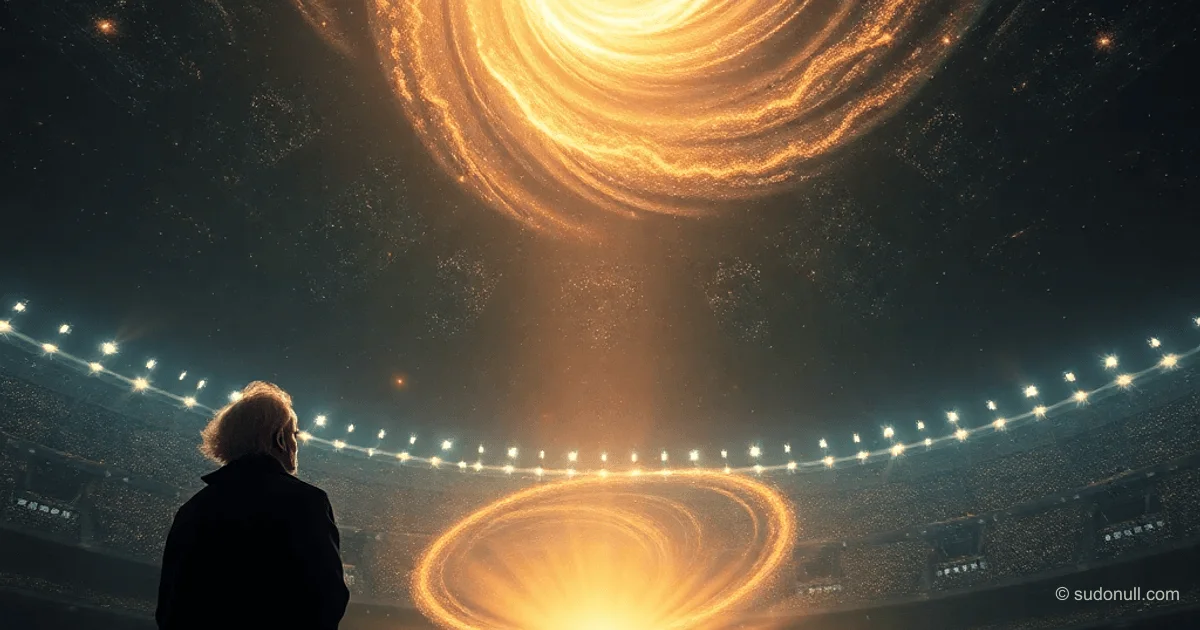
Hegel's Dialectics and Quantum Cosmology: From Singularity to Multiplicity
Modern cosmology rejects the image of matter exploding into pre-existing space. The Lambda-CDM model describes the Big Bang as the expansion of spacetime itself from a state of extreme density and temperature. General relativity identifies a singularity—a point where curvature becomes infinite and equations break down. This isn't the end of the story, but an indicator that quantum gravity is needed.
Hypotheses like loop quantum gravity or string theory propose transitions: from a 'bounce' of a compressed phase or from a quantum vacuum into classical space. These models are tested for mathematical consistency and indirect effects, such as cosmic microwave background spectra.
Hegelian Being and the Pre-Cosmological State
Hegelian logic begins with pure being—abstract, without internal distinctions. Similarly, the pre-Big Bang state lacks distinguishable space, time, or particles. This isn't everyday emptiness, but an undifferentiated unity.
The transition occurs through internal dynamics:
- Quantum fluctuations generate inhomogeneities.
- Inflationary expansion unfolds potential into actual space.
- Symmetry breaking gives rise to fundamental interactions.
This sequence reflects a dialectical moment: identity is unstable; it differentiates, generating movement and complexity.
Hierarchy of Complexity: From Particles to Consciousness
Physics identifies a chain of stages:
- Elementary interactions in the early universe.
- Formation of quarks and leptons.
- Nucleosynthesis and atoms.
- Star formation, galaxies, chemical elements.
- Biochemistry and the evolution of life.
Hegel described a similar progression: mechanism, chemism, teleology. This isn't teleology in a mystical sense, but a logical hierarchy where each state contains the seeds of the next through contradictions.
Structural isomorphism is evident: physical models and dialectics both operate through transitions from the abstract to the concrete.
Multidimensionality in String Theory and Philosophical Parallels
String theory postulates 10- or 11-dimensional space with compactified dimensions. This explains the observed three dimensions through the curling up of extra dimensions to Planck scales. The mathematics is elegant, but experimental confirmations are lacking—the program remains hypothetical.
Philosophically, this preserves dialectics: a symmetrical multidimensional unity is broken, actualizing the observed asymmetry. From the potential of compactified forms to the real trajectories of particles.
Methodology of Science and Dialectics
Both approaches are dynamic. Physics encounters anomalies like the Hubble tension—discrepancies in expansion measurements. Models are revised.
Hegel emphasized resolving contradictions through the development of concepts. The scientific method is analogous: hypotheses are tested, anomalies are integrated into new theories.
Key takeaways:
- The singularity signals the limits of general relativity, requiring quantum gravity.
- The dialectical transition from being to becoming mirrors inflation and symmetry breaking.
- The hierarchy of physics is isomorphic to Hegelian logic of complexity.
- String theory demonstrates the preservation of dialectical structure in multidimensional models.
- Both philosophy and cosmology are processes, not static truths.
Understanding the beginning through these lenses reveals the universality of thought structures: from the indistinguishable emerges the distinguishable, from simplicity—complexity.
— Editorial Team










No comments yet.