SEBERD IT Base: How to Create a Useful Cybersecurity Resource Without Marketing
The cybersecurity world faces a paradox: there's plenty of content, but it's often superficial and pushes commercial products. The SEBERD IT Base project offers an alternative—a deep dive into attack techniques without ads or cookie-cutter solutions.
Quality Issues in Cybersecurity Content
The modern cybersecurity content market suffers from information overload. Most materials simply note the rise in threats without explaining attack mechanics. Typical structure: sensational headlines about critical risks, a superficial vulnerability overview, then a pitch for a specific solution. This approach creates an illusion of knowledge but provides no practical skills for analyzing attacks.
Key observations behind SEBERD IT Base:
- Content is often created for algorithms and ad budgets, not learning
- No platforms exist for breaking down attack techniques without commercial bias
- Demonizing hackers hinders objective analysis of tactics
The project focuses on technical mechanics: exactly how vulnerability exploitation works, which protocols are involved, and which commands are used. This fundamentally differs from news digests or vendor documentation.
Live Threat Feed Instead of a Marketing Homepage
The site ditched the standard homepage with benefit icons. Instead, it features an aggregated threat feed built from authoritative sources:
- FSTEC (BDU)
- NVD (NIST)
- MITRE ATT&CK
- Thematic RSS/Atom feeds
Technical implementation:
- Data fetched via API and RSS, no HTML parsing
- Normalization and deduplication of entries
- Temporary PHP cache to reduce load
- AI pipeline converts raw data into structured cards
Each feed entry includes:
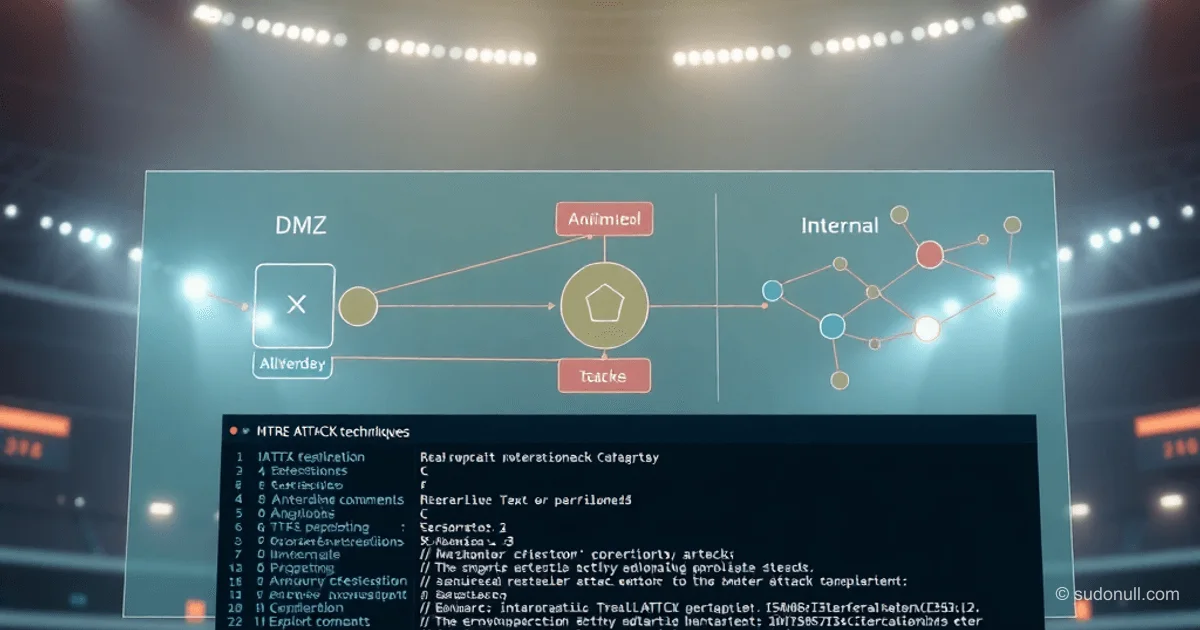
- Interactive attack diagram with DMZ and Internal zones
- Animated attack vector
- Real terminal commands
- Step-by-step technique breakdown per MITRE ATT&CK
- Specific defenses
The system is resilient to temporary source outages: if feeds are unavailable, it switches to a simplified mode with cached data. This ensures predictable load even during traffic spikes.
Graph Navigation: Replacing Flat Menus
Traditional categorization fails to reflect connections between cybersecurity concepts. For example, understanding Kerberoasting requires knowledge of Kerberos, Active Directory, and Windows authentication. SEBERD IT Base uses a graph model where:
- Each category, tag, and article is a graph node
- Node connections show semantic overlaps
- View modes: categories, tags, pages, raw JSON
Selecting a node (e.g., "Social Engineering") displays all related materials. This lets you:
- See overlaps with "Web Security"
- Track links to "Monitoring and SIEM"
- Discover adjacent topics via tags
The graph turns content into a unified knowledge system where articles, labs, and tools complement each other. This approach mirrors the real structure of the field, where red team, blue team, and forensics are inextricably linked.
Tools Lab: Technical Implementation
This section features over 100 utilities, grouped by category. All tools run without registration, processed in-browser via JavaScript. This avoids sending sensitive data to the server. For external requests (DoH, geolocation, threat intel), it uses a proxied whitelist.
Main tool categories:
- Cryptography: AES Rounds Visualizer, RSA Step Simulator, Padding Oracle Attack Visualizer
- Network Security: BGP Hijacking Simulator, TCP Handshake Visualizer, Nmap Scan Visualizer
- Web Security: XSS Playground, SQL Injection Visualizer, CSRF Attack Simulator
- Forensics: Memory Forensics Simulator, Packet Capture Analyzer
- Practical Tools: MITRE ATT&CK Navigator, CVSS Calculator, Firewall Builder
Each widget includes layers for "Practice / How It Works / Theory." For example, the CIDR calculator not only computes subnets but also visualizes bit operations. This helps you grasp the mechanics, not just get the result.
Key Takeaways
- Cybersecurity content should focus on attack mechanics, not selling solutions
- Graph navigation better reflects connections between cybersecurity concepts than flat categorization
- Client-side browser processing boosts security for user inputs in web tools
- Integrating the threat feed, labs, and graph creates a self-contained learning system without marketing pitches
The project is positioned as a resource for cybersecurity practitioners, developers, and students ready for deep dives. Its LAMP-stack implementation (Ubuntu, Nginx, Apache, PHP, MySQL) proves complex features are possible without hyperscaling. Core principle: depth of understanding trumps audience reach.
— Editorial Team









No comments yet.