The Complete History of the Internet: From ARPANET to AI
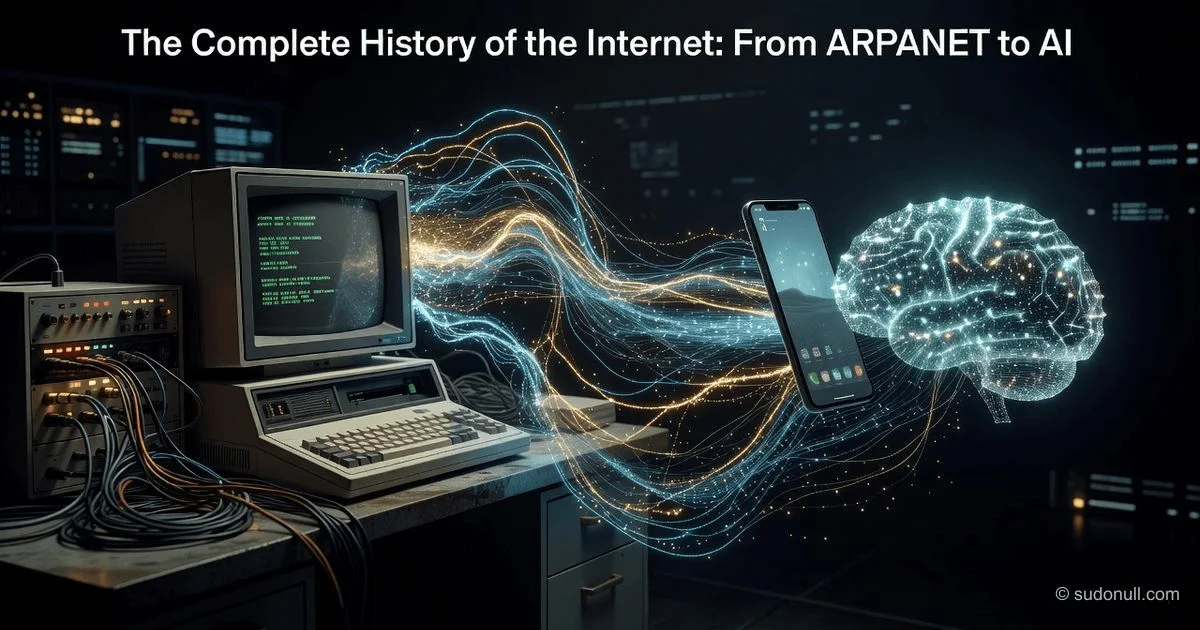
The internet's journey from a fragile military network to a global infrastructure powering artificial intelligence is a remarkable story of human ingenuity. This history of the internet and how it was created and evolved reveals a progression from Cold War-era packet switching to the social and mobile revolution, culminating in the current AI era . The official "birth" of the modern internet is often marked on January 1, 1983, with the adoption of TCP/IP, but its foundation was laid years earlier with the creation of ARPANET .
What You'll Learn
By the end of this article, you'll understand the key technological breakthroughs that defined each internet era, from the first message sent over ARPANET to the rise of generative AI. You will be able to trace the evolution of the internet through its major milestones and grasp how each phase built upon the last to create the digital world we inhabit today. You'll see clearly how the foundational decisions of the past, like packet switching and open protocols, directly enabled the AI-driven experiences of the present.
How It Works: From Packet Switching to Protocols and the Web
The internet's functionality is built on a few core innovations that, combined, created a resilient and scalable global system.
The Foundation: Packet Switching
Before the internet, communication networks used "circuit switching," like a traditional phone call, which required a dedicated connection between two points. The internet's key innovation was packet switching. In 1965, MIT scientist Lawrence Roberts developed a method to break data into smaller "packets" that could travel independently across a network and be reassembled at their destination . This made the network far more robust, as data could be rerouted if part of the network failed—a critical feature for its military origins .
A Universal Language: TCP/IP
As different networks were built, they couldn't communicate with each other. To solve this, Vint Cerf and Bob Kahn developed the Transmission Control Protocol/Internet Protocol (TCP/IP) . TCP/IP provided a common language that allowed any network to connect to any other, regardless of the hardware or operating systems involved . On January 1, 1983, ARPANET officially adopted TCP/IP, making it the foundational protocol of the "internet" as we know it . This standard is a core reason why the history of the internet and how it was created and evolved is a story of unification.
The User-Friendly Layer: The World Wide Web
While the internet was the network of networks, the World Wide Web was the system that made it accessible. In 1989, British scientist Tim Berners-Lee, working at CERN, proposed a system of interlinked documents accessible via a browser . By 1991, he had created the first web browser, server, and website, inventing the technologies we still use today: HTML (for content), HTTP (for transmission), and URLs (for addresses) . CERN's decision to make the technology freely available in 1993 was a pivotal moment, unleashing the web's explosive growth .
Why It Matters: The Internet's Impact on Society
The internet has transcended its origins to become a fundamental pillar of modern life, transforming nearly every aspect of human society.
Democratization of Information
Before the web, access to information was limited. The internet, and especially the World Wide Web, democratized knowledge, putting vast libraries of data at the fingertips of anyone with a connection . Early search engines like Google used algorithms like PageRank to help users navigate this information, and today's AI-powered tools are set to make that access even more conversational and intuitive .
The Social and Mobile Revolution
The rise of Web 2.0 in the early 2000s made the internet a participatory platform. Social networks like Facebook (2004) and Twitter (2006) redefined how people connect and communicate globally . Simultaneously, the launch of the iPhone in 2007 and the subsequent mobile internet revolution made the web an "always-on" utility . This constant connectivity has reshaped commerce, entertainment, and social interaction, creating entirely new economies and industries.
The Age of AI
The vast amount of data generated by decades of internet activity is the fuel for today's artificial intelligence. Generative AI, like large language models, represents a paradigm shift . Instead of just retrieving links, AI can synthesize information, create content, and offer solutions to complex problems, becoming an expert-like assistant for billions . This is the latest chapter in the history of the internet how it was created and evolved—a move from a passive network to an intelligent, interactive system.
By the Numbers
| Year | Milestone | Significance |
|---|---|---|
| 1969 | First ARPANET Message | "LO" sent from UCLA to Stanford, marking the birth of networked communication . |
| 1971 | First Email | Ray Tomlinson sends the first network email, introducing the "@" symbol . |
| 1983 | Adoption of TCP/IP | The internet's official birthday and the creation of a unified standard . |
| 1984 | Domain Name System (DNS) | Replaces numeric IP addresses with easy-to-remember names . |
| 1991 | First Website | The World Wide Web becomes publicly available . |
| 1993 | Mosaic Browser | The first graphical browser popularizes the web . |
| 1998 | Google Founded | Begins the era of modern, algorithmic web search . |
| 2004 | Facebook Launches | Ushers in the era of mass social networking . |
| 2007 | iPhone Launched | The beginning of the mobile-first internet . |
| 2022 | ChatGPT Released | Brings generative AI into the mainstream . |
Common Myths vs. Facts
| Myth | Fact |
|---|---|
| The internet and the World Wide Web are the same thing. | The internet is the network infrastructure, while the World Wide Web is a service built on that infrastructure . |
| The internet was invented to survive a nuclear attack. | While ARPANET was a project of the U.S. Department of Defense, its design for decentralized communication was to share computing resources, though its resilience was a key feature . |
| The first message on ARPANET was successful. | The first attempted message was "LOGIN," but the system crashed after transmitting just "LO" . |
| Tim Berners-Lee invented the internet. | He invented the World Wide Web, which runs on the internet. Vint Cerf and Bob Kahn are credited as the "fathers of the internet" for creating TCP/IP . |
| The "browser wars" were a minor tech squabble. | The competition between browsers like Netscape and Internet Explorer drove rapid innovation and helped popularize the web for mainstream users . |
What You Should Do With This Knowledge
Understanding the internet's history gives you a powerful lens through which to view its future. With this context, you are better equipped to navigate the complexities of the digital age.
- Be a Critical Consumer: Recognizing that the internet was built on open protocols and commercial interests can help you question the source and nature of information you find online, especially as AI-generated content becomes more common.
- Understand the AI Shift: Realizing that AI is the latest evolutionary stage of the internet, built on its data and infrastructure, can help you prepare for how it will reshape your work and life.
- Appreciate the Foundation: Knowing the principles of packet switching and TCP/IP highlights the internet's underlying resilience and why it has been so difficult to govern or control, a fact that remains central to debates on digital sovereignty and cybersecurity .
Frequently Asked Questions
When was the internet invented? The modern internet's official "birthday" is January 1, 1983, when the ARPANET officially switched to the TCP/IP protocol, creating a universal standard for computer networks . However, its foundational technology, ARPANET, first went online in 1969.
What came first, the internet or the World Wide Web? The internet came first. The internet is the global network of computers, while the World Wide Web is a system of interlinked documents and resources that operates on that network. Tim Berners-Lee invented the Web in 1989, making the internet useful to the general public .
What is ARPANET and why is it important? ARPANET was the first operational packet-switching network, created by the U.S. Department of Defense. It proved that computers could be reliably linked over large distances and laid the groundwork for the development of TCP/IP, the foundational protocol of the modern internet .
How did the internet evolve from the 1990s to today? The internet evolved from a text-based academic tool (the Web) to a visual, commercial platform (the dot-com boom), then to a social and participatory medium (Web 2.0). It became a mobile, "always-on" utility with the advent of smartphones and is now evolving into an AI-integrated and intelligent ecosystem .
What role does AI play in the future of the internet? AI is becoming the next major layer of the internet, transforming how we interact with it. Instead of merely searching for information, AI can generate content, answer questions conversationally, and act as a personalized assistant, making the internet more intuitive and powerful .
Sources
- Virgin Media Edit, "History of the Internet: A Timeline," 2025
- EdrawMind, "History of Internet changes," 2025
- Arms Control Center, "History of the Internet," (PDF)
- TechEngage, "The Complete History of the Internet: 1969 to 2026," 2026
- APNIC and ARIN mailing lists, "Launch of The Internet Ecosystem Book," 2025
— Editorial Team










No comments yet.