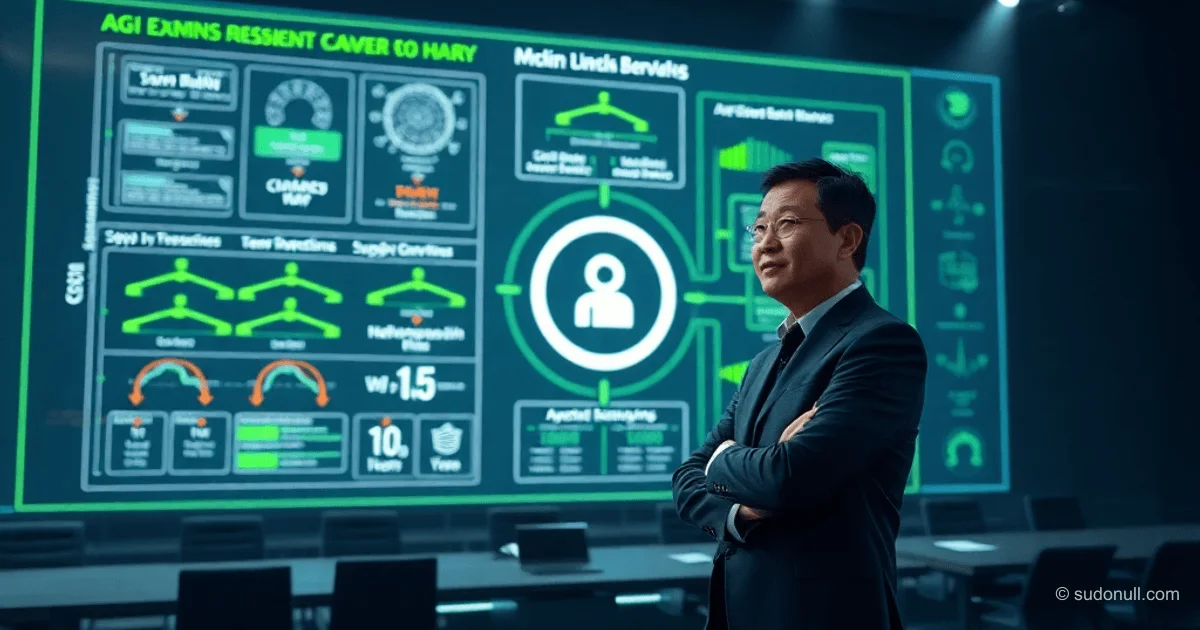
# Jensen Huang: AGI Is Already Here, But It Has No Chance Against NVIDIA
Jensen Huang stated outright on the Lex Fridman podcast (#494): AGI has been achieved. "I think it's now. I think we've achieved AGI." However, he clarified that current systems couldn't manage a corporation on NVIDIA's scale. Lex Fridman defined AGI as the ability of AI to autonomously launch and grow a company worth over $1 billion. Huang agreed but highlighted the difference between short-term success and sustainable growth.
For example, models like Claude can create a viral web service, attract an audience, and quickly monetize it to a billion dollars. But such a project is doomed to decline without long-term management of supply chains, teams, and strategies amid uncertainty.
Agentic Systems as the Foundation of Progress
Huang emphasized the development of agentic frameworks like OpenClaw. Modern agents:
- Plan multi-step tasks;
- Integrate tools;
- Launch sub-agents;
- Execute complex chains of actions.
The key shift is the inference stage. It generates the bulk of the computational load: agents reason, interact, and produce data for subsequent training. This closes the loop: inference → new data → model improvements.
Huang pegged the odds of a scenario with 100,000 coordinated AI agents running a company like NVIDIA at 0%. Technical barriers combine with organizational ones: strategic planning and management under uncertainty remain human domains.
Redefining AGI in the Industry
Huang's statement signals a paradigm shift. Intelligence as a tool for solving tasks is already mainstream, but as the ability for sustainable corporate growth—it's not there yet. This contrasts with Andrew Ng's (Google Brain) estimates: decades away from classic AGI. There's no consensus on AGI's definition, allowing for fresh takes on progress.
Huang stresses: NVIDIA benefits from the AI boom thanks to inference workloads. Massive computations for agents are the main driver of GPU demand.
What Matters
- AGI by Huang's definition means current systems capable of short-term business projects, but not running corporations;
- Inference dominates training in compute costs due to agentic chains;
- OpenClaw and similar frameworks show planning and hierarchical agents;
- Coordinating thousands of agents for complex systems is unattainable at current levels;
- Lack of consensus on AGI definition spurs new interpretations.
Technical Implications for Developers
For mid- and senior-level specialists, this means focusing on inference optimization. Agentic systems require:
- Efficient tool use (API integration, external services);
- Hierarchical planning (sub-agents for subtasks);
- Scalable data storage from inference for RAG and fine-tuning;
- Monitoring reasoning chains (reasoning traces).
When implementing, test for robustness: single agents handle prototypes, but scaling to 100+ requires human-in-the-loop. Test on real business scenarios—from web services to supply chain simulations.
— Editorial Team










No comments yet.