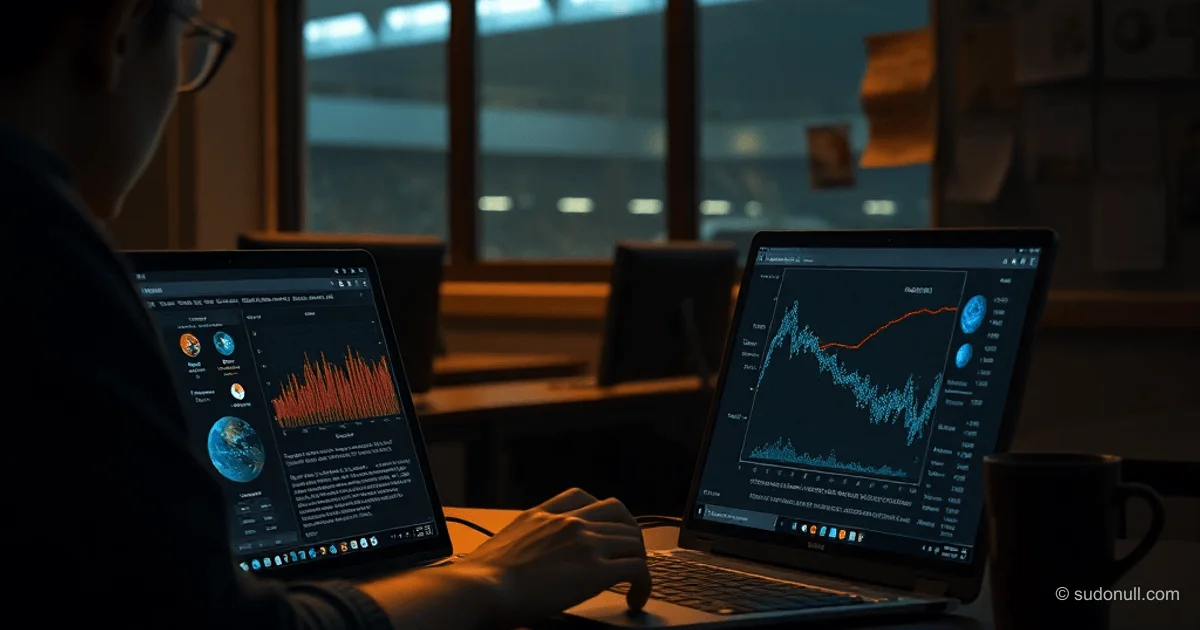
Hybrid AI for Exoplanet Mass Prediction: From KNN Failure to XGBoost Triumph with Physical Filtering
A high school team developed ExoLogica AI — a system combining XGBoost's gradient boosting with physical laws to reconstruct exoplanet masses from NASA, exoplanet.eu, and ExoKyoto archives. After failing with KNN, which ignored planetary physics, the Neuro-Physical Synthesis architecture delivered realistic density predictions and classifications, incorporating the Fulton Gap and Kepler’s laws. Built in Python with a Tkinter interface, the tool enables server-free data analysis.
The system standardizes heterogeneous databases, applies machine learning for initial estimates, and refines results using physical formulas—avoiding artifacts like the "clone wall" phenomenon.
Data Standardization Across Global Archives
Merging NASA Exoplanet Archive, exoplanet.eu, and ExoKyoto requires format alignment. Planets are identified by different keys: pl_name in NASA, name in EU, #PlanetName in ExoKyoto. Masses are normalized to Earth masses.
Code for column mapping:
def standardize_columns(df, source_type):
    mappings = {
        'NASA': {'pl_name': 'name', 'hostname': 'star_name', 'pl_masse': 'mass_e'},
        'EU': {'name': 'name', 'star_name': 'star_name', 'mass': 'mass_e'},
        'ExoKyoto': {'#PlanetName': 'name', 'StarName': 'star_name', 'MassEarth': 'mass_e'}
    }
    return df.rename(columns=mappings.get(source_type, {}))

df_total = pd.concat([df_nasa, df_eu, df_jp]).drop_duplicates(subset=['name'], keep='first')
This approach removes duplicates while preserving records with the most data. The dataset exceeds 9,000 objects, with missing masses due to the transit method.
The Tkinter interface displays a summary table with color coding: green for terrestrial, blue for ocean worlds, red for hot Jupiters. ESI (Earth Similarity Index) is automatically calculated.
Comparing ML Algorithms on the Unified Dataset
Testing three models revealed distinct strengths and weaknesses:
- KNN: Extrapolates nearest neighbors, resulting in a "clone wall"—all predicted densities cluster around ~8.82 g/cm³. Ignores nonlinear patterns such as the Fulton Gap.
- Random Forest: Stable but averages anomalies, reducing sensitivity to rare planet types.
- XGBoost: Gradient boosting iteratively corrects tree-based errors. Detects transitions from rocky planets to gas giants without explicit labeling.
XGBoost outperformed on validation metrics, especially in predicting masses for radii between 1.5–2 R⊕.
Neuro-Physical Synthesis Architecture
The prediction process unfolds in three layers:
- ML Layer: XGBoost predicts mass based on radius, orbital period, and stellar parameters.
- Physical Layer: Validates against Kepler’s Third Law and Stefan-Boltzmann Law. Computes equilibrium temperature and insolation.
- Synthesis Layer: Corrects if ML violates physics—for example, replacing an iron-rich planet with a gas giant when density exceeds a physical threshold.
In the interface, the "Artificial Intelligence" mode shows before-and-after results: KNN produces uniform densities, while XGBoost + physics yields diversity (4.49 g/cm³ for mini-Neptunes, low values for frozen worlds around red dwarfs).
Logarithmic plots of mass vs. density highlight key zones: sub-Earths, super-Earths, mini-Neptunes. KOI-4878 b is classified as a "Giant Mercury" with an anomalously high iron core.
Interface and Analytics for Developers
The Tkinter app includes:
- Tables with ESI and classification.
- Visualizations of ML errors (the clone wall).
- Synthesis graphs with phase zones.
- Object cards with verification: Proxima Centauri b is a frozen rocky world; TRAPPIST-1 e/f/g are Earth-like in the habitable zone.
Built with scikit-learn, xgboost, and pandas, it runs smoothly on school computers. The "Academy" section documents formulas for transparency.
Key Takeaways:
- Hybrid ML + physics eliminates hallucinations common in pure AI in astrophysics.
- XGBoost independently discovers the Fulton Gap in the data.
- Standardizing three databases creates a complete exoplanet catalog.
- The Tkinter interface makes analysis accessible without Jupyter.
- Predictions are verified via density and ESI for real candidates.
— Editorial Team










No comments yet.