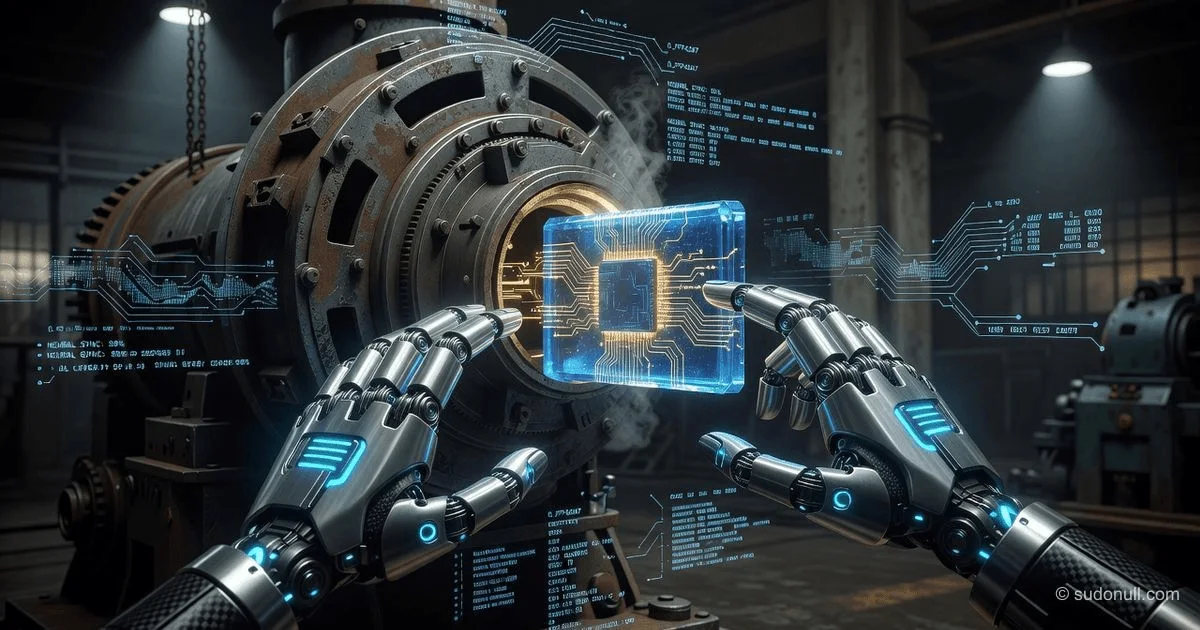
Intel and Hitachi Announce Strategic Collaboration in 'Physical AI' for Industry
Japanese Hitachi and American Intel launch a joint project to deploy AI in manufacturing, energy, and transportation. The partnership focuses on five key areas, including quantum computing, custom chips, and factory automation, to accelerate digital transformation in the real economy.
Analytical article: Intel and Hitachi — The Quiet Restructuring of the Industrial AI Foundation
Not a partnership, but a mutual necessity for two giants that can no longer ignore 'physical' AI.
When news feeds exploded with headlines about Intel and Hitachi collaborating on 'Physical AI,' many dismissed it as a standard press release. Companies signed yet another memorandum promising to 'explore opportunities' and 'synergies,' they thought. But if you dig deeper, you'll understand: what happened on June 4, 2026, is not a friendly handshake. It's a deal between two predators that realized they were drowning alone.
Intel desperately needs validation for its contract manufacturing business (Foundry) after early setbacks and losing processor market share. Hitachi, in turn, is experiencing an existential identity crisis: the Japanese conglomerate wants to be not just a manufacturer of trains and turbines, but a global leader in 'digital social infrastructure.' The meeting of these two interests spawned a deal that will radically reshape the industrial software landscape over the next 12 months.
Right now, I'll break down why this deal is a market signal, who is losing money right now, and where the skeletons in this alliance's closet are hidden.
[The Essence]: What's Really Happening
The official statement says Intel and Hitachi will join forces in five pillars: foundry tools, quantum computing, energy optimization, custom chips for Edge AI, and factory automation. Sounds like a generic roadmap for any tech company, right? But the essence is different: they are changing the decision-making architecture in heavy industry.
Until now, AI existed in 'digital sandboxes' — data centers. Hitachi, through its Lumada 3.0 platform, is pulling AI into the physical world — onto rails, into power grids, and onto assembly lines. A mistake there doesn't cost a chat ban; it costs a transformer explosion or a train crash. Consequently, hardware requirements change dramatically. Standard Nvidia GPUs powered through a tangle of cables in the cloud won't cut it. You need low-level control, predictable latency, and, most importantly, reliability at a failure rate of 0.00001%.
Intel comes in with its secret weapon — 18A technology and mature experience in x86-compatible real-time systems. Hitachi gets not just a 'chip partner,' but access to an architecture that allows embedding AI agents directly into PLC controllers. This means AI will physically control the factory, bypassing cumbersome cloud layers.
For Intel, this is also a way to fill its new fabs (which cost tens of billions of dollars) with orders. Hitachi is a huge consumer of silicon. Now, instead of buying chips from TSMC, Hitachi will tightly integrate its systems at the hardware level with Intel. This is a classic 'vendor lock-in' scheme, but at the highest technological level.
Timeline and Context
Let's set the record straight. This is not a spur-of-the-moment decision. I've been tracking the precursors since early 2025. The real foundation was laid by a series of events that the media stubbornly treated separately, though they are links in the same chain.
May 2025: Hitachi signs a strategic agreement with Anthropic to deploy Claude for 290,000 employees and establish a 'Frontier AI Deployment Center.' Hitachi officially declares its course toward 'Physical AI.'
April 2026: Intel publishes a strong quarterly report, showing revenue of $13.58 billion, largely driven by growth in the AI segment. But the main thing is they finally confirm Tesla's transition to their 14A node for the TeraFab project. This was the first sign that Intel is becoming a serious player in contract chip manufacturing for new industrial giants.
Early June 2026: A few days before the Intel announcement, Hitachi expands its partnership with Google Cloud, integrating Gemini into its OT environments (operational technology). Why would they need Intel then? Here's the crux: Google gives them the 'brain' (AI models), while Intel provides the 'nervous system' and 'muscles' (chips and manufacturing).
June 4, 2026: A five-pillar collaboration with Intel is announced. Note the wording — 'Strategic collaboration to explore opportunities.' But in the serious business world, 'explore opportunities' over the last two quarters has become slang for 'we've already signed an NDA and started kernel-level SDK integration, but we don't want to scare Wall Street analysts.'
Who Wins and Who Loses
Winners: Intel shareholders. This contract means their Foundry business is no longer a 'story of hopes.' Hitachi is not a startup that will die tomorrow. It's a giant with over $60 billion in revenue that will steadily load Intel's fabs with orders for specialized chips for robotics and power grids over the next 5-7 years. Intel's stock price, which has traditionally suffered from distrust in its manufacturing division (except for the reporting spike in April), finally gets a long-term driver.
Winner: NVIDIA? Surprisingly, yes, but indirectly. By freeing up the top tier of complex industrial tasks for x86, Hitachi will still use Nvidia GPUs for heavy model training in data centers. But at the edge, NVIDIA loses a piece of the pie — Intel is pushing its architecture where the CPU takes over real-time control functions.
Losers: Siemens and Schneider Electric. European industrial giants have long bet on their own closed ecosystems and collaboration with AMD (via Xilinx). The Intel + Hitachi + Anthropic + Google alliance creates a US-Japan 'Alliance of Four' that pushes Europeans out of the predictive analytics market for power grids. Siemens lacks its own powerful contract chip manufacturer of this level, and now they'll have to pay more or fall behind.
Loser: TSMC (but imperceptibly for now). Although TSMC continues to dominate advanced logic for smartphones and HPC, this contract cements Intel's status as a 'reliable second source' for critical infrastructure. Large corporations like Hitachi fear putting all eggs in one basket (TSMC in Taiwan due to geopolitical risks). Intel becomes their 'politically safe choice #1.'
What the Media Isn't Saying
Typical analysts happily list the five points of collaboration and close their laptops. I'll tell you what they're missing.
Insight #1: The Death of Cloud AI in Industry
Everyone talks about AI, but few understand that the classic cloud is dying for CNC machines. The contract includes a clause: 'Energy optimization deploying Hitachi's HMAX Energy within Intel's fabs.' What does this mean in practice? Hitachi will install its transformers and control systems at Intel's plants. But these systems will run on Intel chips. This creates a feedback loop that doesn't require the internet. Intel's fab becomes a laboratory where AI learns to manage electricity without sending data to Microsoft or Amazon data centers. This is a complete ousting of cloud providers from workshops where 1 ms latency is critical.
Insight #2: Spy Thriller, Japanese Style
Hitachi has vast experience in building control systems for nuclear power plants and high-speed trains. Intel, as an American champion, now gains access to these engineering developments through joint work on 'custom silicon.' This isn't just chips. It's an entry into the defense and ultra-secure applications market. European regulators will start an investigation within 6 months: does this alliance violate critical technology transfer rules? But Americans and Japanese won't care — they've created an exclusive club.
Insight #3: Quantum Theater
The statement mentions quantum computing. I'll tell you as an insider: there will be no breakthrough in 2026. But the joint R&D work is needed for one trick — quantum-safe cryptography for industrial protocols. Hitachi and Intel are preparing infrastructure for the day when a quantum computer cracks current RSA. Behind the facade of 'studying quantum technologies' lies a rushed effort to protect US and Japanese power grids from future cyberattacks using quantum algorithms. It's insurance for a decade ahead.
Forecast: Next 30 Days and 90 Days
Next 30 Days
- Pressure on TSMC and Samsung Foundry: TSMC shares may correct by 3-5% as the market shifts focus from monopoly to duopoly. Investors will start reassessing Intel Foundry's potential.
- Personnel changes at Siemens: Expect quiet layoffs or restructuring in Siemens' Digital Industries division. Europeans won't quickly find an answer to the 'Intel+Hitachi' alliance and will start buying up small AI developers in Europe to compensate for the lag in 'physical AI' (e.g., some German digital twin startups).
- Concrete timelines for Edge SoC development: Hitachi will officially announce a specific product (likely named HX-1 or something similar) built on Intel 18A for managing robotic warehouses. This will be a direct blow to ARM solutions.
Medium-term Forecast (90 Days)
- Wave of M&A deals in Israel: Right after this contract, I predict Intel, through its venture arm (Intel Capital), will start buying Israeli automation startups. Reason: Israel is a champion in computer vision software, which Hitachi needs for train and turbine maintenance systems.
- EU regulator reaction: The European Commission will ask for contract details to ensure Hitachi isn't transferring grid control technologies that could be used for military purposes (dual-use). This will lead to headlines like 'EU blocks technology transfer,' but in reality, it will delay the project by at most a month.
- Qualcomm's decline in automotive segment: Qualcomm has been aggressively trying to enter 'smart factories' through digital chassis. The Intel-Hitachi alliance shows automakers (Toyota, Honda) that there's a more reliable Japanese-American path than buying solutions from Qualcomm. Within a quarter, Toyota will announce a shift to a 'Hitachi inside on Intel' system, which will be a cold shower for San Diego.
Summary: View this contract not as an engineering one, but as a geopolitical maneuver. The US, through Intel, gains control over Japanese industry, while Japan, through Hitachi, secures chip supply without the risk of a Taiwan crisis. Win-win. Everyone else is an outsider.
— Editorial Team






No comments yet.