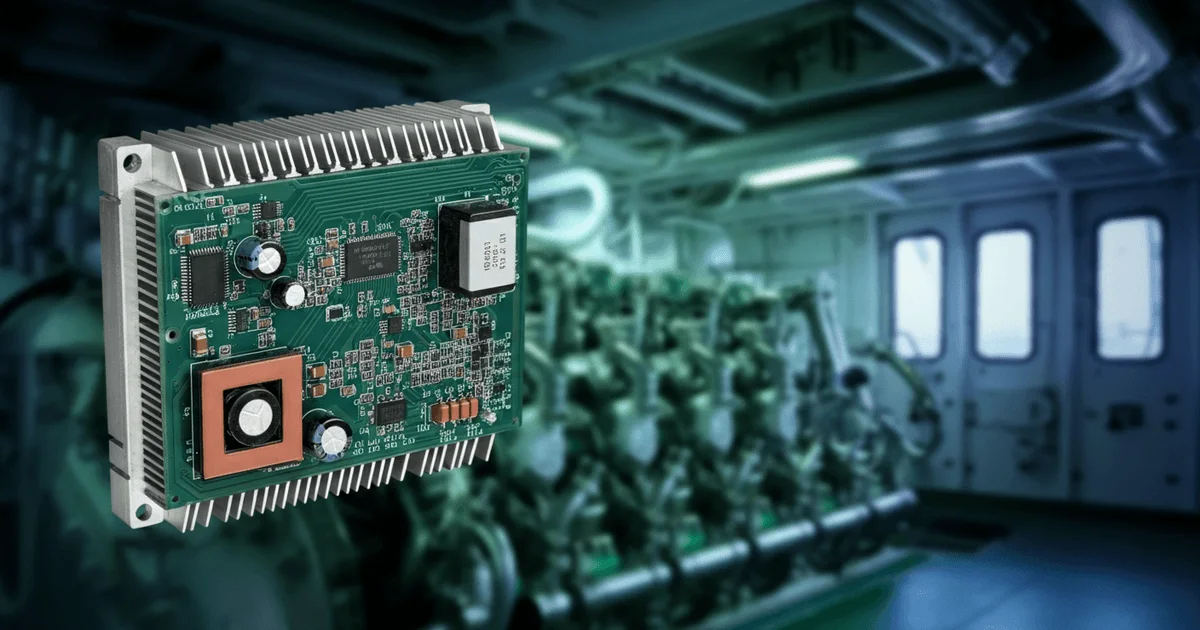
Intelligent Power Modules: The Key to Efficient Marine Electric Propulsion
Modern shipbuilding is undergoing a transformation, actively shifting from traditional propulsion systems to electric propulsion. This move is driven by several advantages, including enhanced maneuverability, cost-effectiveness, and the ability to integrate the ship's electrical power system. At the heart of this evolution are Variable Frequency Drives (VFDs), which control propulsion electric motors (PEMs) and thrusters. The efficiency and reliability of these systems directly depend on the power modules used, and this is where Intelligent Power Modules (IPMs) come to the forefront, followed by their more advanced version — Highly Intelligent Power Modules (HIPMs).
Electric Propulsion in Marine Applications: Advantages and Components
The development of ship electric propulsion systems (EPS) has become a key area in marine engineering over the past few decades. Eliminating the mechanical link between the engine and propeller in favor of electrical power transmission provides several critical advantages: improved maneuverability, especially for vessels requiring precise positioning (icebreakers, tugboats, emergency rescue vessels), reduced noise and vibration, and optimized fuel consumption by allowing main engines to operate at optimal regimes. The transition to AC EPS has enabled the integration of propulsion and ship-wide electrical power systems into what are known as integrated power systems (IPS), simplifying control and enhancing overall efficiency.
A typical structure of a modern EPS includes propulsion electric motors (PEMs), semiconductor Variable Frequency Drives (VFDs) with their control systems (VFD CS), as well as switchgear and, if necessary, a power transformer. Induction motors (IMs) are widely used as PEMs due to their reliability and ease of maintenance.
VFDs, in turn, are often built around a DC link, comprising a voltage rectifier (controlled or uncontrolled) and a voltage source inverter (VSI). Active Front-End (AFE) rectifiers, based on IGBT transistors, offer significant advantages over uncontrolled diode rectifiers. AFEs allow for power factor regulation, minimization of distortions in the ship's electrical grid, and energy regeneration back to the grid during braking, which increases the vessel's overall energy efficiency. VFD control systems, built on microcontrollers, are responsible for regulating the speed and torque of PEMs, ensuring their starting, stabilization, power limiting, braking, and reversing, as well as collecting diagnostic information and providing protection in emergency situations.
Intelligent Power Modules (IPMs): The Foundation of Modern Converters
At the core of modern VFDs are Intelligent Power Modules (IPMs), which are highly integrated devices combining semiconductor components (such as IGBT or MOSFET transistors and diodes) and control, monitoring, and protection circuitry — the driver — within a single package. This integration is a response to the global trend towards reducing size and weight characteristics, increasing functionality, and enhancing the integration level of electronic components.
IPMs can feature various power stage configurations, from a single transistor to a three-phase bridge with a brake chopper, or even a complete circuit including a diode rectifier and a transistor inverter. Leading global power electronics manufacturers such as Fuji Electric, Infineon, Mitsubishi, Powerex, Semikron Danfoss, and Toshiba offer a wide range of IPMs. The SKiiP series from Semikron Danfoss deserves special attention, serving as a benchmark for quality and reliability in the high-power IPM segment. These modules, which integrate a half-bridge transistor converter, driver, isolated power supply, sensors, and heatsink, demonstrate cutting-edge characteristics, enabling the creation of more powerful and compact converters without compromising reliability.
The advantages of IPMs compared to discrete components are clear and multifaceted:
- Enhanced Reliability: Integrated drivers provide robust protection for transistors against short circuits, overvoltages, and other fault conditions.
- Compactness: The highly dense arrangement of electronic elements and structural solutions significantly reduces the size and weight of VFDs.
- Improved Electrical Characteristics: Minimal length of power conductors reduces stray inductances, thereby lowering switching overvoltages and improving noise immunity.
- Simplified Maintenance: The modular design facilitates the replacement of IPMs in case of failure, reducing equipment downtime.
Although the cost of IPMs may exceed the total cost of discrete components required to assemble a similar converter, overall savings are achieved by reducing development, testing, and commissioning costs. Creating a high-quality discrete converter demands significant time and intellectual resources from highly qualified specialists, ultimately making IPMs a more cost-effective solution.
Highly Intelligent Power Modules (HIPMs): A Step into the Future
Further development of IPMs has led to the emergence of Highly Intelligent Power Modules (HIPMs), which boast an even higher degree of integration and extended functionality. HIPMs include not only drivers and power semiconductors but also integrated voltage, current, and temperature sensors. This allows them to monitor key operating parameters in real-time and provide a full suite of protection and service functions. Such modules can measure DC link voltage, phase currents, transistor temperatures, and effectively protect the converter from most fault situations, including software errors. Essentially, a properly designed system based on HIPMs becomes exceptionally resilient to failure.
The use of HIPMs significantly simplifies and accelerates the entire VFD development cycle. For the design engineer, it is sufficient to place the module in the cabinet, ensure its cooling, and connect the power busbars and communication lines. The most labor-intensive aspects of power stage design are already resolved during the HIPM's development phase. Similarly, assembly and commissioning processes are simplified: there's no need for skilled operations like applying thermal paste and mounting transistors on a heatsink, nor for detailed waveform verification of each transistor, as the module's functionality is guaranteed by the manufacturer.
Future Outlook and Key Innovations
The future of power modules is tied to further enhancements in their intelligence and functionality. It is expected that HIPM drivers will increasingly be built on microcontrollers, Field-Programmable Gate Arrays (FPGAs), or Application-Specific Integrated Circuits (ASICs). This will enable new, important functions such as flexible configuration of driver protection parameters and comprehensive diagnostics of each transistor's status. Information exchange with the VFD control system will occur via highly reliable interfaces like CAN, Ethernet, or UART, utilizing fiber-optic communication lines for maximum noise immunity.
These innovations will allow the VFD control system to dynamically change critical parameters such as dead time duration, current, voltage, and temperature protection setpoints, and perform in-depth diagnostics. In the case of parallel operation of multiple transistors, microprocessor-based drivers will be able to monitor the current and temperature of each element, which is critically important for even load distribution and enhancing the reliability of the entire system. Thus, the development of IPMs and HIPMs is a key factor in creating more powerful, reliable, and intelligent electric propulsion systems capable of meeting the growing demands of modern shipbuilding.
Key Takeaways:
- Ship Electric Propulsion: Modern ship electric propulsion systems (EPS) offer enhanced maneuverability and energy efficiency compared to traditional propulsion complexes.
- Role of Variable Frequency Drives (VFDs): VFDs are the central element of EPS, controlling propulsion electric motors and thrusters, utilizing Active Front-End (AFE) rectifiers for optimized operation.
- Intelligent Power Modules (IPMs): IPMs integrate semiconductors, drivers, and protection into a single package, significantly improving VFD reliability, compactness, and electrical characteristics.
- Highly Intelligent Power Modules (HIPMs): HIPMs represent an advanced version of IPMs with integrated sensors and a full suite of protection functions, simplifying development and enhancing system resilience to failures.
- Future Outlook: Future HIPMs will feature microcontroller-based drivers, FPGAs/ASICs, and high-speed interfaces for advanced diagnostics and flexible parameter configuration, which is critical for powerful and complex systems.
— Editorial Team










No comments yet.