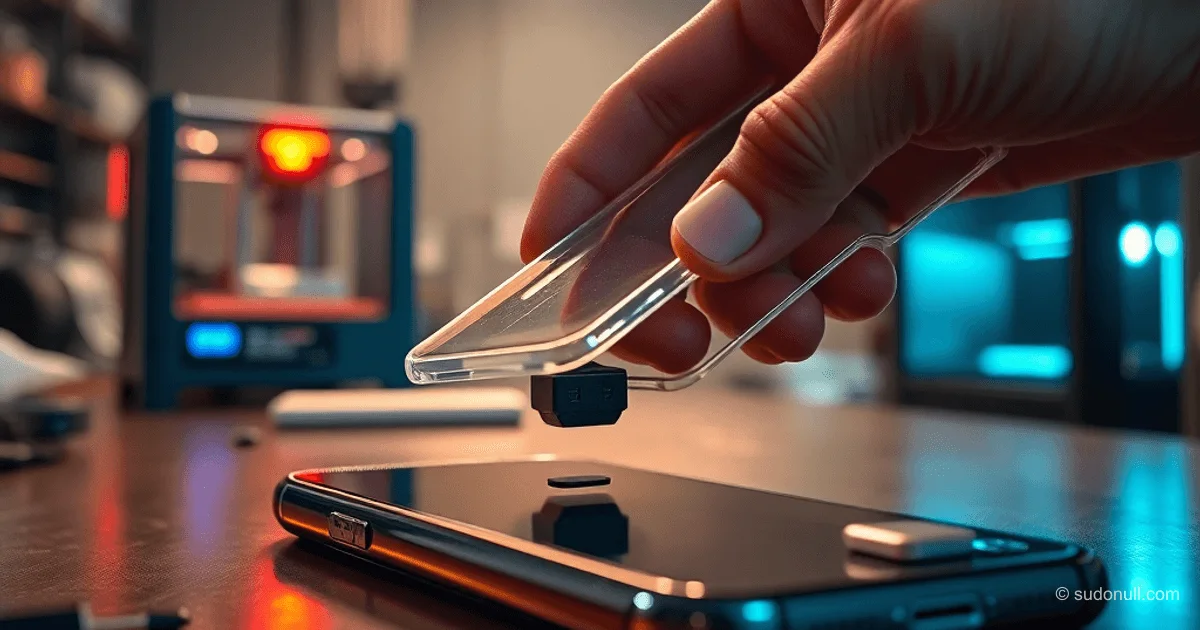
Lightning Case for iPhone 17 Pro: Ken Pillonel's Engineering Experiment
Swiss engineer Ken Pillonel has developed a case that restores the Lightning port on the iPhone 17 Pro. Externally, the case provides a Lightning interface, connecting internally via USB-C to the smartphone. The project combines 3D printing, MagSafe magnetic compatibility, and a demonstration of reverse-modifying Apple's hardware.
Pillonel previously specialized in replacing Lightning with USB-C in Apple devices. After the full switch to USB-C across the lineup due to EU requirements, the community requested a demonstration of the reverse process. The case is a response to those requests, highlighting the flexibility of custom solutions for retrofitting interfaces.
Case Design and Materials
The case is manufactured using selective laser sintering (SLS) from TPU 90A powder on a Formlabs printer. This material provides flexibility, impact resistance, and precise Lightning port geometry.
The inner part of the case is equipped with a USB-C connector that inserts into the iPhone 17 Pro's port. Built-in magnets compatible with MagSafe ensure secure attachment. Auxiliary elements—magnet holders—are printed on a Prusa Core One L FDM printer.
Assembly requires precise calibration: magnets are pressed into slots, and the USB-C is secured with glue or retainers. The finished case preserves the iPhone's ergonomics, adding minimal bulk to the bottom.
Production Process and Features
SLS printing allows for monolithic structures without supports, minimizing post-processing. TPU 90A on the Shore scale balances rigidity and elasticity, making it ideal for cases.
MagSafe magnets are integrated for wireless charging without losing functionality. The engineer tested the connection strength: the case withstands drops and everyday use.
The project is documented in a video on Pillonel's YouTube channel, showcasing CAD modeling, printing, and assembly stages. 3D printing models are partially open to the community.
Ken Pillonel's Previous Projects
The engineer is known for a series of Apple device modifications. Here are the key works:
- Dual-port iPhone 12 mini with simultaneous Lightning and USB-C support;
- Wired AirPods modification with a 3.5-mm jack;
- First Android smartphone with a Lightning port;
- Repairable AirPods Pro case with replaceable batteries;
- Mass retrofit of Lightning → USB-C in iPhone X, AirPods Max, and AirPods Pro.
These projects demonstrate expertise in soldering, 3D printing, and reverse-engineering connectors.
Key Points
- The case uses SLS printing of TPU 90A for precise Lightning replication with MagSafe support;
- Internal USB-C ensures full compatibility with iPhone 17 Pro without modifying the device itself;
- The project highlights the trend toward custom accessories for restoring outdated interfaces;
- Open models enable replication in hobbyist and professional workshops;
- Demonstrates evolution from USB-C mods to reversible solutions.
Applications for Developers and Engineers
The project is useful for studying the integration of legacy interfaces into modern devices. Embedded systems developers can adapt the approach for prototypes with hybrid ports.
Key lessons:
- SLS vs FDM: SLS is preferable for functional prototypes with moving parts;
- Materials: TPU 90A is optimal for connector cases (flexibility + ±0.1 mm precision);
- Magnetic attachment: 20x3 mm NdFeB magnets provide 5–10 N holding force;
- CAD modeling: Fusion 360 was used for simulating mounting points.
Such modifications are relevant in IoT and industrial design, where compatibility with legacy equipment is required.
— Editorial Team










No comments yet.