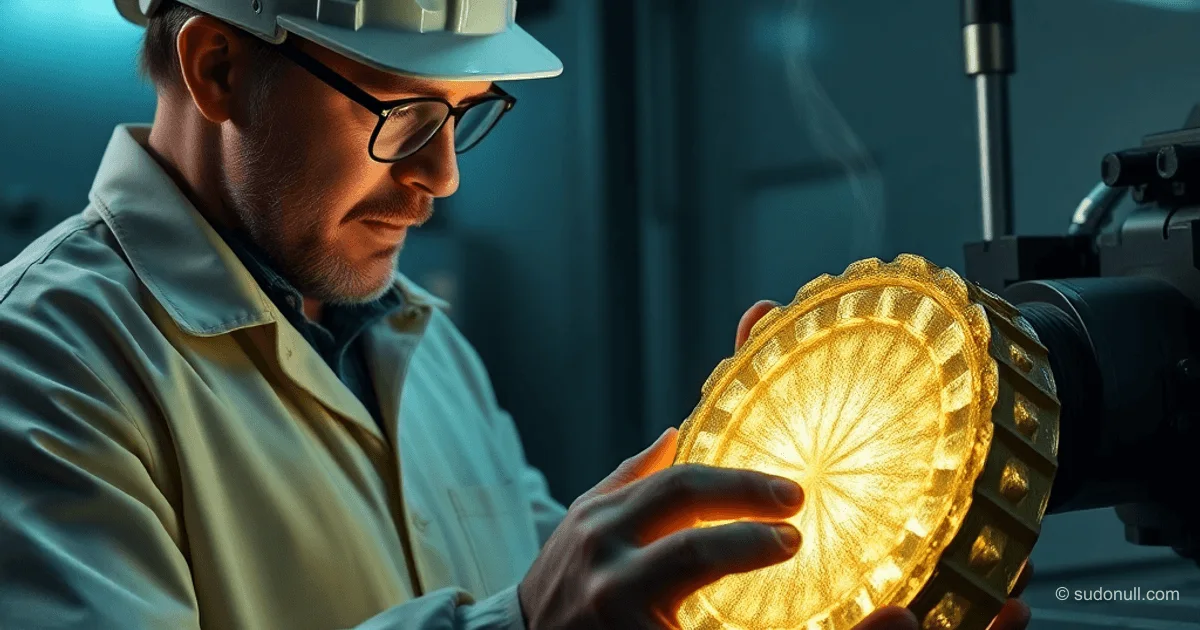
# Metallic Glasses for Electric Motors: Minimizing Core Losses
Electric motors lose efficiency due to hysteresis losses during remagnetization in crystalline materials. Researchers from Saarland University propose replacing them with metallic glasses—amorphous alloys without a crystalline structure. These materials minimize heat generation, particularly in high-speed and compact motors.
Traditional soft magnetic iron alloys with large grains are effective, but when the magnetic field changes in the stator, Weiss domains encounter defects in the crystal lattice. This causes core losses proportional to the rotor's rotation frequency. The amorphous structure of metallic glasses eliminates such barriers: magnetic domains reorient freely without energy expenditure to overcome grain boundaries.
Properties and Production of Metallic Glasses
Metallic glasses are formed by rapidly cooling a melt, "freezing" atoms in a disordered state. This provides strength superior to steel and low coercive losses. Ralph Busch emphasizes: the absence of crystallites allows domains to respond to the field without friction.
Production of parts uses:
- Pressure die-casting for mass production.
- Additive manufacturing (L-PBF—laser powder bed fusion) for complex rotor and stator geometries.
The EU project "Additive Manufacturing of Amorphous Metals for Soft Magnetic Materials" is funded by millions of euros. The key breakthrough is three alloys resistant to crystallization during 3D printing:
- Easily vitrify upon cooling.
- Retain soft magnetic properties.
- Suitable for printing functional engine components.
Optimizing L-PBF for Industrial Applications
Laser powder bed fusion (L-PBF) requires precise temperature control to prevent crystallization. Busch's team is working to improve reproducibility: optimizing laser parameters, powder composition, and post-processing. This will enable scaling production without losing amorphousness.
In lab tests, metallic glasses show a sharp reduction in losses compared to nanocrystalline alternatives. Next steps include motor prototypes with 3D-printed cores for validation under real loads.
What Matters
- Amorphous metallic glasses eliminate remagnetization losses thanks to the absence of crystallites and free mobility of Weiss domains.
- L-PBF enables creating complex stator and rotor parts inaccessible to traditional methods.
- Three alloys identified for printing: resistant to crystallization, soft magnetic, and strong.
- The EU project focuses on industrial scalability of L-PBF.
- Potential for high-speed miniature motors with efficiency close to 100%.
— Editorial Team










No comments yet.