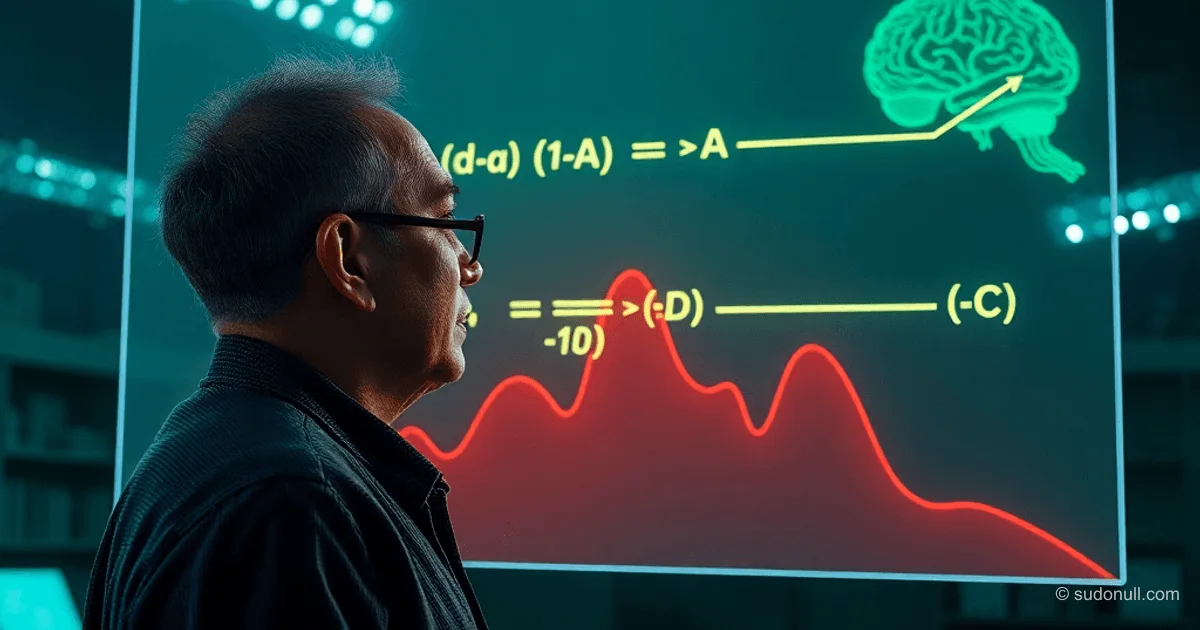
The Dynamics of Human Agency Decline in the Age of AI Delegation
Human agency—the capacity for independent judgment—is prone to atrophy when tasks are excessively delegated to AI. A formal dynamic model shows that even minimal delegation of judgment (D_J > 0) leads to irreversible collapse of agency (A → 0) over 15, 50, and 150-year horizons. Key insight: delegating computations (D_C) causes atrophy 15–20 times slower than delegating judgment.
The model incorporates neurobiological mechanisms of synaptic pruning and the autocatalytic nature of agency, offering testable hypotheses for cognitive science and AI safety.
Distinguishing Delegation: Computation vs Judgment
AI task delegation splits into orthogonal categories with distinct atrophy rates:
- Computation (D_C): data search, optimization, draft generation. AI acts as a tool requiring verification. Atrophy is minimal (β_C ≈ 0.05).
- Judgment (D_J): selecting options, setting goals, assessing risks without validation. Shift from author to interface. High atrophy (β_J ≈ 0.8).
This asymmetry stems from neuroscience: judgment demands integration across multiple brain regions; computation relies on localized skills.
Formalizing the Dynamics of Agency
Agency A ∈ [0,1] is modeled as an autocatalytic process:
\frac{dA}{dt} = A(1 - A) \cdot \big[ \alpha(1 - D_J) - \beta_J D_J - \beta_C D_C \big]- The logistic factor A(1-A) bounds A within [0,1], peaking sensitivity at A=0.5.
- Positive term α(1 - D_J): training through independent judgment (α ≈ 0.1).
- Negative terms: atrophy from D_J (β_J D_J) and D_C (β_C D_C).
Parameters reflect empirical findings: β_J >> β_C due to judgment’s complexity.
Simulation Results Across Time Horizons
Model simulated with initial A(0)=1 and D_J(0) from 0% to 30%.
15-Year Horizon
| D_J(0) | A(15) | Mode |
|--------|--------|--------------|
| 0% | 0.98 | Preservation |
| 10% | 0.97 | Preservation |
| 30% | 0.92 | Preservation |
Illusion of stability: losses remain imperceptible.
50-Year Horizon
| D_J(0) | A(50) | Mode |
|--------|--------|---------------|
| 5% | 0.868 | Preservation |
| 10% | 0.733 | Transitional |
| 20% | 0.343 | Collapse |
| 30% | 0.000 | Collapse |
Critical threshold: 7.5–10%.
150-Year Horizon
Any D_J(0) > 0% → A(150) = 0 (collapse). Threshold approaches zero.
The Slow Catastrophe: Key Takeaways
- Only D_J = 0 ensures agency preservation across all timeframes.
- With D_J > 0, collapse is inevitable—timing depends on level: 30% → 20–25 years; 5% → 100–150 years.
- D_C amplifies the effect but weakly.
D_J is not measured by number of queries, but by cognitive load weight (complexity × responsibility × novelty).
Examples of weights:
- Movie selection: 0.1
- Routine email: 1
- Investment decision: 10+
Practical Implications for Cognitive Resilience
The model generates actionable hypotheses:
- Individual level: cap D_J < 5% by load weight. Manually verify 95%+ judgments.
- Professional context: audit delegation practices in teams (e.g., software development).
- Educational approach: train judgment using 'AI + human critique' protocols.
- AI safety design: build models with 'judgment transparency' to reduce trust without verification.
Empirical testing: longitudinal studies tracking A via tasks (Raven matrices + real-world cases) before/after AI interaction.
What Matters Most
- Agency is a use-it-or-lose-it process.
- D_J >> D_C in destructiveness (β_J/β_C ≈ 16).
- Collapse is invisible at 15 years but unavoidable beyond 50.
- D_J threshold → 0 as t → ∞.
- Measure D_J by cognitive load, not time.
— Editorial Team










No comments yet.