# Nanoscale QR Code on Ceramics: Storage Density Up to 2 TB on A4
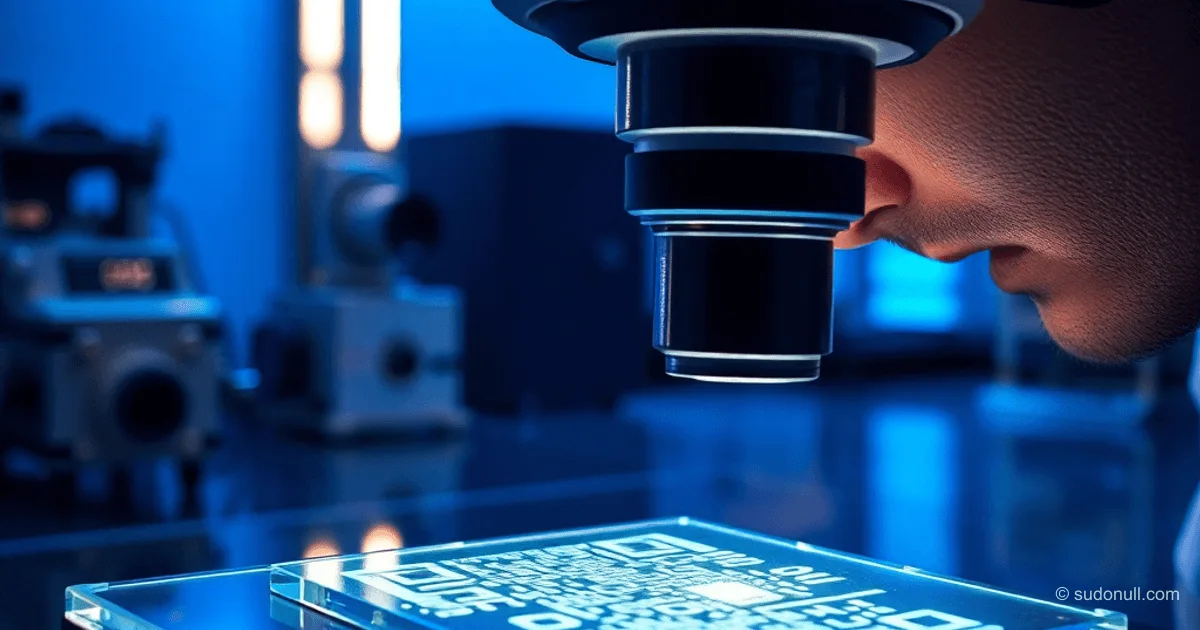
Scientists from Vienna University of Technology and Cerabyte have created a QR code measuring just 1.98 μm²—smaller than a typical bacterium. Each of its 29×29 modules is 49 nm in size. Visualization and reading require an electron microscope, as optical systems can't resolve it. The record has been confirmed by Guinness World Records; the previous record was 5.38 μm² with 80 nm modules.
The technology uses a thin film of chromium nitride on a glass substrate. Deposition is performed using a focused ion beam (FIB), enabling precise writing at the nanometer scale. This opens the door to ultra-dense archival media for long-term data storage.
Durability and Stability of Ceramic Media
Ceramic chromium nitride is inert to degradation, unlike magnetic disks or NAND flash, where data is lost over decades due to oxidation, charge migration, or magnetic fields. Expected storage life is hundreds or thousands of years under room conditions. It's like cave paintings, highlighting archival reliability: information is preserved without power consumption or maintenance.
The recording density is revolutionary: over 2 TB of data fits on an A4 sheet. This is achieved through nanometer-scale modules and no gaps, unlike optical discs (Blu-ray — ~50 GB per disc).
Advantages Over Traditional Systems
Ceramic QR media outperform traditional systems in several ways:
- Energy Efficiency: Zero consumption after writing, unlike HDD/SSD with constant power draw.
- Eco-Friendliness: No CO₂ emissions or rare earth metals used in data centers.
- Archival Stability: Resistant to temperatures up to 1000°C, radiation, and corrosion.
- Scalability: Potential for 3D structures with even higher density.
Comparison with existing technologies:
| Technology | Density (TB/cm²) | Storage Life (years) | Energy |
|--------------|------------------|----------------------|---------|
| HDD | ~0.001 | 5–10 | High |
| NAND SSD | ~0.05 | 10–20 | Medium |
| Ceramic QR | ~0.2+ | 1000+ | None |
Data are approximate, based on prototype specifications.
Prospects for Industrial Application
Developers are focusing on optimization:
- Faster writing: Current FIB is a lab method; goal is industrial ion lithography.
- New materials: Testing oxides and nitrides for better contrast and density.
- Scaling: Moving to mass production for library, bank, and government archives.
The technology is ideal for cold storage, where access is rare but data integrity is critical. Integration with existing systems will require SEM/TEM-based scanners, but costs will drop with demand.
Potential for microfluidics and biomedicine: QR tags on microchips for lab tracking.
Key Points
- QR code of 1.98 μm² with 29×29 modules at 49 nm—Guinness World Record.
- Chromium nitride on glass applied via FIB, enables 1000+ years of data storage.
- Density >2 TB on A4, zero energy use after writing.
- Greener than data centers, resilient to extreme conditions.
- Plans: Faster writing, new materials, industrial scale.
— Editorial Team










No comments yet.