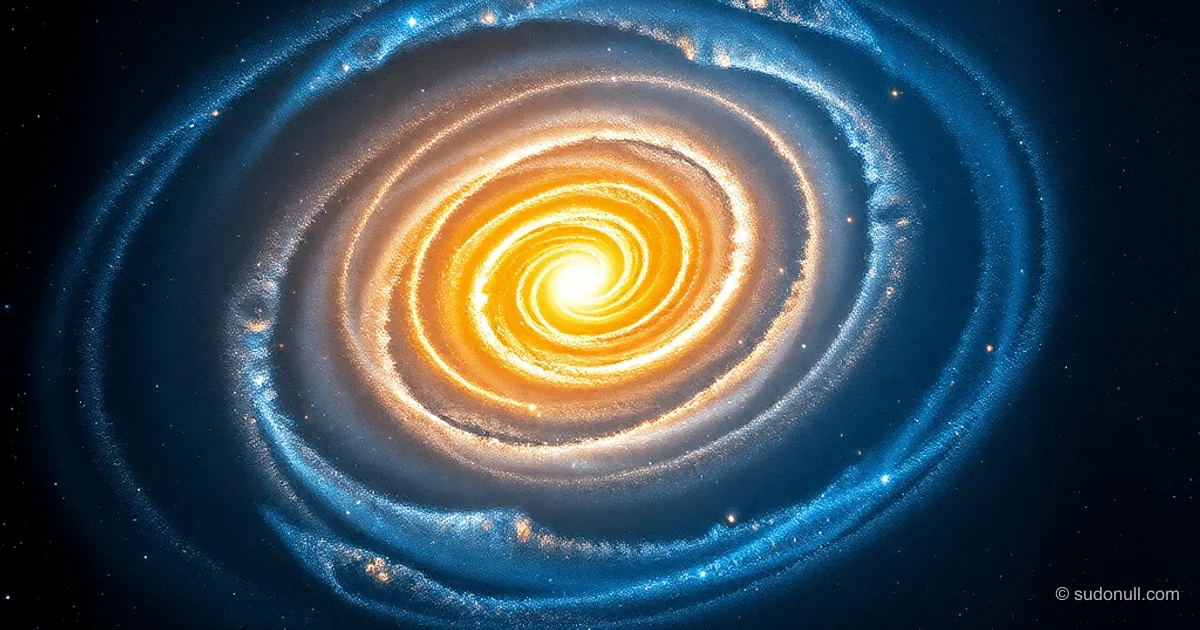
NGC 6000: A Spiral Galaxy with an Active Core in Scorpius's Dusty Veil
The spiral galaxy NGC 6000, located in the constellation Scorpius, displays a striking color gradient from a yellow core to blue spiral arms. New 2025 Hubble Space Telescope images reveal structural details: an active galactic nucleus with high surface brightness, likely a supermassive black hole, and intense star formation in the disks. Distance — 80–90 million light-years, diameter — 66 thousand light-years.
Why Galaxies Are Rare in the Direction of Scorpius
Interstellar dust along the Milky Way creates a zone of avoidance, obscuring distant galaxies. Visibility is minimal toward the Galactic Center, in the constellations Sagittarius and Scorpius. NGC 6000 was discovered by John Herschel in 1834 as a nebula and included in the New General Catalogue. Despite the dusty veil, fresh Hubble images show background galaxies toward the Scorpion's Claws, bordering Libra.
For amateur telescopes, the object is inaccessible: 13th magnitude and southern declination.
- Zone of Avoidance: Milky Way dust blocks the view.
- Discovery: John Herschel, 1834.
- Observations: Regular due to proximity to other objects in Scorpius — nebulae, clusters, double stars.
- Background: Dozens of distant galaxies are visible through the dust.
Color Gradient: Old Stars in the Core, Young Stars in the Arms
From the center to the periphery, the color shifts from yellow-orange (old stars, ~3000 K) to blue (young O/B-type stars, tens of thousands of K). This is typical for spiral galaxies, but in NGC 6000 the gradient is pronounced.
The core is densely populated, with gas and dust depleted. The active nucleus is a candidate quasar with a supermassive black hole. Accretion of matter generates X-ray emission and jets. Stellar winds from the center create shock waves, compressing hydrogen clouds and accelerating star formation by 10+ times.
Result: a burst of young stars in the spiral arms over millions of years.
The Bar and Structural Dynamics
A central bar connects the nucleus to the spiral arms. The bar indicates past nuclear activation: jets and winds enhanced star formation, forming bridges. Over time, orbital dynamics warp the bar, transforming it into spirals.
Interactions with other galaxies can supply fresh gas, reactivating the black hole.
- Size: 66,000 light-years (smaller than the Milky Way).
- Distance: Refined via supernovae 2007 and 2010 — 80–90 million light-years (previously 112 million based on redshift z, v_rad = 2300 km/s).
- Supernovae: Confirm parameters, indicate a high star formation rate.
Key Takeaways
- NGC 6000's active nucleus is a supermassive black hole with accretion, X-rays, and jets.
- The color gradient reflects segregation: old stars in the core, young stars in the arms due to stellar winds.
- The bar is a consequence of past activity, influencing spiral morphology.
- Distance 80–90 million light-years, diameter 66 thousand light-years — a medium-sized spiral galaxy.
- 2025 Hubble images pierce Scorpius's dusty veil.
All spiral galaxies undergo similar cycles of activation and star formation.
— Editorial Team










No comments yet.