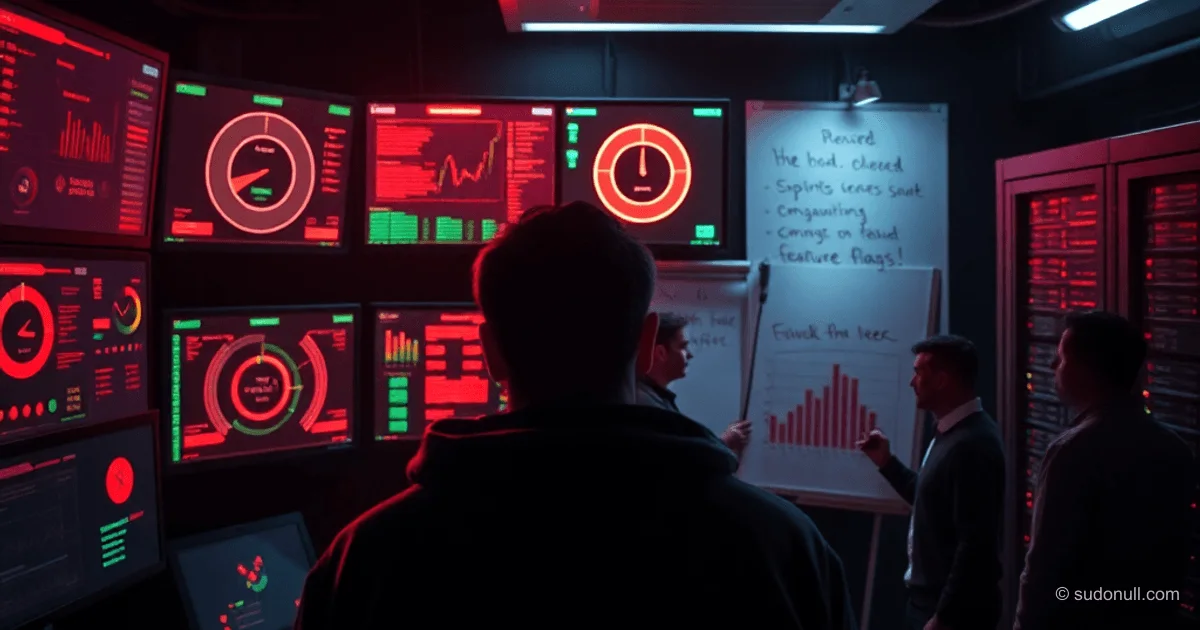
Midnight Prod Outage: Stabilizing the Monolith and Team Coordination
The pager alert "PROD: everything red" yanked me out of bed. Rushing to the incident room: SRE playbook—stabilize, analyze, post-mortem. Team divvied up roles: coordination, communications, database, metrics and logs monitoring. Goal: unearth the root cause buried under layers of legacy code.
Stakeholders got the first update: "Service down. Team on it. Next update in 15 minutes." Monitoring showed all metrics red except one green blip. Logs flooded with timeout errors hitting the monolith, affectionately dubbed "the dragon."
Diagnosis: From Message Queues to Database Bottlenecks
Message queue metrics spiked exponentially, consumers crashing from timeouts. Culprit: sluggish database queries. Here's a prime offender:
SELECT * FROM users WHERE some_condition ORDER BY created_at LIMIT 1000;
-- No index on some_condition or created_at, scanning 10M+ rows—total disaster.
DBA spotted missing indexes and N+1 query issues in the new service. Legacy architect confirmed: the monolith hoards global state, not built for scaling without a refactor.
Urgent Kubernetes migration pitch? Shot down. It'd pile on complexity mid-crisis without fixing the real issue.
Security Gatekeeping and Hard-Won Compromises
Request for temp access to throttle traffic and roll back the feature? Security stonewalled it. Threat model demands risk sign-off. Compromise: one-hour access with full logging and audit report.
Actions:
- Throttle traffic with rate limiting.
- Roll back new feature via feature flag.
- Monitor recovery: red → pink → gray → stable green.
Stakeholders updated: "Stabilized. Analysis ongoing. Next update in 30 minutes."
Root Cause and Key Lessons
Incident contained: queues jammed, DB hammered by unoptimized queries from the new service. Monolith leashed and stable, but it screams for a systematic overhaul.
OKR manager jumps in: double releases, "rewrite everything," Kubernetes everywhere. Risk: chasing big-bang projects over incremental wins.
Key takeaways:
- Root cause was sloppy queries and queues, not the monolith itself.
- Clear incident roles are make-or-break: coordination, comms, deep expertise.
- Security can bend with time-bound access and audits.
- Skip hasty migrations in crisis; prioritize stabilization.
- Post-mortem will shape the roadmap: indexes, feature flags, gradual refactoring.
Team wrapped stabilization in 2 hours. Next: post-mortem and action plan.
— Editorial Team










No comments yet.