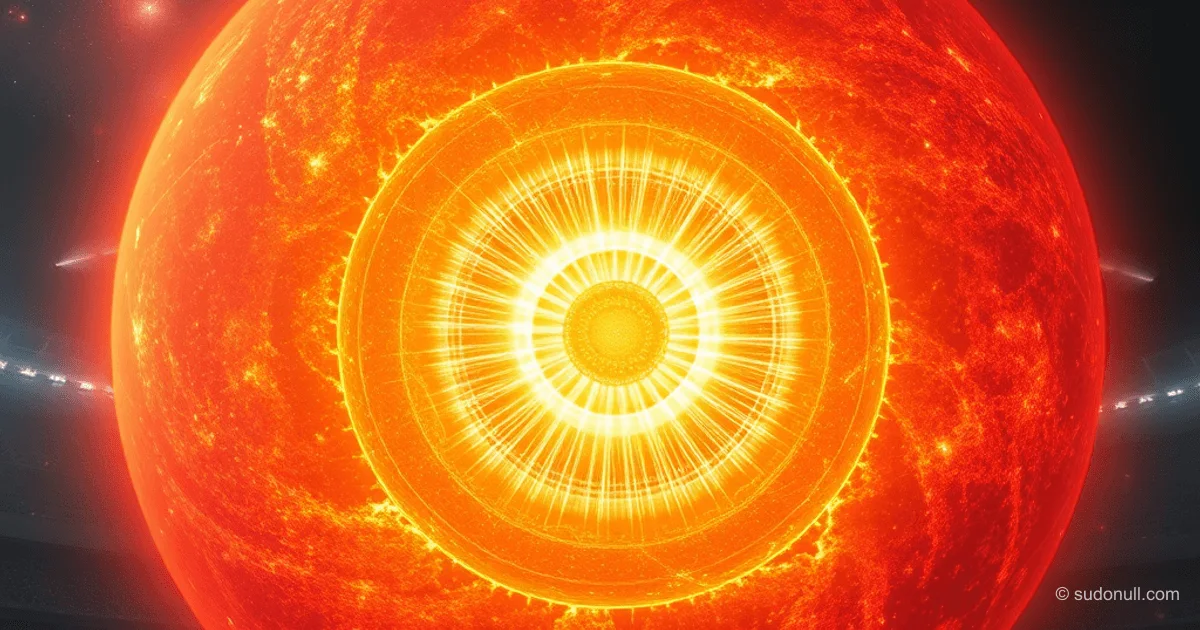
Key Nucleosynthesis Processes in Stellar Evolution
In the cores of Sun-like stars, at temperatures around 10 million K and densities of 35–149 g/cm³, the proton-proton chain for helium synthesis occurs. Two protons fuse into a deuteron, releasing 1.44 MeV, with one proton undergoing β⁺ decay, emitting a neutrino and a positron. The deuteron captures a third proton, forming ³He with 5.5 MeV of energy. The final stage is the fusion of two ³He nuclei into ⁴He and two protons, releasing 12.86 MeV.
The total energy of the cycle is 27 MeV across five reactions (the first two repeat twice). Neutrinos carry away 0.5 MeV, with the remainder heating the plasma. The Sun converts approximately 4 million tons of mass into energy every second.
The Coulomb barrier of protons (140 keV) is overcome by quantum tunneling: the quantum probability allows particles with energy below the barrier (average ~1 keV) to penetrate.
An alternative pathway (20% of cases):
- ³He + ⁴He → ⁷Be + γ (1.58 MeV)
- ⁷Be + e⁻ → ⁷Li + ν (0.05 MeV)
- ⁷Li + ¹H → ⁴He + ⁴He (17.34 MeV)
A rare branch (0.2%):
- ⁷Be + ¹H → ⁸B + γ (0.14 MeV)
- ⁸B → ⁸Be + e⁺ + ν (7.7 MeV)
- ⁸Be → ⁴He + ⁴He (3 MeV)
The CNO Cycle in More Massive Stars
In stars with masses of 1.02–1.5 M⊙ at T > 15 million K, the carbon-nitrogen-oxygen (CNO) cycle dominates, where C, N, and O catalyze helium synthesis from hydrogen:
- ¹²C + ¹H → ¹³N + γ
- ¹³N → ¹³C + e⁺ + ν
- ¹³C + ¹H → ¹⁴N + γ
- ¹⁴N + ¹H → ¹⁵O + γ
- ¹⁵O → ¹⁵N + e⁺ + ν
- ¹⁵N + ¹H → ¹²C + ⁴He
25 MeV is released (excluding neutrinos). The cycle is efficient due to trace amounts of C from previous supernovae.
The Triple-Alpha Process and α-Synthesis
In giants >8 M⊙ at 100–200 million K and ρ >1000 g/cm³, three ⁴He nuclei fuse into ¹²C via an intermediate ⁸Be:
3 ⁴He → ¹²C + γ
Helium burns out in ~10 million years compared to billions for hydrogen. As helium is depleted, the core contracts, T rises to 500 million K, initiating the α-process:
- ¹²C + ⁴He → ¹⁶O + γ
- ¹⁶O + ⁴He → ²⁰Ne + γ
- ²⁰Ne + ⁴He → ²⁴Mg + γ
Gamma photons knock α-particles out of nuclei, maintaining a helium flux from the shell.
At 1 billion K:
- ¹²C + ¹²C → ²³Na + ¹H or ²⁰Ne + ⁴He
- ¹⁶O + ¹⁶O → ³²S + γ
Elements up to Fe are formed.
Neutron Capture and the Iron Limit
⁵⁶Fe, ⁵⁹Co, and ⁶²Ni have the maximum binding energy per nucleon—synthesis beyond this point absorbs energy. At 3 billion K:
- ¹²C + ¹²C → ²³Mg + n
- ¹⁶O + ¹⁶O → ³¹S + n
The s-process (slow neutron capture): a nucleus captures a neutron, undergoes β-decay, building elements up to Bi.
Supernova Explosion and the r-Process
A core >8 M⊙ collapses into a neutron star/black hole. The infalling envelope (helium, O) compresses, T~billion K, initiating a cascade synthesis of C–Fe within seconds. The explosion ejects 1–16 M⊙ into space.
In supernova conditions—the r-process: rapid capture of multiple neutrons before β-decay. Nuclei up to A≈270 are formed. Long-lived isotopes (²³²Th, ²³⁵U, ²³⁸U) persist; others decay.
Key Takeaways
- Binding energy determines thermonuclear fusion: mass defect <1% converts to energy; beyond Fe, the process is endothermic.
- Quantum tunneling is crucial: allows overcoming the Coulomb barrier at T<<required.
- Cycles depend on mass: pp in solar-type, CNO in 1–1.5 M⊙, α and heavy elements in >8 M⊙.
- Supernovae are the source of heavy elements: r-process creates transuranic, s-process up to Bi.
- Observable evidence: neutrinos, isotopes in the Solar System confirm the model.
— Editorial Team










No comments yet.