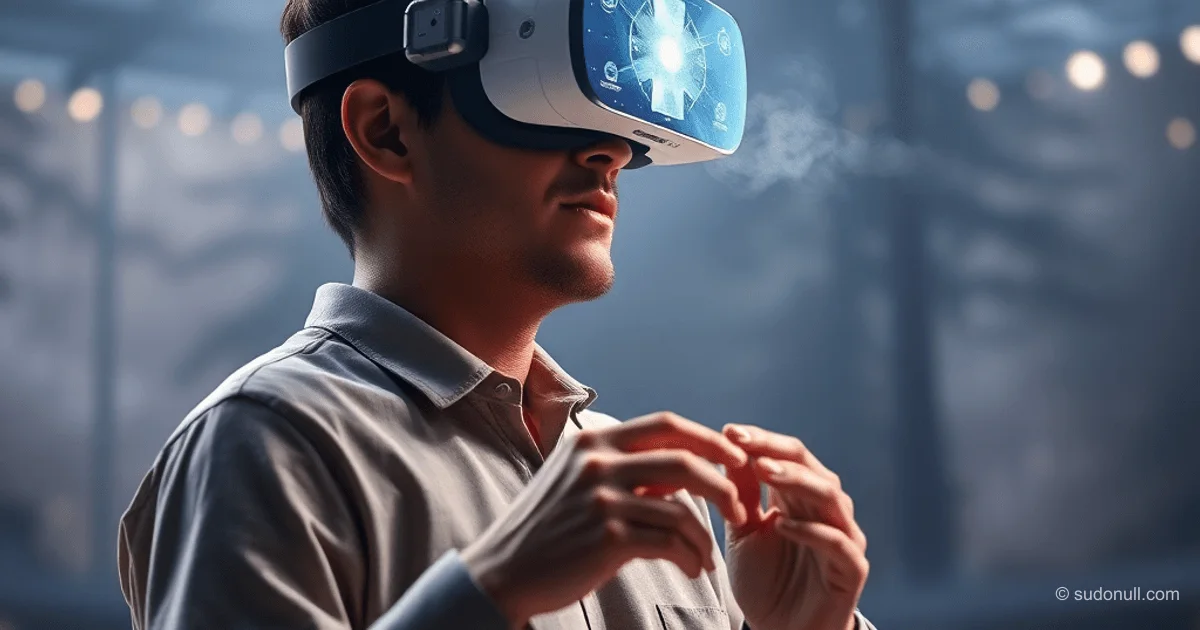
# Compact Olfactory Display for VR Headsets: Real-Time Mixing of Up to 8 Scents
Engineers from the Tokyo Institute of Science have created a compact device for VR headsets that synchronizes scents with visual and audio effects. The system mixes up to eight aromatic components in real time, adjusting intensity and proportions for precise reproduction. This solves the problem of bulky olfactory displays, enabling seamless integration into wearable VR devices without delays.
Smell enhances immersion in virtual reality by activating memory and emotions. The technology uses a micro-dispenser, an ultrasonic nebulizer based on surface acoustic waves, and an electroosmotic pump for dosage control. Liquid scents are transformed into a fine mist detectable by the olfactory system.
Technical Implementation and Components
Key elements of the system:
- Micro-dispenser: Dispenses micro-droplets of liquid scent with nanosecond-level precision.
- SAW Nebulizer (surface acoustic wave): Converts liquid into aerosol using ultrasound, minimizing particle size for quick perception.
- Electroosmotic Pump: Regulates substance flow, ensuring stable concentration without pulsations.
- Control Circuit: Size-optimized, processes signals from VR content for dynamic mixing.
Optimization focused on reducing latency: from signal to scent takes less than 100 ms. This is critical for synchronizing with dynamic VR scenes, such as flights or walks.
Testing included measuring concentration control accuracy. Experiments confirmed reproducibility of scent levels in the 0.1–10 ppm range, suitable for human perception without irritation.
Testing and User Experience
The prototype was integrated into a standard VR headset. Participants tested virtual locations: forest, ocean, city streets. Scents were generated based on content metadata—for example, pine for the forest or salt for the sea.
Results:
- Presence level increased by 40% on the IPQ (Igroup Presence Questionnaire) scale.
- Scent recognition delay—50–80 ms.
- Mixing stability: proportion deviation <5% with 8 channels.
Users noted the realism: scents enhance emotional engagement, especially in training simulations.
Applications in VR and Related Fields
The technology is suitable for:
- Training VR simulators (medicine, engineering).
- Memory therapy for the elderly: stimulation through familiar scents.
- Immersive perfume marketing.
- Gaming industry: dynamic scents in open-world games.
Comparison with the Stockholm display (a few years ago): the Japanese version is more compact (weight <50g), supports more channels, and real-time mixing.
Demos at conferences confirmed feasibility: the device is easily scalable for consumer VR.
Key Points
- The device mixes 8 scents in real time with latency <100 ms.
- Components: SAW nebulizer, electroosmotic pump, micro-dispenser.
- Testing: concentration accuracy 0.1–10 ppm, 40% increase in presence.
- Applications: VR training, therapy, gaming.
- Advantage: compactness and integration into headsets without modifications.
— Editorial Team










No comments yet.