Building an OLTP Core: API Contracts, Page Size, and Adaptive Tuning
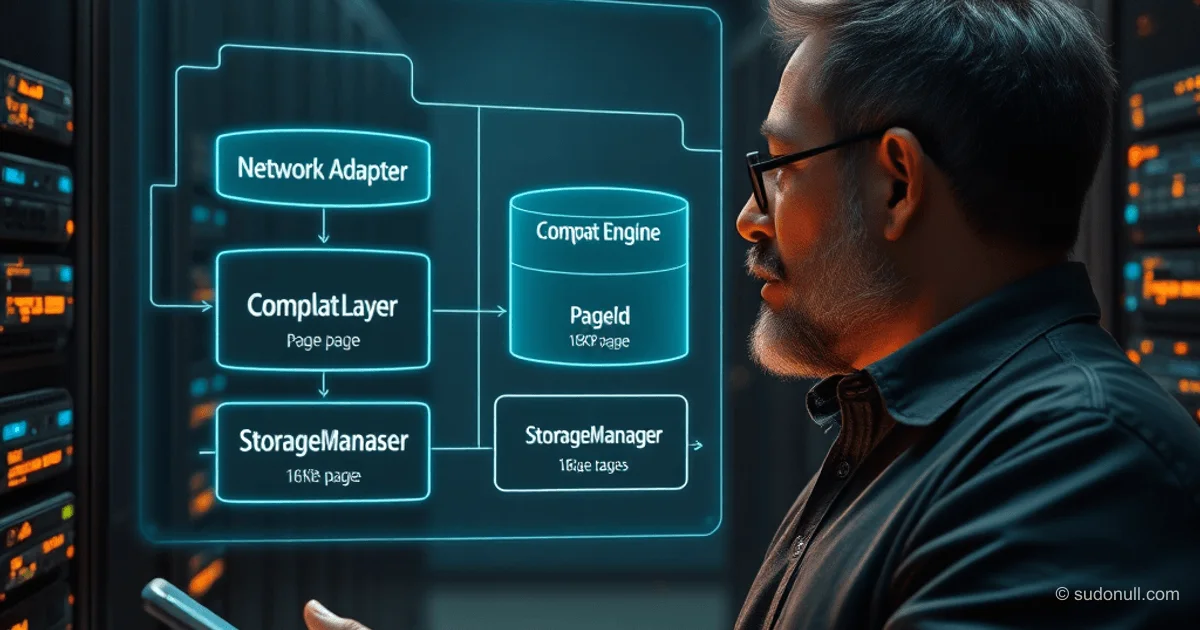
Developers of a new OLTP database implemented a strict architecture with isolated layers using trait interfaces in Rust. Each layer has clear API contracts, page size is configurable per tablespace, and configuration is managed by a Resource Broker without manual tuning. Diagnostics integrate via USDT and eBPF.
Page Size and Tablespace Settings
Data page sizes range from 4-8 KB for pure OLTP to 16-32 KB for HTAP on NVMe. Each tablespace is a separate file with a fixed page size after creation. Default is 16 KB. PageId is composite: [tablespace_id:16][page_index:48]. The BufferPool routes requests to sub-caches by size.
The superblock at the file start stores tablespace metadata independently of page size. On mount, it checks configuration; mismatches prevent startup without degradation.
Architectural Layers and API Contracts
The core is divided into four layers:
- Adapter Layer (async tokio): terminates TLS, parses wire protocol.
#[async_trait]
pub trait NetworkAdapter {
    async fn handle_connection(&self, stream: Box<dyn ConnectionStream>) -> Result<(), NetworkError>;
}- CompatLayer: parses SQL to AST, emulates pg_catalog, translates to LogicalPlan, rejects unsupported features (error 0A000).
pub trait CompatLayer {
    fn translate_query(&self, ast: SqlAst) -> Result<LogicalPlan, CompatError>;
}- Core Engine (sync): optimizer, executor, transaction manager. Runs in a spawn_blocking pool.
pub trait ExecutionEngine {
    fn execute_plan(&self, plan: LogicalPlan, session: &Session) -> Result<ResultSet, ExecutionError>;
}- StorageManager: facade over PageProvider and TransactionLogSink. Core requests pages and UNDO records.
pub trait StorageManager {
    fn pin_page(&self, page_id: PageId, mode: LockMode) -> Result<PageGuard, StorageError>;
    fn append_undo(&self, txn_id: TxnId, record: UndoRecord) -> Result<UndoPtr, StorageError>;
}
Layer boundaries prevent detail leaks: lock metrics exclude async waits.
Adaptive Tuning and Resource Broker
Around 60 parameters are split into budgets, guardrails, and overrides. Operators set high-level limits:
[resources]
memory_budget = "16GB"
cpu_budget    = "auto"
io_iops       = 5000
Advisors (MemoryAdvisor, IoAdvisor, CpuAdvisor) redistribute resources every second:
- CpuAdvisor: DOP and thread pool vs throttling.
- MemoryAdvisor: BufferPool vs work_mem under load.
- IoAdvisor: transaction priority, burst awareness in the cloud.
Safeguards
- Hysteresis: 5s window, 5% steps to avoid oscillations.
- Hard Floors: min. 128 MB for BufferPool/UNDO.
- Graceful Transition: new limits for new allocations.
- Expert overrides override autotuning.
Background UNDO log purge instead of VACUUM. Runtime changes without restart.
Diagnostics: USDT Probes and eBPF
Diagnostic mechanisms are baked into the binary. USDT probes for runtime analysis, eBPF for tracing with no overhead.
Key Takeaways:
- Page size per-tablespace with startup checks.
- Strict trait contracts between layers prevent leaks.
- Resource Broker: budgets → autotuning with guardrails.
- Diagnostics via eBPF/USDT in the core.
- Ditch manual tuning for adaptive mechanisms.
— Editorial Team










No comments yet.