Optimizing LIMS Onboarding: Reducing Turnover from 50% to 7% in Tube Sorting
In the laboratory's sorting department, staff turnover reached 50% during the 7-day probationary period. New hires made mistakes due to a non-intuitive interface, while experienced employees were overloaded. The development of onboarding for the LIMS system focused on metrics: Time-to-Productivity (reduced from 3 days to 1), Error Rate, and Turnover Rate. The key insight was that the sorter's attention is on the tube, with the screen used peripherally. This allowed training to be embedded into the workflow without interruptions.
The sorting process involves receiving batches of biomaterial, scanning barcodes, relabeling by test type (urgent, PCR, VIP), and placing tubes in racks. Errors at this stage lead to lost samples, delayed testing, and patient risks.
Interface Design Principles
Moving away from standard templates: pop-up tutorials disrupt the rhythm, and gamification is inappropriate in a professional setting. Instead, four principles were implemented:
- Peripheral Attention: Color cues and lights instead of reading text.
- Continuous Flow: Learning integrated into real work.
- Contextual Help: Hints during pauses, without stress.
- Incremental Responsibility: Interface adapts to experience level.
These rules account for employees' zero digital literacy and the physical dominance of the process.
Initial Screen Implementation
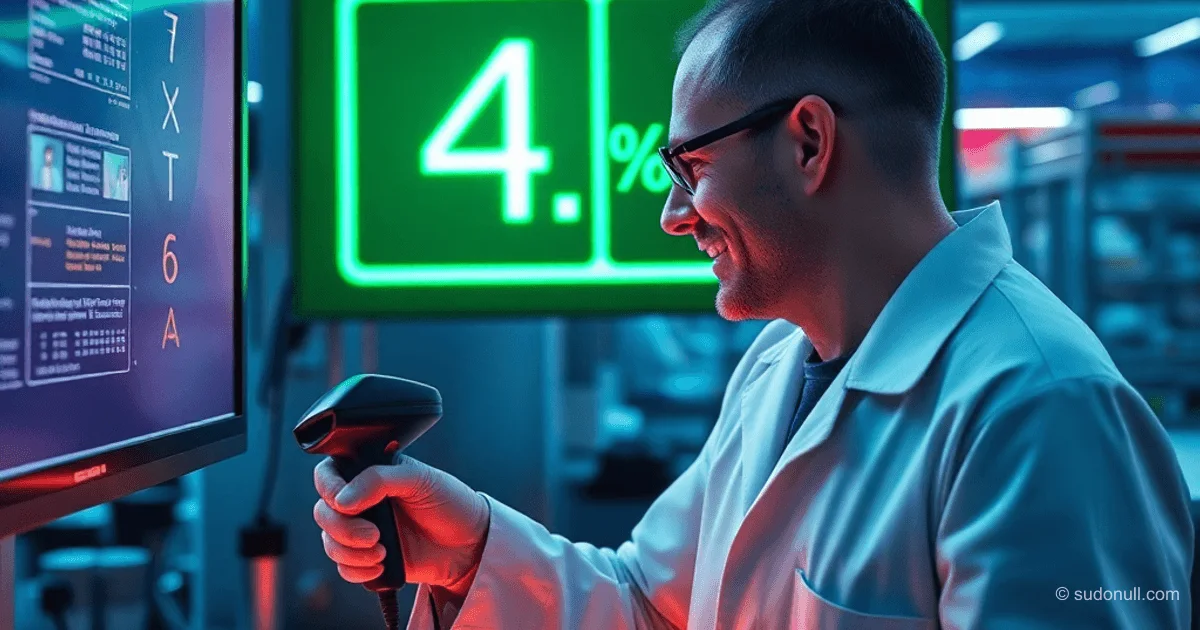
A new hire sees a large number "5" with the instruction: "Take a tube and scan the barcode." After each successful scan, the counter decreases, with a confirmation "Great job!" For errors—instructions to rescan or relabel. Upon completion—a visual effect to indicate mode deactivation.
First scan scenario:
1. Scan the barcode.
2. If OK: "Excellent, 4 more."
3. If error: "Apply a new barcode and scan."
This approach turns abstract training into a concrete goal achievable in minutes.
Color Markers and Deferred Help
The screen frame changes color for peripheral perception:
- Green: Success, continue.
- Yellow: Barcode or sequence error.
- Red: Quarantine, refer to supervisor.
Sounds are excluded for open-space environments. The system monitors pauses and errors: after 5 errors in 30 minutes—a gentle return to the "countdown from five" mode. Hints are displayed during lulls, reinforcing the action sequence.
Adaptation for Senior Roles
For shift supervisors, the interface evolves: blocks for managing quarantined samples and communicating with departments are added. Decision confirmation—holding the spacebar for 5 seconds with a progress bar. This ceremony emphasizes responsibility, with subsequent instructions moved to the wiki.
Measurable Implementation Results
After 3 months:
- Time-to-Productivity: From 3 days to 1.
- New Hire Error Rate: Down 35%.
- Turnover Rate: From 50% to 7% (1 resignation per 2–3 months).
- CSAT: 95% (feedback: "feeling of success from the first minute," "system helps, doesn't yell").
Stable pace and reduced buddy load improved the lab atmosphere.
Key Takeaways:
- Onboarding reduces turnover by integrating into the physical workflow.
- Color signals and counters provide peripheral feedback without distractions.
- Role-based adaptation prevents burnout of key employees.
- Metrics confirm ROI: TTP, errors, turnover.
- Future enhancements: Adaptive models based on behavioral patterns.
System Future Development
Planned:
- Adaptive onboarding predicting attention dips based on pace and style.
- ERP integration to optimize schedules by TTP.
- HCM linkage to assess potential based on behavioral patterns.
This will turn onboarding into a performance management tool.
— Editorial Team










No comments yet.