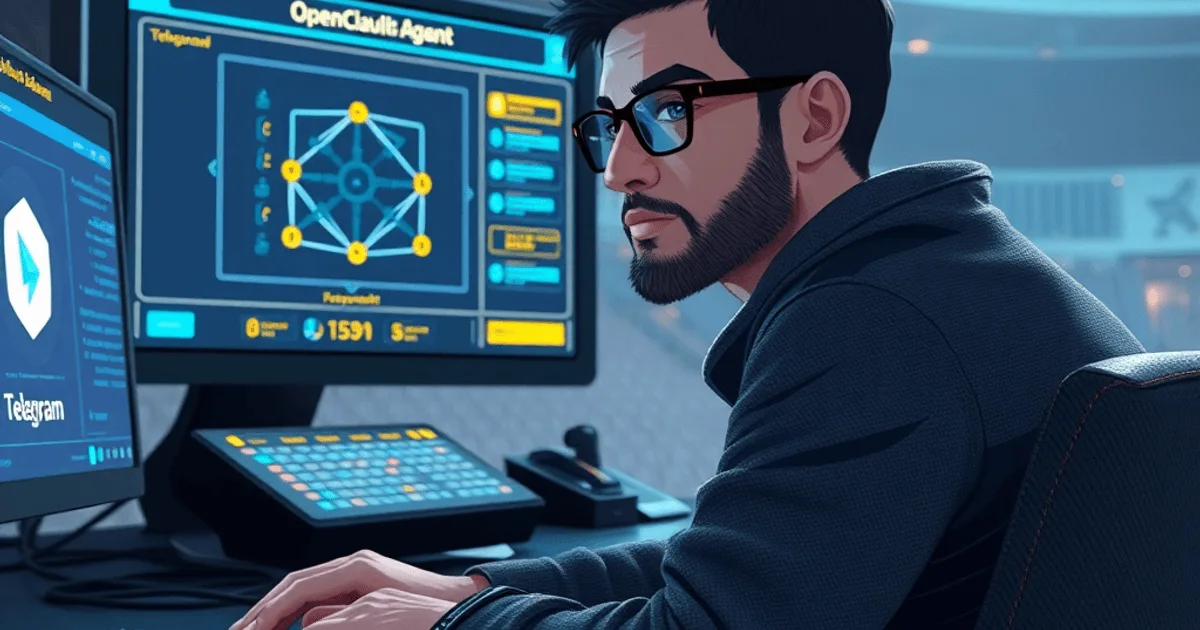
Multi-Agent Architectures in OpenClaw: From Orchestration to ACP Integrations
OpenClaw goes beyond a basic chatbot, delivering a full multi-agent system for distributing tasks among specialized performers. The platform lets you create persistent agents with isolated workspaces, spin up temporary subagents for specific jobs, and delegate coding to external tools via the ACP protocol.
Multi-Agent Architecture in OpenClaw
OpenClaw's multi-agent approach rests on three core concepts, each tackling a specific type of task:
- Standalone Agent — a persistent performer with its own workspace folder, memory, and role in the system. Ideal for long-term functions like research, text rewriting, or content publishing.
- Subagent — a temporary child process launched by the main agent for a one-off task. It works only with the provided context and shuts down after completion.
- ACP (Agent Control Protocol) — a mode that hands off coding tasks to external specialized tools like Codex, Claude Code, or Gemini CLI. OpenClaw acts as the session orchestrator.
This three-tier structure turns the main agent into a dispatcher, efficiently allocating work based on type, complexity, and required expertise.
Setting Up Persistent Agents in Practice
Creating a standalone agent starts with a workspace command, like Create a new Researcher agent with its own workspace. Next, link it to a communication channel. Use the Telegram Bot API with Link Researcher agent to Telegram bot [BOT API], or if Threaded Mode is enabled in BotFather, tie it to a specific topic in the chat: Link Researcher agent to current Telegram DM topic.
To use it, delegate from the main agent: Hand off market analysis task to Researcher agent. This makes the main agent the entry point, with specialized agents handling their domains—boosting context depth and quality for recurring tasks.
Strategies for Working with Subagents
Subagents shine for scenarios that don't warrant a full persistent agent. Key use cases include:
- One-Off Research:
Spin up a subagent to research multi-agents in OpenClaw and return only key takeaways. The agent handles the task and delivers a concise summary. - Parallel Processing of Complex Tasks:
Break this task across subagents: one for standalone agents, one for subagents and ACP, then synthesize a unified summary.The main agent parallelizes the work and compiles the final response.
This method cuts context management overhead for disposable ops and scales up handling of large info volumes.
Integrating External Tools via ACP
ACP is the most technically advanced—and powerful—layer. It taps specialized AI coding tools while OpenClaw manages the session and orchestration. First, install and authorize the target tool's CLI client (e.g., Codex) on the OpenClaw server.
ACP Operating Modes
- One-Shot Session:
Run this task via a one-shot ACP session and return a quick summary. Perfect for standalone engineering jobs without long-term context. - Persistent Context:
Create a persistent ACP session via Codex. Builds a session for multi-stage projects, though it can clutter a single chat. - Isolated Coding Room in Telegram:
Create a persistent ACP session and link it to Telegram topic https://t.me/c/1111111111/3. The top choice—spawns a dedicated topic (not a bot!) where technical context builds sequentially, separate from the main chat.
Orchestration as the Killer Feature
OpenClaw's true power emerges when the main agent coordinates the entire ecosystem. It can:
- Take a complex user task.
- Break it down into components autonomously.
- Delegate research to a persistent agent.
- Assign one-off analysis to a subagent.
- Offload coding to an external ACP tool.
- Aggregate results from all performers into a final deliverable.
This eliminates micromanaging every step, letting users focus on high-level directives.
Key Takeaways
- OpenClaw delivers three-tier multi-agent capabilities: persistent agents, subagents, and ACP integrations.
- Telegram—with bot and topic support—is perfect for visually and logically separating roles and workspaces.
- ACP unlocks specialized AI coding tools (Codex, Claude Code), elevating technical task quality.
- The main agent evolves from casual chat buddy to control center for a distributed workforce.
- Start with standalone agents, graduate to subagents, then tackle advanced ACP setups.
— Editorial Team










No comments yet.