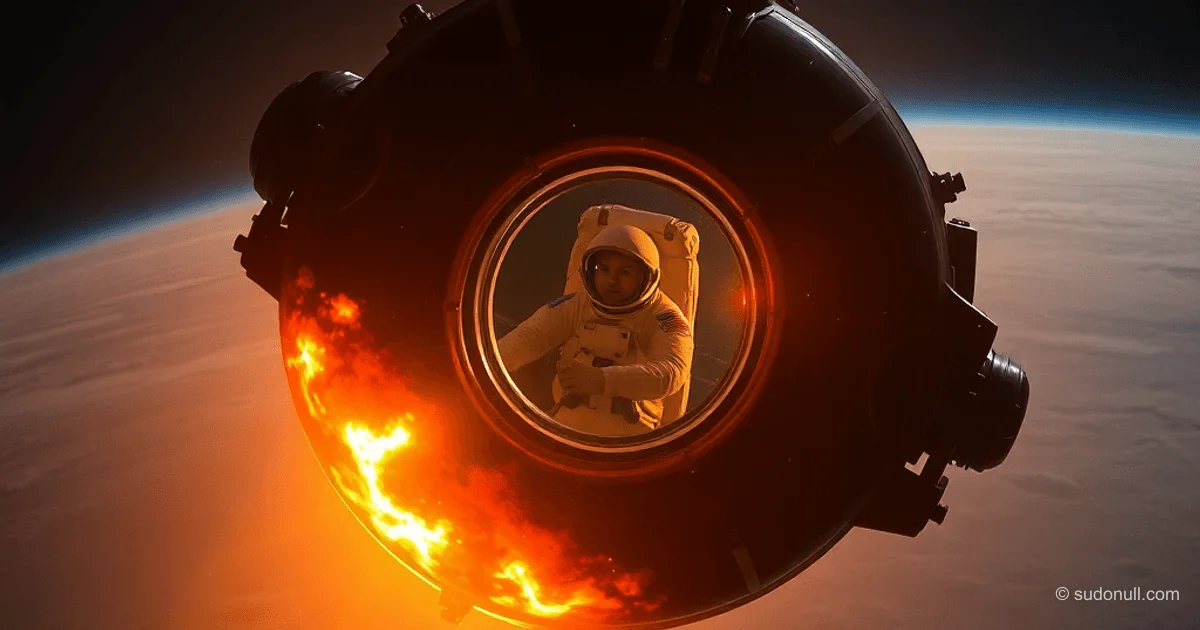
# Technical Failures of the Orion Capsule: Why Artemis Lags by Decades
The Orion capsule for the Artemis program has been in development since 2006—nearly 20 years to create a crewed spacecraft. The total budget has exceeded $30 billion, making it one of the most expensive capsules in history. For comparison, SpaceX's Crew Dragon reached orbit in 2020 after four years of development and costs orders of magnitude lower.
The marginal cost of a single Orion launch is estimated by NASA OIG at $1 billion. This is comparable to building a U.S. Navy nuclear submarine. The only uncrewed flight in operational configuration (Artemis I, 2022) revealed issues with the heat shield and systems, requiring an additional $5 billion and four years of fixes before Artemis II.
Comparison with Modern Analogs
The cost and timeline graph shows: Orion took four times longer and is six times more expensive than Crew Dragon. A modified Dragon on Falcon Heavy could perform a lunar flyby (analogous to Apollo 8) for $500 million—a month's Orion budget. Vulcan or New Glenn could also do this without modifications.
| Capsule | Development Timeline | Budget (inflation-adjusted) | First Crewed Flight |
|------------------|----------------------|-----------------------------|---------------------|
| Orion | 2006–2026+ | >$30 billion | 2026? |
| Crew Dragon | 2016–2020 | ~$3 billion | 2020 |
Meanwhile, HLS (Starship lunar lander) has been in development since 2021 for <$3 billion, tackling lunar landing—a more complex task than a flyby.
Technical Limitations of the Design
Orion is not capable of orbital maneuvers around the Moon (10 orbits like Apollo 8), limited to a 'there-and-back' trajectory. The heat shield has been only partially tested: full verification comes on Artemis II with four astronauts in deep space. Mass and life support systems are not yet optimized for reusable missions.
Artemis I issues:
- Overheating of the heat shield during atmospheric entry.
- Failures in the service module (ESA).
- Delays due to integration with SLS.
These are not isolated failures: the program is inherited from Constellation (canceled in 2010), with accumulated errors in the architecture.
Organizational Factors Behind the Failures
Criticism focuses on NASA's systemic problems: 'Dittemore's Law' describes degradation in science-intensive organizations, where bureaucracy stifles innovation. Former leaders (Loverro, Cook, Dambacher) promote outdated Boeing/Lockheed architectures, ignoring Constellation's failures ($100 billion with no results).
SpaceX, for $13 billion (government budget + their own), created a rocket 4 times more powerful than SLS and 100 times cheaper. China plans to land taikonauts by 2029, overtaking Artemis.
Key Points
- Orion Budget >$30 billion over 20 years without full certification for crewed missions.
- Launch Cost $1 billion—100+ times more expensive than analogs, without reusability.
- Technical Risks: heat shield and systems have not passed full deep space tests.
- Alternatives Ready: Dragon/Falcon Heavy for lunar flyby—available now, for $500 million.
- Geopolitical Context: falling behind China undermines U.S. leadership.
Outlook and Risks for Artemis II
Artemis II (2026?) will repeat Apollo 8, but with risks: first crewed week in Orion. Delays in HLS and SLS make things worse. Recommendations: pivot to commercial platforms to cut costs and speed things up.
— Editorial Team










No comments yet.