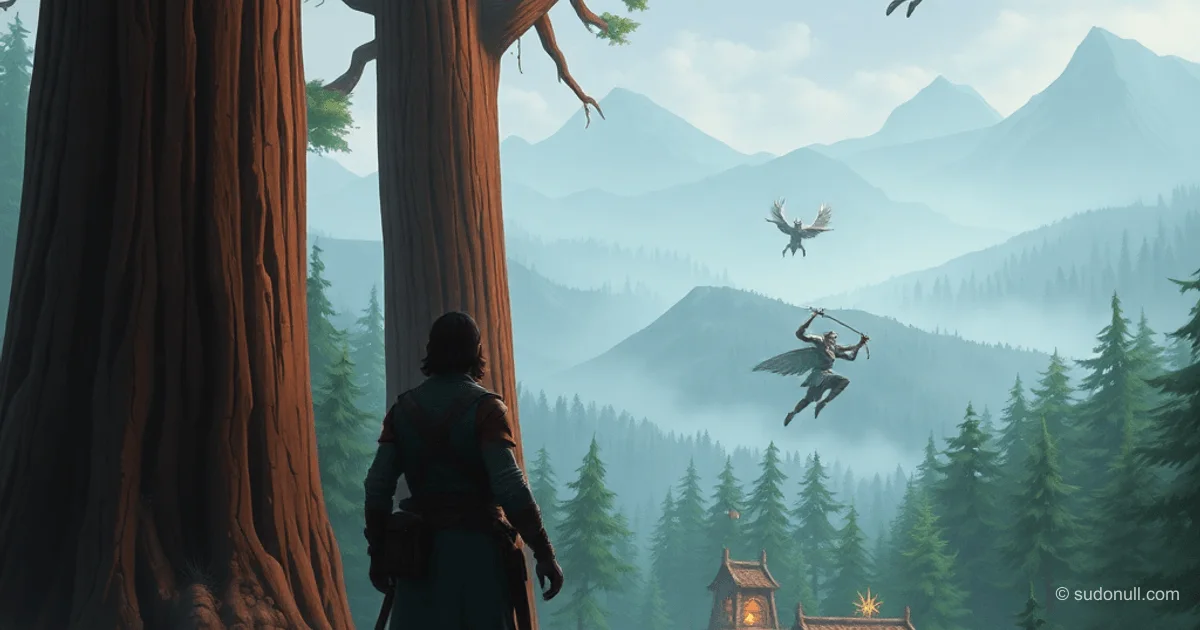
The Illusion of 3D in 2D Games: Parallax and Sprite Vertex Manipulation in Bridgebourn
A powerful blend of parallax scrolling and sprite vertex manipulation creates convincing depth in the isometric ARPG Bridgebourn. Solo developer 2HeadedHero built a painterly world without 3D models over 10 years, maintaining performance on Intel HD Graphics 4000. A free demo is available on Steam.
Bridgebourn fuses Diablo 2-style mechanics with custom spells and elemental reactions. The semi-open world of Fadelands is hand-drawn in layers, where every element is optimized for visual tricks. This isn’t just aesthetic—it reduces art and rendering costs dramatically, making a solo project feasible.
Using Parallax for Scene Depth
Bridgebourn’s parallax system uses a multi-layered structure: dozens of transparent layers move at different speeds relative to the camera. Foreground elements (grass, bushes) shift faster; distant ones (hills, sky) move slower—classic 2D platformer technique, enhanced for isometric perspective.
Key implementation details:
- Layers are sorted by Z-order from depth 0 to 1.
- Parallax speed scales with distance:
speed = base_speed * (1 - depth). - Transparency and blending ensure seamless transitions between planes.
As the camera glides above the scene, foreground sequoias accelerate while distant mountains remain nearly static. This approach avoids GPU strain compared to full 3D with occlusion culling.
Trade-off: requires manual layering of art. Each location consists of dozens of PNGs with pre-assigned depth, increasing asset volume but simplifying runtime rendering.
Sprite Vertex Manipulation
Sprite vertex manipulation deforms flat sprites using vertex shaders. Tree or tower vertices shift to simulate tilt, sway, or perspective—no mesh needed. One quad with a texture becomes a pseudo-3D object.
Example effect in shader (pseudocode):
vec2 vertices[4] = vec2(0.5, 0.5), vec2(-0.5, 0.5), ...);

for(int i=0; i<4; i++) {
  vertices[i].y += sin(time + vertices[i].x * freq) * amplitude * depth;
  vertices[i] *= perspective_matrix;
}
Tree tops deviate 5–10% from base position; grass sways procedurally. In combat, effects intensify: spell explosions add vertex offsets to nearby objects.
Trade-offs:
- Performance: Vertex shaders are cheaper than geometry shaders in 3D.
- Art: Sprites must be symmetric for natural deformation.
- Limitations: Not suited for complex animations (e.g., walking legs require skeletal systems).
Combined with parallax: parallax layers render first, then vertex shifts apply to foreground sprites. Camera follows a party of four heroes without artifacts.
Gameplay and Optimization
ARPG mechanics center around a hero party: manual control or AI commands. Custom spells combine elements (fire + ice = steam), triggering chain reactions. Loot, skill trees, narrative quests echo Diablo 2 meets Final Fantasy.
Minimal technical specs:
- CPU: 4-core 2.4 GHz (64-bit)
- RAM: 2 GB
- GPU: Intel HD 4000
- Storage: 1 GB
- Platforms: Windows 10+, macOS Sonoma (Intel), Steam Deck
Optimization stems from 2D design: no LOD, physics, or raytracing. Sprite manipulation at the vertex stage doesn’t bottleneck even on the Steam Deck after fixes.
What Matters
- Visual identity through clever tricks: Parallax + vertex shift replace 3D art, saving 90% on modeling resources.
- Solo long-term viability: 10 years of work possible with focus on core loop and aesthetics, avoiding scope creep.
- Accessibility: Free demo on Steam (app/2027760), co-op up to 4 players + Remote Play.
- Transparent trade-offs: Handcrafted art is costly to produce but cheap to run—ideal for indie devs.
Practical Insights for Mid/Senior Devs
This case study applies to Unity/Godot 2D projects: parallax setup takes 1–2 days, vertex manipulation needs a custom shader (~50 lines). Test on low-end hardware: target 60 FPS on HD 4000.
For ARPGs: integrate effects into combat—particle systems on parallax layers boost immersion without performance hits. Avoid overkill: 20–30 layers suffice for depth.
Bridgebourn proves: technical ingenuity beats high-end hardware. For the global indie scene, it’s a blueprint showing how niche styles (painterly + pseudo-3D) captivate Reddit and Steam audiences.
— Editorial Team










No comments yet.