How Metallicity Physics and Radiative Hydrodynamics Explain Variations in Type II Supernova Light Curves
Type II supernovae are not uniform explosions. Their light curves, rise times, amplitudes, and color evolution vary significantly. New two-dimensional radiative hydrodynamic simulations and analyses of stellar metallicity reveal the fundamental reasons for these differences: it’s not extreme mass loss but rather the density of the circumstellar medium and the pre-shock radiation from the shock wave that determine the nature of the breakout. This changes the interpretation of observational data and improves the accuracy of reconstructing progenitor parameters.
Metallicity as a Switch for Evolutionary Pathways
The key finding of the first study is the existence of a clear metallicity threshold that separates two evolutionary scenarios for massive stars. Researchers have determined that to transition into the red supergiant (RSG) phase, a star must have a metallicity of ≥ 0.1 Z⊙ (one-tenth of the solar metallicity). Below this threshold, the star remains compact—a blue supergiant (BSG)—even with masses of 20 M⊙ or more.
The reason lies in the physics of opacity and energy transport. Higher metallicity increases the abundance of heavy elements (C, N, O, Fe), which enhance radiation absorption in the core. This lowers the effective core temperature, slows down nuclear burning, and promotes expansion of the outer envelope even during helium fusion. As a result, the star quickly transitions into the RSG regime, with a radius up to 1,000 R⊙.
Conversely, at low metallicities (for example, in the early universe or in dwarf galaxies), the star maintains a compact structure. Its radius at the end of the main sequence (TAMS) remains small—less than 10 R⊙. Such stars undergo carbon and neon burning without significant expansion and explode as BSG progenitors, producing supernovae with markedly different spectral and photometric characteristics.
This has a direct observational consequence: in galaxies with lower metallicity (such as the Large Magellanic Cloud), the fraction of RSG progenitors is lower than in the Milky Way. Data confirm that over 90% of observed Type II supernovae have RSG progenitors specifically in intermediate-metallicity environments.
Shock Breakout: Not an ‘Explosion’ but a Diffusion Process
The second study focuses on the physics of the breakout itself—the first visible signal of collapse. Traditionally, it was believed that a delayed breakout (by several days) indicated extreme mass loss and the formation of a dense circumstellar envelope. However, new two-dimensional multi-group radiative hydrodynamic simulations refute this hypothesis.
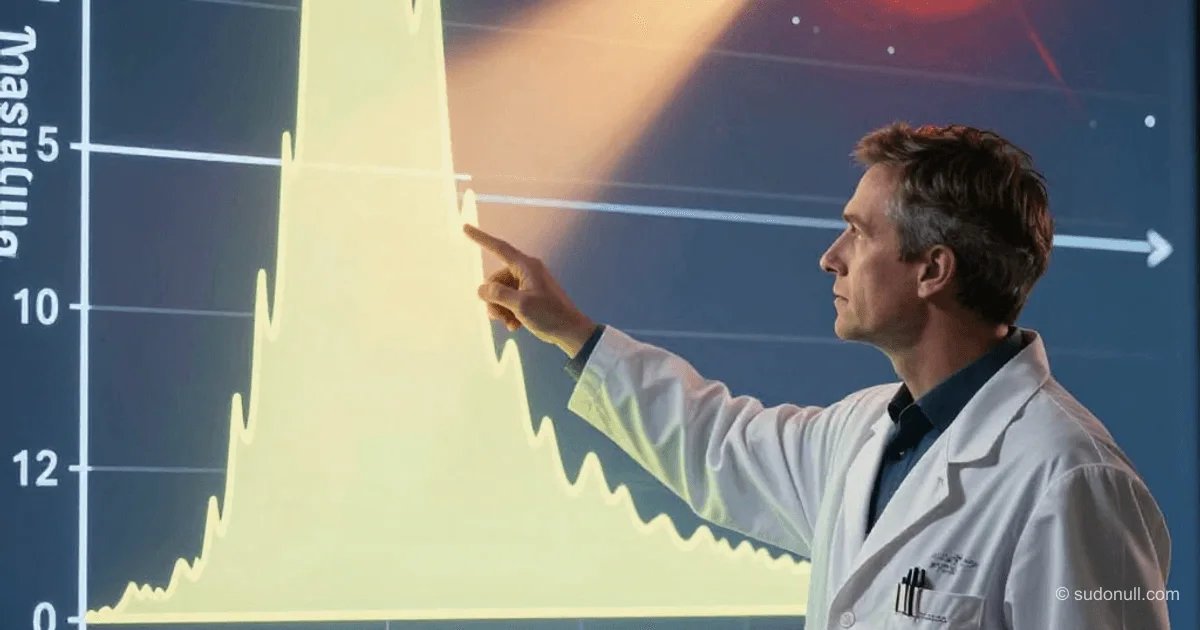
Modeling shows that the primary factor is not the envelope’s mass but its optical thickness and the pre-existing radiation generated by energy leakage ahead of the shock front. As the shock wave moves through the outer layers, some of its energy is emitted as soft X-ray and UV radiation. This radiation heats and ionizes the surrounding gas, causing it to expand and pushing the photosphere outward—beyond the star’s geometric surface.
The result is the formation of an expanded yet low-density “pre-breakout photosphere.” It is this feature that determines the nature of the breakout:
- The rise time of the light curve slows down: photons diffuse through a larger medium.
- The peak brightness decreases: energy is spread over a larger area.
- The color becomes “redder”: the effective photospheric temperature drops due to expansion.
Thus, the same mechanism—pre-existing radiation—explains three observable effects previously attributed to different causes.
Critical Parameters Affecting the Light Curve
Analysis of the two studies identifies four key physical parameters that determine the shape of a Type II supernova’s light curve:
- Stellar progenitor metallicity (Z)—determines the initial radius and evolutionary pathway (RSG vs. BSG).
- Optical thickness of the outer envelope (τ)—directly controls photon diffusion time and breakout width.
- Intensity of pre-existing radiation (L_pre)—depends on shock velocity and local opacity; governs photospheric displacement.
- Geometric asymmetry (ε)—two-dimensional models reveal Rayleigh–Taylor instability at the interface between the shock wave and the envelope, leading to localized acceleration of the breakout in certain directions.
These parameters are not independent: for example, high metallicity → large radius → high τ → strong L_pre → pronounced photospheric shift. This creates correlations in the observed data that can now be quantitatively modeled.
What Matters
- Metallicity ≥ 0.1 Z⊙ is a necessary condition for forming a red supergiant; below this threshold, stars remain compact and explode as blue supergiants.
- Delayed shock breakout is caused not by the envelope’s mass but by its optical thickness and pre-existing radiation, which displaces the photosphere.
- The first two-dimensional multi-group radiative hydrodynamic simulations demonstrate that breakout asymmetry is a natural consequence of Rayleigh–Taylor instability, not an artifact of one-dimensional models.
- An expanded photosphere reduces peak brightness and makes the spectrum redder, which is critical for correctly interpreting data from the Vera C. Rubin Observatory.
- These mechanisms allow for unified interpretation of supernova light curves observed across different metallic environments—from nearby galaxies to high redshifts.
Preparing for the Data Flood: From Theory to Observations
The launch of the LSST (Legacy Survey of Space and Time) project at the Vera C. Rubin Observatory will change the paradigm of supernova research. About 10 million events are expected over 10 years. Most will occur at z > 0.5, where spectroscopic identification is difficult. In this context, photometric light curves become the primary source of information.
The two presented studies provide a physically grounded model that allows inverting observed light curves back to progenitor parameters: metallicity, radius, mass-loss rate, and degree of asymmetry. For example, if a slow, faint, and reddish breakout is observed, it likely corresponds to an RSG with Z ≈ 0.5–1.0 Z⊙ and τ > 100. If the breakout is sharp and blue, it probably indicates a BSG with low metallicity and τ < 10.
The key advantage is moving away from empirical templates toward physical modeling. This increases the reliability of parameter reconstruction and enables detection of anomalies that point to new physical processes—for example, interactions with hidden companions or unusually strong magnetic fields.
For technical specialists, it’s important to understand that these models require solving a system of radiative hydrodynamics equations in a multi-group approximation. They use adaptive grids that account for both deep layers (where neutron flux dominates) and the outer atmosphere (where detailed spectral groups in the 0.1–100 eV range are crucial). Computational complexity remains high: a single two-dimensional simulation takes about 200,000 CPU hours on an AMD EPYC-based cluster.
— Editorial Team










No comments yet.