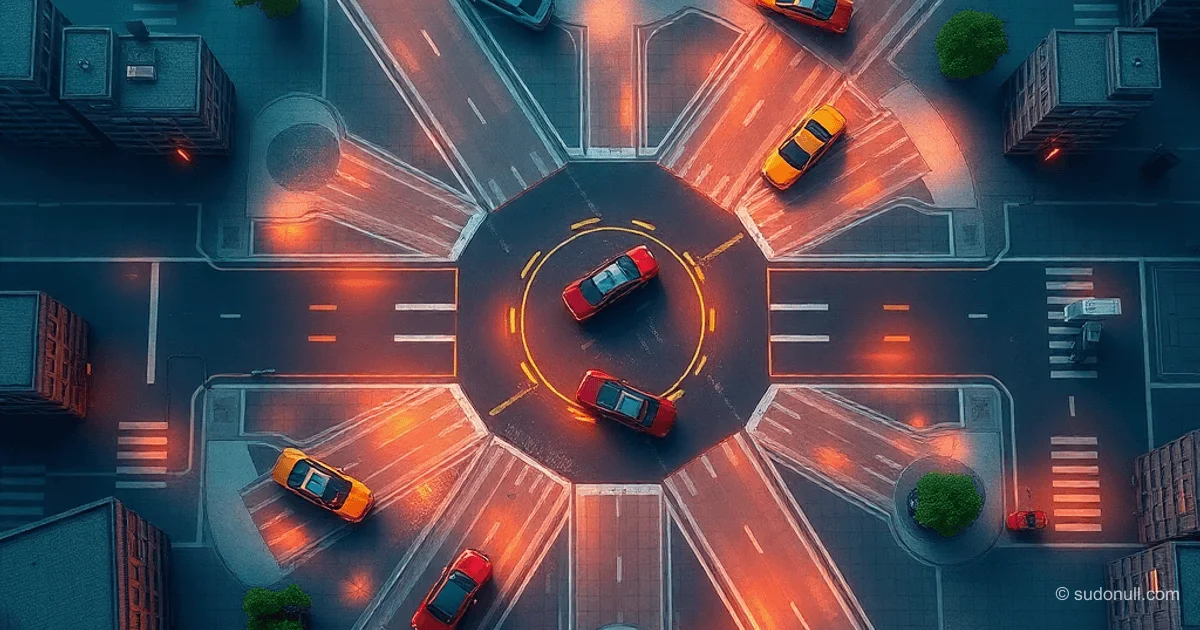
Traffic Simulation in Pizza Tycoon: Running Smoothly at 25 MHz
In Pizza Tycoon, traffic is handled by a straightforward system that runs on a 386 processor clocked at 25 MHz. Each vehicle moves one pixel per game tick. The main loop checks for obstacles and adjusts coordinates: +1 to X when heading east, -1 to Y when going north.
The progress counter counts down from 16 to 0. When it hits zero, it resets to 16 and triggers tile boundary logic: picking a direction and updating the sprite. 16x16 pixel tiles keep everything in sync—heavy calculations happen 16 times less often than pixel-by-pixel movement.
At spawn, progress is randomized (1–16) to spread the load across frames.
Road Layout and Direction Rules
Maps are a 160x120 grid of tiles from landsym.vga. Roads are one-way: tile 0x16 goes east, 0x06 goes west, 0x26/0x36 handle vertical paths.
Corners add branching. Tile 0x56 (CORNER_SW) allows west or south. Choice: 50% turn/straight. Banning two left turns in a row keeps things natural.
Maps are designed logically—adjacent tiles always support valid paths.
- Straight tiles: Fixed direction.
- Corners: Probabilistic choice with anti-looping.
- T/X intersections: Corner combinations.
Collisions via Pairwise Checks
O(n²) for 25 vehicles means 625 checks per frame. Optimization: early exit by direction. East+west pairs bail out without coord checks, since one-way roads prevent head-ons.
Checks:
- Directions (cuts half the pairs).
- Lane (same road match).
- Coordinate math (rare, <10 pairs).
Collision → pause 10 ticks. Jams clear naturally: lead vehicle moves first.
Bugs (clipping through) are a side effect of optimizations, fine for visual sim.
Vehicle Spawning and Recycling
Entering street mode: scan 132 tiles (12x11). For roads, roll dice based on neighborhood density. Corners excluded.
Exiting screen: replace with new vehicle of opposite direction/color on same tile. Scrolling handles new lanes similarly.
// Spawn pseudocode
for each road_tile in viewport:
  if random(traffic_density) > threshold:
    spawn_car(tile, random_direction, random_progress)
Disassembling Assembly and Modern Pitfalls
The Pizza Legacy author spent 14 years on overkill graphs, A*, and collisions. Original is simpler: tiles dictate paths, no physics/speeds.
Assembly analysis + LLM revealed the mechanics. Restoration: switch in decide_desired_direction (Car.cpp) by tile types.
| Approach | Complexity | Efficiency |
|----------|------------|------------|
| Original | Simple rules | 25 MHz, 30 vehicles |
| Modern | Graphs, physics | Deadlocks on 2010+ CPUs |
Key Takeaways
- One-way tiles eliminate pathfinding.
- Early collision exits minimize loops.
- Pixel-by-pixel movement + infrequent updates = low CPU load.
- Probabilistic turns + anti-looping = realism without AI.
- Vehicle recycling skips list management.
— Editorial Team










No comments yet.