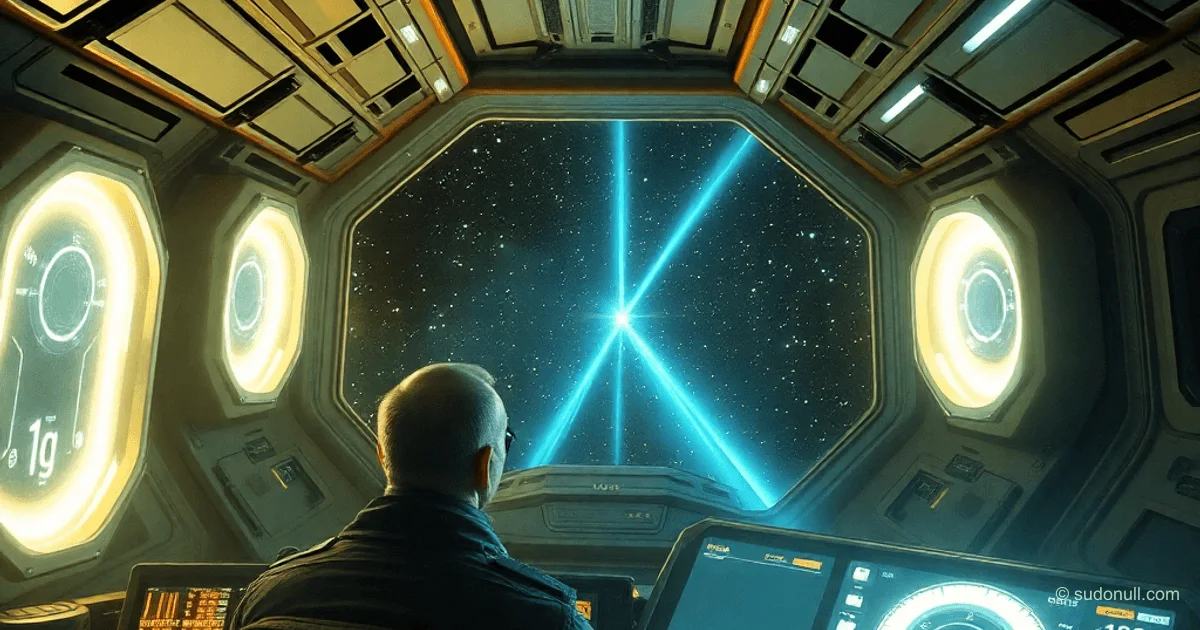
Portal Starship: Wormhole Propulsion with Negative Mass
A starship could reach the nearest stars in decades with constant 1g acceleration. After a year of such thrust, it hits about 0.5c, covering the distance to Alpha Centauri in roughly 10 years. The catch? Reaction mass: you have to accelerate it along with the ship, demanding exponentially growing fuel reserves. The fix: an external accelerator that doesn't store mass onboard.
A wormhole-based portal delivers a particle acceleration stream straight to the starship, dodging beam divergence over interstellar distances.
Properties of Negative Mass
Wormholes need negative mass for stability. A.G. Shklovsky's theory suggests these "shadow" particles are part of ordinary matter, like in π±-mesons (positive-mass quark + negative-mass quark). Shadow particles differ from antiparticles: their mass is negative, but charge keeps its sign.
Like-charged shadow particles attract via Coulomb's law, with force >> gravity. This lets us form dense objects for portals controlled by electric fields.
Electric field from charge Q:
$$ \vec{E} = \frac{1}{4\pi\epsilon_0} \frac{Q}{r^3} \vec{r} $$
Force on particle with charge q and mass m = -|m|:
$$ \vec{F} = q \vec{E}, \quad \vec{a} = \frac{\vec{F}}{m} $$
x-projection: F > 0 (rightward), but a < 0 (toward Q) due to negative m. Attraction achieved.
Gravitational field:
$$ \vec{g} = G \frac{M}{r^3} \vec{r}, \quad \vec{F} = m \vec{g}, \quad \vec{a} = G \frac{M}{r^3} \vec{r} $$
Acceleration is independent of the particle's m sign but depends on source M. Negative mass repels positive mass gravitationally, hindering self-organization, but electricity compensates.
Momentum Transfer Through the Portal
The portal consists of two gates (entrance/exit) linked by a shortcut. A particle enters the first, exits the second with reversed direction—momentum flips.
From momentum conservation: the gates get recoil. The portal path's projection on our metric is tachyonic motion, but without interactions.
Model: particle collides with entrance → tachyon → collides with exit → particle. Direction set by gate orientation.
Portal Sail Principle
Exit gate oriented so particles reflect backward, imparting momentum to the ship—like a laser sail, but without dispersion.
Advantages:
- Stream density holds over dozens of light-years.
- Maneuvering: rotate gates or reflector.
- Deceleration: reverse orientation.
- Communication: real-time channel via portal.
Even without gate rotation, an exit mirror ensures reflection.
Efficiency of the Acceleration Beam
Laser photons have minimal divergence but low momentum (p = E/c). Chemical/ion engines deliver 1g briefly due to exhaust mass.
Thrust efficiency: p = m * v_exh. Peak at v_exh ≈ c, but photons lose to massive particles at same energy (p_ion >> p_photon).
The portal delivers heavy particle streams (ions, protons) loss-free.
Key Takeaways
- Negative mass from shadow particles enables electrically controlled wormholes.
- Portal transfers momentum via gate impulse change, reflecting the stream.
- Solves laser sail issues: beam spread, maneuvers, braking, comms.
- More energy-efficient than photons thanks to massive particles.
- Alpha Centauri flight: ~10 years at 1g.
— Editorial Team










No comments yet.