Qucs - open-source CAD for electronic circuit simulation
Currently there are not many open-source CAD systems. However, there are some pretty decent products among CAD for Electronics (EDA). This post will be about the Qucs open source electronic circuit designer . Qucs is written in C ++ using the Qt4 framework. Qucs is cross-platform and released for Linux, Windows and MacOS.
The development of this CAD system began in 2004 by the Germans Michael Margraf and Stefan Jahn (currently not active). Now Qucs is being developed by an international team, which includes me. Project managers are Frans Schreuder and Guilherme Torri. Under the cut will be talked about the key features of our circuit simulator, its advantages and disadvantages compared to peers.
The main program window is shown in the screenshot. There, a resonant amplifier on a field-effect transistor was simulated and waveforms of the voltage at the input and output and also the frequency response were obtained.
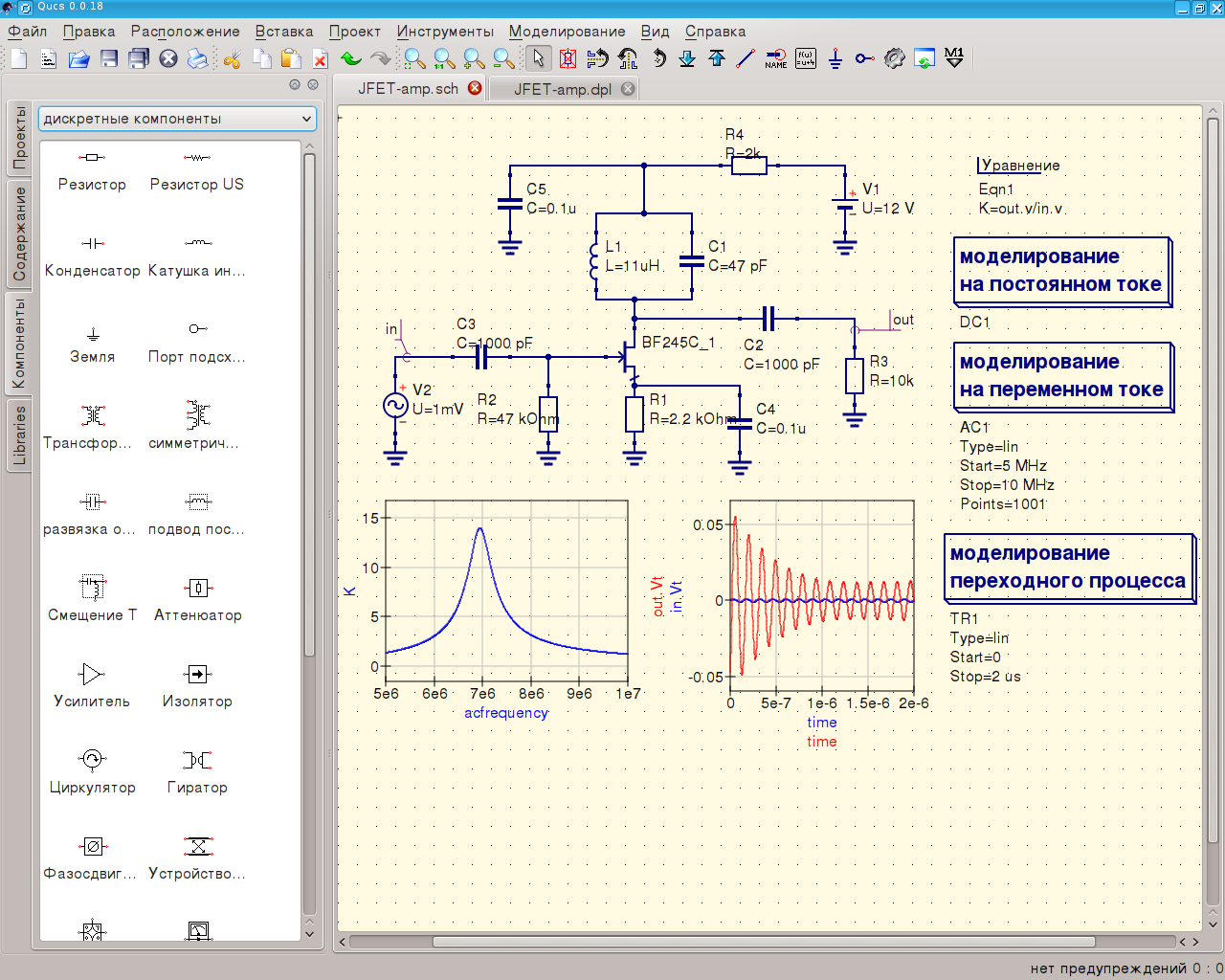
As you can see, the interface is intuitive. The central part of the window is occupied by the actually simulated circuit. Components are placed on the diagram by drag and drop from the left side of the window. Simulation types and equations are also special components. The principles of editing circuits are described in more detail in the documentation for the program.
The Qucs schema file format is XML-based and comes with documentation. Therefore, the Qucs schema can be easily generated by third-party programs. This allows you to create circuit synthesis software, which is an extension of Qucs. Proprietary software typically uses binary formats.
We list the main components available in Qucs:
The component library uses its own XML-based format. But you can import existing Spice-based component libraries (provided in datasheets for electronic components).
The following types of modeling are supported:
Simulation results can be exported to Octave / Matlab and post-processed.
Qucs is based on the newly developed circuit modeling engine. A distinctive feature of this engine is the built-in ability to simulate S-parameters and SWR, which is important for the analysis of RF circuits. Qucs can convert S parameters to Y and Z parameters.
The screenshots show an example of modeling the S-parameters of a high-frequency broadband amplifier.

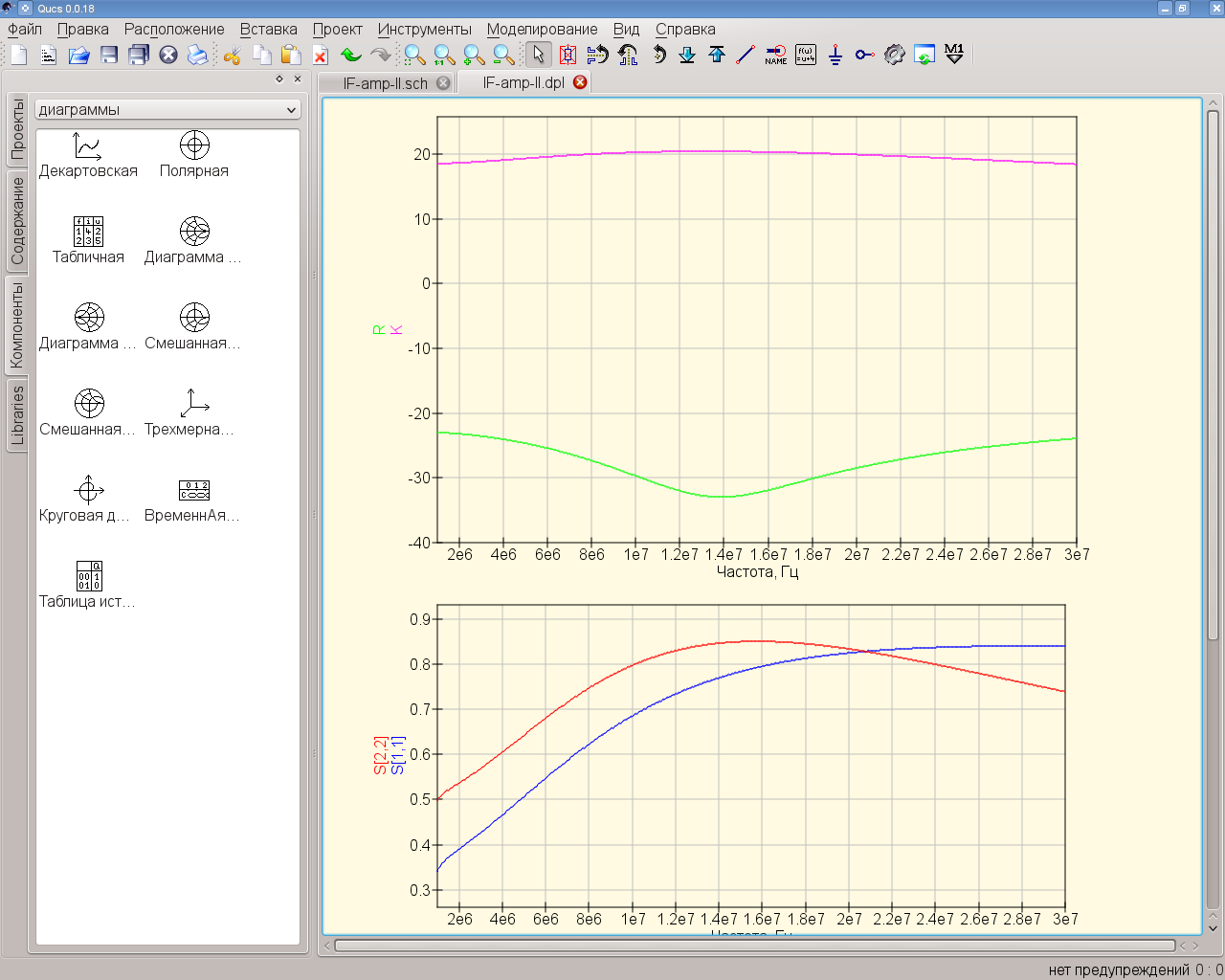
So, a distinctive feature of Qucs is the ability to analyze complex frequency characteristics (CFC), graphing on the complex plane and Smith diagrams, analysis of complex resistances and S-parameters. These features are absent in the proprietary MicroCAP and MultiSim systems, and here Qucs even surpasses commercial software and allows to obtain results unattainable for simulators of electronic circuits based on Spice.
The disadvantage of Qucs is the small number of library components. But this drawback is not an obstacle to use, since Qucs is compatible with the Spice format in which models of electronic components in datasheets are presented. Also, the modeler is slower than similar Spice-compatible modelers (e.g. MicroCAP (proprietary) or Ngspice (open-source)).
We are currently working on the possibility of providing the user with a choice of engine for modeling the circuit. You can use the built-in Qucs engine, Ngspice (a spice-compatible console simulator similar to PSpice) or Xyce (a simulator with support for parallel computing via OpenMPI)
Now let's look at a list of innovations in the recent release of Qucs 0.0.18 promising areas in the development of Qucs:
We can conclude that, despite its shortcomings, Qucs is a very worthy alternative to proprietary CAD for modeling electronic circuits.
Qucs resources:
Project site: qucs.sourceforge.net
Github repository: github.com/Qucs/qucs
Domestic components library for Qucs: github.com/ra3xdh/qucs-rus-complib
The development of this CAD system began in 2004 by the Germans Michael Margraf and Stefan Jahn (currently not active). Now Qucs is being developed by an international team, which includes me. Project managers are Frans Schreuder and Guilherme Torri. Under the cut will be talked about the key features of our circuit simulator, its advantages and disadvantages compared to peers.
The main program window is shown in the screenshot. There, a resonant amplifier on a field-effect transistor was simulated and waveforms of the voltage at the input and output and also the frequency response were obtained.
As you can see, the interface is intuitive. The central part of the window is occupied by the actually simulated circuit. Components are placed on the diagram by drag and drop from the left side of the window. Simulation types and equations are also special components. The principles of editing circuits are described in more detail in the documentation for the program.
The Qucs schema file format is XML-based and comes with documentation. Therefore, the Qucs schema can be easily generated by third-party programs. This allows you to create circuit synthesis software, which is an extension of Qucs. Proprietary software typically uses binary formats.
We list the main components available in Qucs:
- Passive RCL Components
- Diodes
- Bipolar transistors
- Field effect transistors (JFET, MOSFET, MESFET and microwave transistors)
- Ideal Op Amps
- Coaxial and microstrip lines
- Library components: transistors, diodes, and microcircuits
- File components: subcircuits, spice subcircuits, Verilog components
The component library uses its own XML-based format. But you can import existing Spice-based component libraries (provided in datasheets for electronic components).
The following types of modeling are supported:
- DC Modeling
- Modeling in the frequency domain on alternating current
- Time domain transient modeling
- Modeling S-parameters
- Parametric analysis
Simulation results can be exported to Octave / Matlab and post-processed.
Qucs is based on the newly developed circuit modeling engine. A distinctive feature of this engine is the built-in ability to simulate S-parameters and SWR, which is important for the analysis of RF circuits. Qucs can convert S parameters to Y and Z parameters.
The screenshots show an example of modeling the S-parameters of a high-frequency broadband amplifier.
So, a distinctive feature of Qucs is the ability to analyze complex frequency characteristics (CFC), graphing on the complex plane and Smith diagrams, analysis of complex resistances and S-parameters. These features are absent in the proprietary MicroCAP and MultiSim systems, and here Qucs even surpasses commercial software and allows to obtain results unattainable for simulators of electronic circuits based on Spice.
The disadvantage of Qucs is the small number of library components. But this drawback is not an obstacle to use, since Qucs is compatible with the Spice format in which models of electronic components in datasheets are presented. Also, the modeler is slower than similar Spice-compatible modelers (e.g. MicroCAP (proprietary) or Ngspice (open-source)).
We are currently working on the possibility of providing the user with a choice of engine for modeling the circuit. You can use the built-in Qucs engine, Ngspice (a spice-compatible console simulator similar to PSpice) or Xyce (a simulator with support for parallel computing via OpenMPI)
Now let's look at a list of innovations in the recent release of Qucs 0.0.18 promising areas in the development of Qucs:
- Improved Verilog compatibility
- Porting to Qt4 continues
- Implemented a list of recently opened documents in the main menu.
- Implemented the export of graphs, schemes in raster and vector formats: PNG, JPEG, PDF, EPS, SVG, PDF + LaTeX. This feature is useful when preparing articles and reports containing simulation results.
- Ability to open a schema document from a future version of the program.
- Fixed bugs related to the freezing of the modeler under certain conditions.
- A synthesis system for active filters for Qucs is being developed (expected in version 0.0.19)
- Interfacing with other open-source engines for modeling electronic circuits ( Ngspice , Xyce , Gnucap) is being developed. In future versions, the ability to select an engine for modeling the circuit will be added.
We can conclude that, despite its shortcomings, Qucs is a very worthy alternative to proprietary CAD for modeling electronic circuits.
Qucs resources:
Project site: qucs.sourceforge.net
Github repository: github.com/Qucs/qucs
Domestic components library for Qucs: github.com/ra3xdh/qucs-rus-complib