September 8, 2014 at 13:18
Office Evolution History

What first comes to mind when you hear the word “office”? Probably the images: office rooms, soft chairs, the clicking of keys, office gossip, the smell of stale coffee and people so busy that when they type on their computers they don’t even think about smiling. So, all this has remained in the past ... With the development of new technologies in general, the concept of "office space" has undergone drastic changes. Now a startup or freelancer goes to “his office”, where everything is arranged for his convenience. Deskmag's 2013 survey
results are astounding:
- 50% of all employees use the workplace around the clock
- 71% report an increase in their own creativity after moving
- 62% said their working conditions improved
- Nearly 90% of employees reported increased self-confidence
- 70% of employees feel healthier than when working in a traditional office
- Between one third and half of all workers are flexible and mobile.
- 64% of employees stopped breaking deadlines
So what is before us? Let's figure it out!
Humanity has tried to make office work more productive since the inception of offices and continues today. Few people know how fascinating and confusing this path was. IMHO the history of the organization of mental labor can be divided into two stages. The first - from the 18th century to 1900, the second - from the beginning of the twentieth century to the present. And from the beginning of the 20th century to the present day, only five types of office organization have been created.
Just until 1900, office workers around the world had less than 300,000 people, and they were scattered across enterprises, markets, exchanges, factories, and manufactories. In fact, until the twentieth century, the office was just a desk and a chair.

Generally the first office building in history - East India Housein London. Colony management has grown so much that thousands of office clerks were required for paper work alone. All of them had to be gathered in one place and provided them with ideal working conditions. That is how the rapid evolution of offices began, the purpose of which was to create the most free and convenient spaces for work.
Studying the history of offices, I unexpectedly discovered for myself that the center and foundation of any office is an office chair. The one sitting on which you read these lines. The fact is that until the middle of the twentieth century, an ordinary armchair was ... a luxury!

Interior of the House of India. The board sits on chairs.

All the same House of India. People simply presses on benches.
So, the final birth of world mass culture took place in the 60s. And do you know why at this time? Plastic. In the 60s, cheap chairs were stamped. Everyone could buy a miracle for 9 bucks and fall apart for pleasure. Before this, 5% of people had chairs, and 20% of the house didn’t even have chairs. We sat on stools, or even on drawers. All life.


It is because of the “piece” that the history of the office chair is very interesting. Even Protagoras claimed that man is the measure of all things. Consequently, all architecture comes from human proportions, which means that the simplest (but full-fledged!) Architectural element is a chair. It is no accident that every famous architect was noted in history by the creation of his chair, and each architectural era can be expressed through this element of furniture.
Actually, the first cabinet maker Thomas Chippendale was the first to make the chair “affordable and functional” in 1760. He was the first in history to make inexpensive chairs of simple design. "Folk chairs" caused such a sensation that they made the author's surname a household name. The animated series "Chip and Dale" was named in honor of these chairs.

But you understand that the massive chairs caused a response wave of folk art. On the basis of the Chipendale chair, none other than Voltaire makes a powerful leap forward - he is the first to guess to put the chair on wheels, so as not to get up every time with the necessary piece of paper. On the right, Voltaire attached a board that rotated and was intended for writing. On the left was a box in which paper, a pen and an inkwell were stored. This design was equally convenient for both leisure and work.

Subsequently, it began to be called the “Voltaire armchair” - it has been preserved and is now located in the Hôtel Carnavalet Museum in Paris.
Towards the end of the 18th century, a wheeled chair was very common and subsequently only improved. During this period, it became a direct attribute of workrooms. Such seats were often included with a bureau or desk. Wheelchairs were made of wood, were wicker and bent. Cast iron armchairs were rare.

Here's an example of Charles Darwin’s office. As you can see, all the furniture is on wheels. For its time it was like anti-gravity - the future is here and now!

The third inventor on the way to the modern armchair is considered the third US President Thomas Jefferson. This event dates back to 1779 - then Jefferson guessed to make the chair spinning.
But a real office chair was born only at the London World's Fair in 1851.


This chair was the apotheosis of ergonomics and immediately had all the functions of maintaining comfort - it could be tilted, rotated and adjustable in height. Now you could spend at least an entire day at the office desk and not get tired.
Surprisingly, the chair provoked great protest from the church - after all, the chair violated the main commandment of Victorian morality - it allowed to work with pleasure, while the church and the queen advocated humility. It was believed that working on an uncomfortable stool without a back is the only way to demonstrate your sophistication and willpower, and therefore your high morality.
But progress was unstoppable. At the same exhibition in 1851 the world saw the main chair in history, consisting only of bent beech elements, serving for 30-50 years! The miracle of engineering was shown by the Germans.

Vienna chair . The simplest, cheapest, strongest and most comfortable chair in history - it was made possible by the ingenious technology of bending under steam of a beech tree. Otto von Bismarck considered him the most important invention of the German people, who ordered to equip such chairs not only the parliament, but also all state institutions.
He is light, elegant, concise! It has only 6 elements. This simplicity was revolutionary. Vienna chair was the first sign in the mass production of cheap goods.

The parts are fastened together with screws. Unassembled in a box with a capacity of 1 cube. m. fits 36 (!) chairs. This was also a new word in the transportation of goods.

In order to show the strength of chair number 14, it was dropped from the Eiffel Tower. The chair remained unharmed!
So Europe and America chose different paths of office building, and two chairs became symbols of two cultures. Europe showed humility in Viennese chairs, Americans rode through skyscrapers in their office chairs.

Tesla in his laboratory sits on an American classic.
By this time, two remarkable events in architecture had occurred - the Chicago fire and the steel beam. Once in one place at one time, they gave birth to a new kind of architecture.

In 1871, Chicago burns to the ground. The year before, America’s steel mills were moving to a standard steel beam, the price of which was beginning to decline rapidly.
| 1867 | 1870 | 1875 | 1880 | 1885 | 1890 | 1895 |
| $ 166 | $ 107 | $ 69 | $ 68 | $ 29 | $ 32 | $ 24 |

What did the office premises of the 1880-1930s look like? These were always spacious halls, with a free arrangement, because sunlight was then the main means of illumination - from this both size and layout were designed. The profitability of the office was directly dependent on large windows and high ceilings, allowing sunlight to penetrate as deep as possible. The distance from the windows to the walls could not exceed 9 meters, which is the limit of sunlight. The ceilings were 3 to 4 meters high, and the windows, of course, were as large as possible — at least 2x3 meters. If the office needed to be divided, only transparent glass partitions were used for this. All this made it possible to provide ventilation and disperse noise.
Before that, offices had never been located above the second floor, and office buildings themselves could not be higher than 4-5 floors, because there weren’t much hunters to climb steep stairs. Wishing to use the elevator was even less: the fact is that their design was deadly - a platform and a cable. If the cable broke (which is inevitable), the platform fell freely into the shaft. Only in 1854 did Elijah Otis patent an emergency brake for elevators.

Then the inventor hit the audience with a demonstration of his safety device at an exhibition in Crystal Palace in New York - Otis stood on the open platform of the elevator, while his assistant chopped off the rope holding her; however, the platform remained in place and did not fall into the mine thanks to catchers. In 1861, Otis begins the production of electric elevators. In 1900 - creates the first escalator.

The Equitable Building 1870 was the first office building with an elevator, de facto the first skyscraper in front of us. A new type of office was immediately invented - the company occupied the first two floors, and rented the rest for rent.
Now everything has turned upside down. The higher the floor, the more expensive the room - because there is a lot of light above and there is no noise from the street, and panoramic windows give a beautiful view of the city.

An interesting feature of the Flatiron Building in 1904 is that it was one of the first high-rise buildings, the construction of which was mounted on a frame of steel beams. As you can see, the plot of land was very tiny, and the architect simply did not have the opportunity to use stone or concrete, because the thickness of the walls would simply not leave space on the first floors. The building turned out to be so tall that it turned into a wind generator, and men from all over New York came to stare at the bulging skirts of pretty young ladies. From here grow the legs of the famous photograph with a developing dress by Marilyn Monroe.

The race for the floors has begun. In New York, a 30-story building was built in 1899, 47 in 1908, and 60 in 1913. Land prices were not long in coming. In the center of Chicago in 1880, one acre was worth $ 130,000, but already in 1890 it was already worth $ 900,000.

With the beginning of the twentieth century, rapid industrialization began: business colleges training professional clerks opened in every major city in America. The number of white-collar workers began to grow at a rate of 286% per decade, while for other professions the growth was an average of 65%. Their share increased from 5% in 1900 to 11% in 1920.

Guess what types of offices are listed under numbers without Google.
All this time, the office remained a continuation of the factory. The employees simply sat in long rows of tables and did paper work, like the soulless cogs of the system. The authorities did not even talk to them, locked themselves in their separate offices. So the office was invented by the famous labor rationalist Frederick Taylor . He began his career by proposing to make shovels in coal mines three times easier than increasing output. In the same way, he organized an office space - all employees sat at long rows of tables, talking freely, and their leaders occupied separate rooms along the edges of the floor.

However, the avalanche-like growth of information processed by offices, its diversity and an increasing number of different operations required a departure from the "factory" format. It was required to create for each clerk a specialized workplace, with a certain percentage of customization, and hence privacy. At the same time, it was necessary to strengthen integration and facilitate communication between employees. In a word, they all have to get their unique workplace, while remaining a close-knit team.

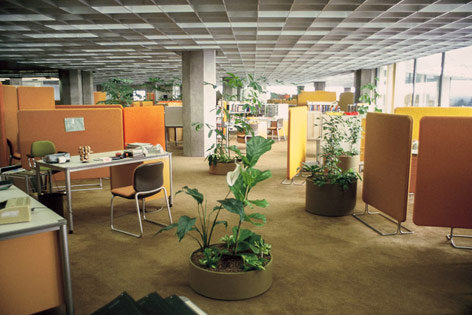
The answer was the German Bürolandschaft. He assumed an open space where office desks are arranged in groups, in a “natural order”, with trees in tubs and convenient walkways. In a word, maximally simulating the natural environment. The main idea of the Germans was to put leaders and subordinates at the same table and completely get rid of the hierarchy in the organization of space.

It’s easy to guess how the Americans simplified this idea. In 1963, engineer and architect Robert Propst introduced the Action Office system , which became known as cubes. At first they looked very loose and liberating.

The idea was simple to genius - to take an American office with long rows of tables and format it according to the German scheme. Tables were set together, and each was fenced off with small partitions. So the clerks received privacy and at the same time remained in the open space, and the company also saved on space. Cubicles were

originally conceived as an instrument of freedom. We give the floor to the famous Gordon Moore:
- By the way, Intel is famous not only for its processors, but also for the fact that it was here that the “cubes” were invented, which in many modern companies have replaced traditional offices. How did you invent them?
“Yes, I remember that moment very well.” We first purchased a large building at Santa Clara 4, the base of which was a huge square. When we imagined how to set up separate office rooms in it, we realized that all this would be very similar to a prison. The only way out was not to build walls, but to divide the entire huge space into “cubes”. And then we thought: some employees will sit in offices, others in cubes, and decided to put everyone else in cubes. I still occupy the largest cube in the company, because I have a huge round table, which in a small one simply cannot fit.
Initially, it was assumed that the cubes could be modified, changing the shape and arrangement, but very quickly it resulted in a “sea of cubes” or, if directly, a “farm of cubes”.

Cubes have become the standard of American office life, however, starting with a symbol of freedom and self-organization, by the end of the century, cubes have become an integral symbol of oppression and lack of freedom. Leaders refused to sit in them, moving to separate spacious offices.

The beginning of the 21st century marks the advent of the Internet, computers, and a host of technologies that have reduced the number of office workers. The papers disappeared, communication was carried out through computers, so tables could already be set as you like. And the offices themselves essentially began to lose their meaning. If earlier it was necessary to keep hundreds of clerks near the factory, now there are ten clerks, they work on the Internet, and the factory has become a virtual concept.
According to the US Bureau of Labor, by 2020, 65 million Americans will become freelancers who will not return to their offices, which will be 45% of all workforce.
Offices began to move away from cubes in the direction of open space with decoration and an "environmentally friendly design." However, this was only an attempt to return to the German ideas of the 50s - people did not want to work in offices anymore, people just needed a convenient place to work. A place for creative work, not a 2x2 meter box.
That was until coworking came into being. In 2005, the young programmer Brad Newberg faced the problem of choice. “Now my choice is either office work with its certainty and communication with employees, or freelance with its freedom and independence. But why can't I get both? ” - He began to reflect - and combined both options. Renting a large room in an office building, he proposed using the same freelancers as he did to work. He called the new scheme of job organization coworking (collaboration).

Coworking CoCo Minneapolis
Coworking offers an ideal organization - an open space organized for convenient separation of teams into work areas, each of which is fenced off with decorative elements, which eliminates noise, but does not allow you to fall into procrastination and completely retire. At the same time, in coworking, the entire space can be reorganized at any moment - tables and partitions on wheels, like Darwin's. DI Telegraph

Workspace
In addition, each clerk has his own place, and the team has his own table. But they are not locked in cubes and can freely communicate with their neighbors - such a moderate socialization gives a sense of elbow and a working atmosphere. At the same time, there is no usual office pressure from the bosses - everyone here sits at the same table, the general atmosphere is democratic to the limit. That allows everyone to be their own manager - and this is beneficially reflected in the statistics (see above on reducing the breakdown of deadlines).
In addition to space, its filling is also easily reorganized - almost every day events for residents are held in coworking, and they themselves can decide which lectures and seminars they would like to see.

Coworking The Fueled Collective
Coworkings usually follow the precepts of the Chicago School and are housed in buildings with a steel frame, which means with high ceilings, spacious halls and huge windows for natural light. If such a building is also in the city center, then in terms of price / quality ratio, such a site cannot have competitors from classical offices.

The Chicago school can be proud.
But the main thing that gives coworking is a critical mass of ideas and professionals. Just as England needed to create the House of India to manage the colonies, so that there was a place to gather all the professional managers, in the 21st century, coworking became offices for managing the Internet.
We put all this at the forefront when we created our coworking in Central Telegraph. We have very high ceilings and panoramic windows instead of walls, free planning and common areas for relaxation, negotiations and recreation. Moreover, each employee has his own personal place, and the company has his own separate table.
A separate table for the team kills three birds with one stone. According to the theory of labor organization, three functions of an employee are distinguished in an office:

It is easy to see that, sitting at the same table, the team easily performs these functions without getting up from chairs.
And by the way, about chairs: in our coworking this is one of the most serious elements, and we took a chairthe famous designers Charles and Ray Ames of the 1949 model. This is exactly the very first plastic chair in history that I wrote about at the very beginning of the article - so that each of the residents of the DI Telegraph coworking has the opportunity to sit on history, moreover, it is considered the most comfortable chair of the twentieth century, which became us the main selection criterion.
But what will happen next? How will the evolution of offices continue?
In 1962, Marshall McLuhan proclaimed that the future was a global village. Like everyone will work from home and stop leaving him. However, in practice it turned out that we are all just too lazy and succumb to the temptations of the house not to work. That is why freelancers move from home to coworking - their productivity simply doubles.
On the other hand, the thesis about the “last working generation” was put forward. If by 2020 the number of freelancers reaches half the workforce, this simply means that half of the people do not work in the classical sense of the word, but have fun - devote themselves to creativity or fantastic startups.

Do you know why the animated series about SpongeBob is so ironic? It's just that this is the first cartoon of the 21st century in which the very process of work is set to be funny. The fact that SpongeBob goes to work is the central humorous moment of the entire series.

For the new generation, work is entertainment and fun. Anything, but not a monotonous senseless work - computers take it upon themselves, and soon robots. People just need a place to work. As a place for sports or a place for creativity. But it will be tomorrow, and our coworking is already working today.
Come see - ditelegraph.com