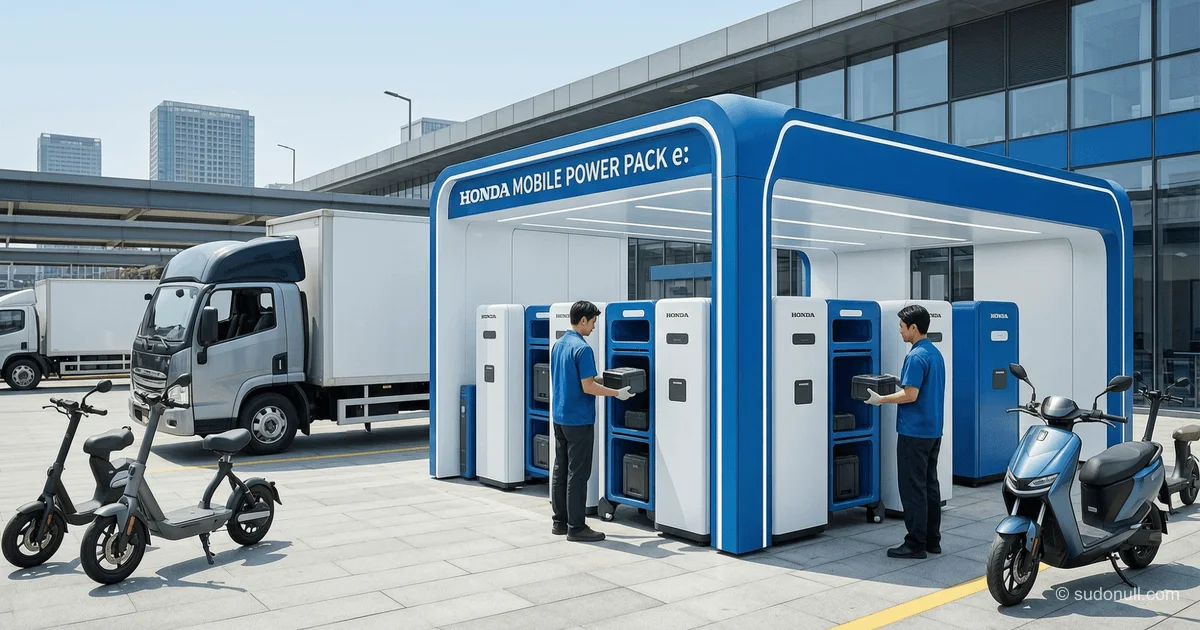
Honda Unveils Swappable Mobile Power Pack e: Batteries for Electric Vehicles
At the ACT Expo in Las Vegas, Honda announced its entry into the US market with swappable portable batteries, the Mobile Power Pack e:, designed to address the challenges of long charging times and insufficient range for commercial electric vehicles.
Honda's announcement at the ACT Expo in Las Vegas is more than just an entry into the US market for swappable batteries. It marks a moment when the giant, having lost the battle for electric cars, changes the game by shifting from the race for "bigger battery capacity" to creating "energy as a service." While the industry continues to struggle with fitting giant batteries into trucks, Honda is quietly building an operating system for electric logistics where the physical size of the battery no longer matters.
The Core: What's Really Happening
Honda has officially announced the launch of its Mobile Power Pack e: (MPP) product in the US market for B2B integrations, with sales starting in just one month—June 2026. On the surface, this looks like another announcement of a "swappable battery" for commercial electric vehicles. But the company's real bet is much deeper and more radical.
Honda is not selling a battery. It is selling a departure from the very concept of stationary charging. In documentation and statements from company representatives, it is emphasized that MPP is designed to solve not one but three "unsolvable" problems of electromobility simultaneously: long charging times, insufficient range, and high battery costs. Until now, the industry has addressed these problems separately and at the expense of the end user: building ultra-expensive megawatt charging stations, demanding subsidies for purchasing huge batteries, or accepting vehicle downtime of 6-8 hours as the norm.
Honda proposes to bypass these problems systematically. The battery becomes a portable, swappable module that can be integrated not only into Honda's own vehicles but also into products from other OEMs. This means Honda is aiming to become an infrastructure standard—a provider of the energy layer for all light commercial vehicles, from scooters to last-mile delivery vehicles.
The first non-obvious insight: this is a direct consequence of Honda's strategic pivot after its failure in the passenger EV market. In March 2026, the company was forced to cancel production of battery electric vehicles in the US, completely terminate its joint project with Sony, and write off huge losses. Less than two months after this fiasco, Honda enters the same arena but with a completely different proposition. Instead of competing with Tesla and Ford in the consumer EV segment, where its position was weak, it shifts the battle to a field where competitors have no presence—the B2B energy supply for commercial fleets. Honda cannot sell an electric car to American consumers, but it can become an indispensable supplier for logistics operators serving those same consumers.
Timeline and Context
The history of MPP began long before this expo. Honda first showcased concepts of swappable batteries at CES 2018, and in April 2019 announced a partnership with Panasonic to test them in Indonesia. Since then, the company has methodically built positions in Asia: investing in the Japanese startup Gachaco (in April 2026 increasing its stake to 47% for $2.14 million), launching pilots in India through a partnership with Bhago Mobility, where MPP batteries power electric delivery scooters on a subscription basis.
Now this same approach is entering the US market. The choice of venue for the announcement is no coincidence: ACT Expo is the leading commercial vehicle show in North America, attracting precisely those clients who calculate cost per kilometer and vehicle downtime daily. Honda is showcasing the product not to Silicon Valley hipsters but to fleet managers for whom "charging time" translates into lost revenue.
At the same expo, Honda also demonstrated its hydrogen fuel cell module, developed jointly with GM, and announced the next generation with improved performance. These are not two separate products but parts of a unified "zero-emission" strategy, where Honda hedges its bets: where instant energy replacement is needed, MPP works; where higher power is required, hydrogen steps in.
Who Wins and Who Loses
Winners:
- Last-mile delivery operators (Amazon, FedEx, UPS). These companies are already electrifying their fleets but face the problem of charging infrastructure for thousands of micro-hubs in cities. MPP allows them to set up swap stations right at sorting centers, reducing vehicle downtime from hours to minutes.
- Startups and specialized vehicle manufacturers. Honda openly offers its battery format to other OEMs. This gives smaller players a ready-made energy system without the need to spend $50–100 million developing their own battery platform.
- Honda itself. The company turns its weakness (lack of a competitive mass-market EV) into strength. It doesn't need to sell cars to profit from electrification—selling energy and equipment is enough.
Losers:
- Tesla and other consumer EV manufacturers. Their business model relies on charging being the end user's problem. MPP shows an alternative system where charging is unnecessary.
- Stationary charging station manufacturers. Fast-charging networks like Electrify America and ChargePoint are investing billions in building stationary hubs. The swappable battery model questions the return on these investments in the commercial vehicle segment.
- Gogoro and other swappable battery startups. With its resources, dealer network, and production scale, Honda can quickly capture a market where pioneer startups have fought for years for each percentage point of share.
What the Media Miss
The key hidden element is the role of Gachaco, the Japanese battery-swapping joint venture in which Honda now holds 47%. Gachaco was co-founded by four Japanese motorcycle giants (Honda, Suzuki, Yamaha, Kawasaki) and energy company ENEOS. This is not just a startup—it is a cartel that can push standardization of the swappable battery format for all motorcycles in Japan and beyond. Through Gachaco, Honda gains leverage over the entire Japanese two-wheeler market, and through its partnership with Panasonic, over all of Southeast Asia.
This means Honda is building a de facto global standard for swappable batteries, not through patent wars but through joint ventures with former competitors. Tesla tried to impose its charging connector on the market through the superiority of its Supercharger network. Honda is more subtle: it enters through a consortium where competitors find it more beneficial to join than to fight. This is classic Japanese business diplomacy, and Western media, focused on the "US vs. China" rivalry, completely miss this third vector.
The second underestimated aspect is the compatibility of MPP with Honda's hydrogen strategy. In Honda's concept, MPP batteries can be charged not only from the grid but also from hydrogen fuel cells. This creates a hybrid architecture where hydrogen acts as a backup energy source for charging batteries in remote locations without access to a powerful grid. For markets like India, Indonesia, or rural areas of the US, where the power grid is unreliable or absent, such a combination could be indispensable.
Forecast: Next 30 Days and 90 Days
30 days (by early June 2026):
Sales of MPP for B2B integrations will begin in the US. Honda will announce the first major integrator partners. I expect these to include delivery vehicle manufacturers—something like the Fastport eQuad, which Honda is already promoting for delivery on bike paths and campuses. Simultaneously, Amazon and FedEx will issue internal requests to assess the feasibility of integrating the MPP format into their electric delivery vans. These requests will not be public, but insider information will inevitably leak through consulting firms.
90 days (by August 2026):
Information will emerge about scaling the Honda-Panasonic pilot in Indonesia, and Honda will link this project to the US launch through a common technology platform. The key moment: negotiations will begin between Gachaco and US distributors about licensing the MPP format for the US market. If this happens, Honda will gain control over the battery-swapping standard on three continents simultaneously—Asia, Europe (via the Japanese consortium), and North America. This will be the moment when swappable batteries cease to be a "niche Asian solution" and become a global format for commercial electric vehicles.
And most importantly: amid this pivot, shares of Tesla and Rivian may begin to lose ground in the commercial vehicle segment simply because investors will start reassessing alternative approaches to electrification. Honda, a company with a market capitalization of about $50 billion, has found a way to strike at a market dominated by companies with capitalizations in the hundreds of billions—and it did so not by competing on specs but by changing the very business model of energy ownership.
— Editorial Team










No comments yet.