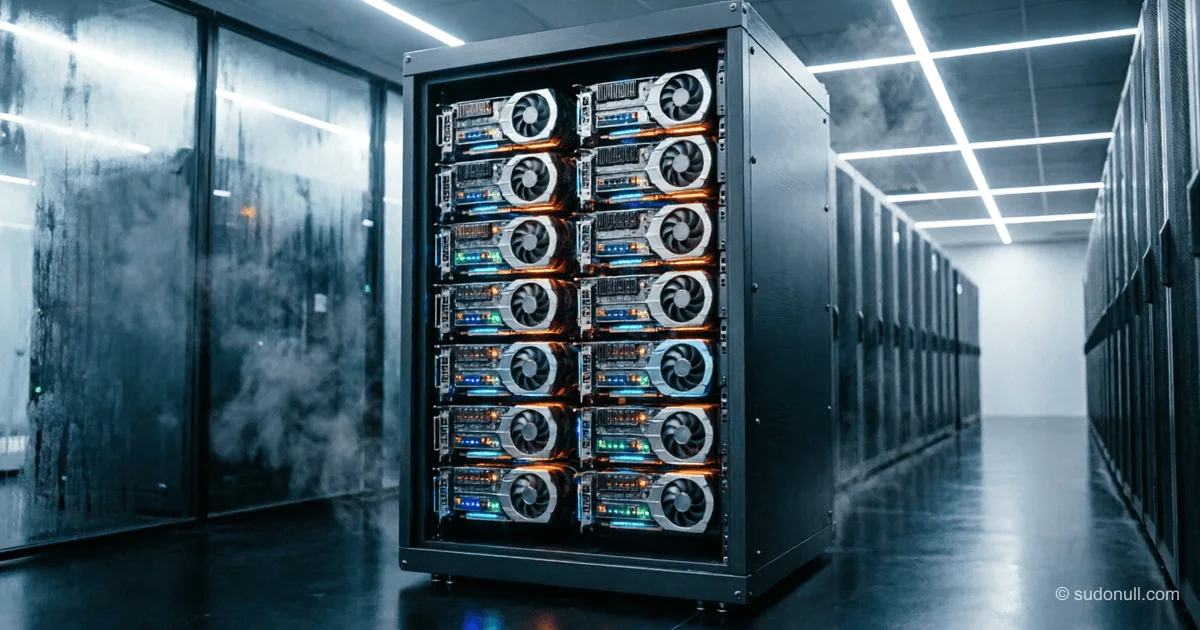
Selectel Unveils Powerful 8U Server Platform for AI and Rendering
Russian provider Selectel has introduced a new high-performance 8U server platform optimized for artificial intelligence, analytics, and rendering workloads. The server supports up to 16 GPUs and up to 4 TB of DDR5 RAM, making it suitable for the most resource-intensive computations.
As an analyst tracking hardware evolution under sanctions, I see this announcement not as a technical presentation but as a strategic pivot for the entire Russian cloud infrastructure market. What is presented as the launch of "yet another piece of hardware" is actually the beginning of the end of the reselling era and a transition to a "our silicon on someone else's architecture" model.
[The Gist]: What's Really Happening
This is not just a server. Selectel is demonstrating an act of technological emancipation from global OEM vendors. A company that historically made money from rental and colocation is now becoming a full-fledged ODM (Original Design Manufacturer) of computing platforms, challenging giants like Dell, HPE, and Lenovo on their own turf.
The key shift that is overlooked: the development of their own motherboard SSE-MB-201 and, more importantly, writing the BIOS and BMC (Baseboard Management Controller) in-house. In the x86 world, BIOS is a holy of holies, typically supplied by AMI or Insyde. Selectel claims full control over this stack. This means the platform is no longer a "black box" for the integrator. Selectel can optimize memory timings at the firmware level for specific workloads, customize GPU riser firmware, and, paradoxically, likely solve the "gray import" problem for accelerators by adapting microcode to non-standard device IDs. This is not just assembling a kit from available Intel Xeon 6 chips and NVIDIA cards; it is creating a managed hardware ecosystem with a high level of vertical integration.
Timeline and Context
The timeline of Selectel's transformation clearly indicates this is not a spontaneous decision but the result of a five-year strategy:
2020: Launch of an investment program in the AI ecosystem. The company invests $15-20 million per year (converted from ruble amounts) in R&D and data center modernization.
2024-2025: Architectural design of the SSE-MB-201 platform. Selectel engineers essentially reverse-engineer Intel Granite Rapids-SP reference designs to create a layout capable of handling 176 PCIe 5.0 lanes and powering 16 GPUs with peak power consumption of up to 700 W each. The challenge is not just to fit the accelerators but to manage heat dissipation of 14 kW per rack.
April 22, 2026: Official announcement of the AI server. Selectel states the solution is available both for rent and for purchase in a private cloud. Total planned investments until 2031 reach $75-83 million.
Who Wins and Who Loses
Winners:
- Selectel itself: Sharp increase in margins. The margin for a service provider selling a self-assembled "box" is fundamentally higher than reselling licensed HPE or rebranding Supermicro. Selectel turns CapEx into intellectual property. Cashback from renting out such machines will not go to the US but will stay within the company.
- Mid-sized and large enterprises (fintech, retail): They get a legal tool for on-premise inference without the risk of cloud license revocation. The server supports up to 32 DDR5-6400 modules and 12 NVMe drives, addressing LLM performance in a closed loop.
Losers:
- Russian system integrators and traditional vendors (Kraftway, Aquarius): Selectel, being a service provider, enters their turf with its own firmware. Having its own data center network, Selectel can test and debug hardware on real customer tasks faster than classic assemblers.
- Western OEMs (Dell, HPE): Their "gray" parallel import through third countries becomes even more expensive and pointless with the emergence of a local platform with a single point of responsibility and custom firmware.
What the Media Isn't Saying
The vast majority of press releases focus on performance (Xeon 6, DDR5, 16 GPUs). My experience with HPC clusters suggests a completely different focus, which is the main insider signal here. Selectel's main victory is not the "hardware" but the hidden war with NVIDIA's proprietary cooling standards.
The average user doesn't think about it, but installing 16 H100/H200 or RTX Pro 6000 Blackwell accelerators in an 8U chassis is a thermal bomb. NVIDIA rigidly dictates specifications for card placement and airflow corridors. The fact that Selectel used a custom SSECH-812 chassis with 12 controlled fans and seven power supplies (2000 W each, 80 Plus Platinum certified) indicates that the company's engineers solved the non-trivial task of "taming" the thermal packages of international chips without regard to NVIDIA's native reference designs. This provides the freedom to install not only standard SXM modules but also "non-standard" accelerators in the future, which, in the context of technological wars, is worth its weight in gold.
Forecast: Next 30 Days and 90 Days
Next 30 days (until June 5, 2026):
Selectel will launch an aggressive B2B campaign with free load testing for fintech and telecom. A strategic partnership with one of the largest retail banks to build a fully isolated private AI cluster on these machines will be announced.
Next 90 days (until August 4, 2026):
The SSE-MB-201 platform will receive a BIOS update expanding the list of supported "non-standard" accelerators, causing quiet horror among competitors. Selectel's next step will be the announcement of a reference design for immersion cooling of this platform, signaling readiness for the era of 100 kW racks. The data center equipment market will finally split into "those who relabel ODM" and Selectel, which controls BMC and power management at the silicon level.
— Editorial Team








No comments yet.