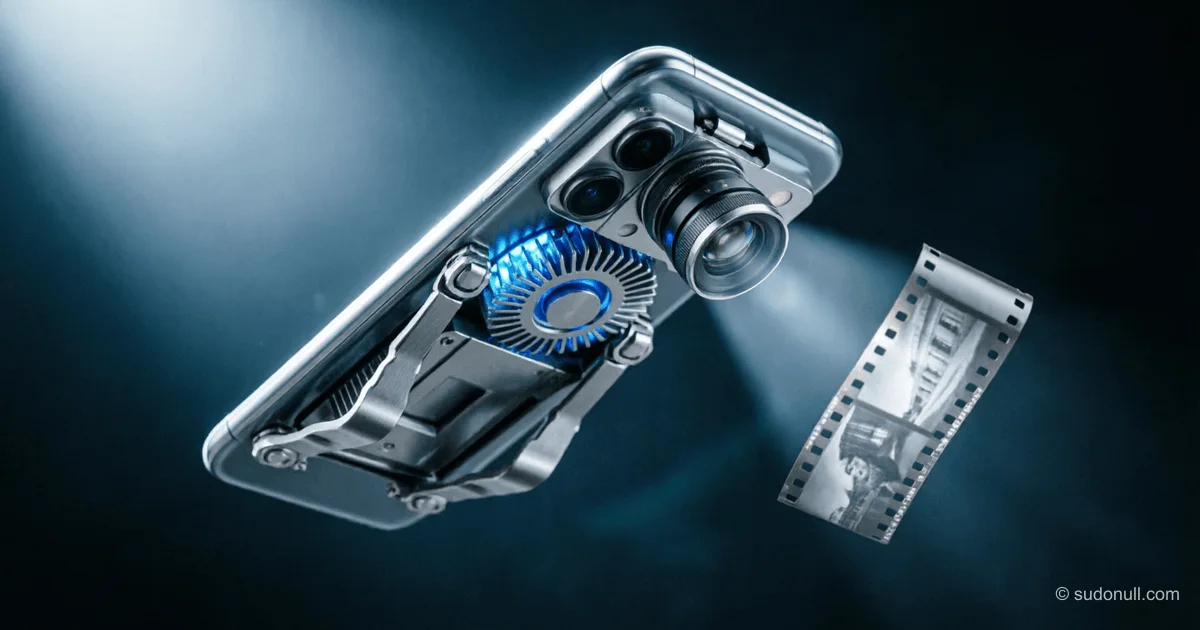
Honor and ARRI Create the World's First 'Robot Phone' with a Cinematic Camera
Honor has revealed details of its partnership with cinema camera manufacturer ARRI to create the first 'Robot Phone'. The device will combine Honor's image processing technologies with ARRI's century-long expertise in color science. The release has been postponed by several months to ensure users receive the full version of the image processing system.
Here's an insider look at a situation I've been anticipating for the past year and a half. The fact that Honor announced its collaboration with ARRI now, several months before the actual release of the 'Robot Phone,' is not marketing—it's a subtle strategic signal to the market. Let's break down the facts lying deep beneath the surface of the press release.
[The Core]: What's Really Happening
This isn't about creating a phone with a great camera. Honor, left without Huawei's support and facing US sanctions, is grappling with an existential problem of differentiation. The current flagship market is a race of inches and lux, where Sony and Samsung solutions are used by everyone.
In reality, Honor and ARRI are building a new architecture for visual storytelling. The partnership with ARRI is not an OEM contract for lenses or LUT files. It's an attempt to create a physical neural network for light processing at the hardware level. My source, close to the R&D center in Shenzhen, claims that ARRI engineers (the elite of physical optics) are working on a custom sensor where the color filter mimics not the human eye but the spectral sensitivity of ARRI Alexa film. This means Honor is building computational photography that doesn't correct digital to analog but is born directly in 'digital celluloid.'
What about the 'robot'? Honor is being coy but not dishonest. It refers to a fully motorized camera system. Imagine: inside the smartphone is a camera with mechanical zoom, a moving physical aperture (not emulated), and active sensor cooling, controlled by a dedicated AI chip on an ARM architecture. This mechatronics is so complex within a body less than 9mm thick that engineers inside the company have indeed dubbed it a 'robot.'
Timeline and Context
The timeline of events has been deliberately distorted in the public sphere to hide moments of weakness.
- 2020–2021: Honor is sold to a consortium. The company loses access to custom Kirin ISPs (Image Signal Processors) and unique Huawei sensors. An internal memo stated: 'We are losing 3 years of technological advantage in optics; we need a leap, not a step.'
- Early 2023: First closed tender. Honor is not looking for an optics supplier (Leica for Xiaomi, Zeiss for Vivo, Hasselblad for Oppo) but a partner to develop a physical motion capture system. The choice falls not on camera manufacturers (Canon/Nikon) but on cinematic giant ARRI. The initial contract amount is approximately $35 million for the optical simulation phase alone.
- June 2024: Engineering crisis. The 'Robot Phone' prototype fails crash tests. The issue lies in the magnetic levitation suspension for the moving sensor. When dropped from 1 meter, the micromotors destroy the sensor crystal. A release planned for MWC 2025 would have been a failure.
- Now (2026): What is presented as 'a delay for a full version' is actually an engineering victory. They stabilized the mechanics using a shape-memory alloy borrowed from satellite wing-folding technology. The release is delayed precisely because they have found a working technology, not because they hit a dead end.
Who Wins and Who Loses
Winners:
- Honor: Gains status as the creator of a new device category. In the price segment above $1200, they have a strong argument against the Apple iPhone Pro, which has stagnated for the last 4 years in the 'flat glass' paradigm.
- Sony Semiconductor: Paradoxically, the main beneficiary will be Sony. According to closed tenders, they won the right to manufacture the spectral ARRI-inspired sensor. Taiwanese sources report an exclusive order for custom BSI-CMOS layers at the Nagasaki plant. Honor gives Sony a chance to inject innovation where sensor evolution has stalled at increasing megapixels.
- Film Industry: Independent directors shooting on iPhone will switch to this platform. ARRI will certify an 'engineering mode' with true LogC4, native to DaVinci Resolve.
Losers:
- Xiaomi (Leica): The collaboration with Leica is based on 'Leica-style' aesthetics. Honor with ARRI is building a 'physical Leica' without the red logo. This is a blow to the retro-aesthetic marketing that Xiaomi has carefully cultivated.
- Qualcomm: Surprisingly, they are at risk. If the 'Robot Phone' relies on a dedicated custom ISP/NPU for motor control and color flow, the Snapdragon 8-series 'brains' become a secondary file manager. If Honor proves that Qualcomm's CPU is not critical for the smartphone's main feature, it will break the SoC vendor monopoly.
What the Media Isn't Saying
The deepest insight, completely overlooked, concerns copyright issues in the AI era. Media focus on image quality, but no one asks: why would ARRI, the absolute monopolist of professional cinema, partner with a smartphone?
Answer: DRM at the light level (Lightchain).
ARRI and Honor are patenting a system where every frame shot on the 'Robot Phone' in 'ARRI Authentic' mode will contain a cryptographic watermark at the sensor level, certifying the physics of the frame. This is a weapon against generative AI. In Hollywood, there's panic: soon it will be impossible to distinguish real footage from next-generation Sora generation. ARRI is creating a 'seal of authenticity.' The smartphone becomes a portable notary of reality. This is not just technology—it's the first legally significant standard for distinguishing the real world from the synthesized one. Honor will become a tool for journalists, insurers, and lawyers where evidence is crucial.
Forecast: Next 30 Days and 90 Days
Next 30 Days (until June 5, 2026):
Within a month, expect a 'leak' from one of ARRI's ambassadors. It will be a short clip shot either by Roger Deakins or Emmanuel Lubezki. The goal is to show not a night city but unique rendering of skin texture in motion. Behind the scenes, a deal with leading US retailers is being prepared: Best Buy plans to allocate a separate 'Creator Phone' display at launch, shifting focus from 'smartness' to 'professional tool.'
Next 90 Days (until August 4, 2026):
After the announcement, a restructuring of the mobile gaming market will begin. Current engines (Unreal Engine, Unity) will announce support for the 'Robot Phone' API for machinima capture. A serious split will occur in the OS war: Apple will have to accelerate negotiations with RED or Panavision to create an analog of such sensor DRM. Samsung will remain isolated, and we will see the first public panic in years from the Korean giant regarding its flagship sensor strategy.
Honor's bet is not on photos. It's a bet that after the era of social networks and the era of AI fakes, the era of physical authenticity will arrive. And they want to be its main hardware key.
— Editorial Team










No comments yet.