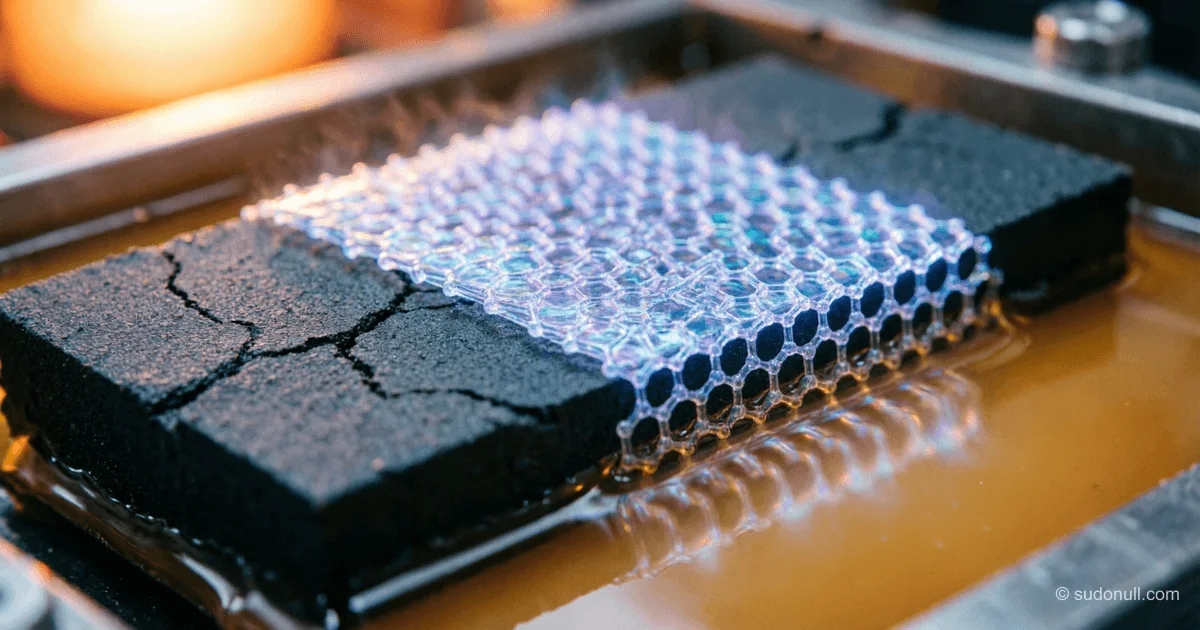
Smart Molecular Coating Created in Hong Kong Significantly Extends Life of Lithium Batteries
Engineers at CUHK have developed an ultra-thin molecular layer that stabilizes the electrode-electrolyte interface. Modified batteries retain 80% capacity after 200 cycles at 60°C, which is critical for electric vehicles.
A 'Molecular Coat' for Batteries: How Hong Kong Engineers Dressed the Electrode and Extended Lithium Battery Life
Introduction
The electric vehicle industry has hit what seems like an invisible wall—and this wall is only a few nanometers thick. It's the interface between the electrode and electrolyte, where chemical reactions invisible to the eye but destructive to the battery occur. A research team led by Professor Lu Yijun from the Chinese University of Hong Kong (CUHK) has found a way to turn this interface from a source of problems into a stabilization tool, using an ultra-thin molecular coating that acts like a high-tech 'coat' for the electrode.
The development, published in the prestigious journal Nature Nanotechnology, addresses one of the fundamental problems of lithium-metal batteries: electrolyte degradation at high voltage. Unlike traditional approaches where engineers modify either the electrode itself or the electrolyte composition, the CUHK team proposed a third path—precise tuning of the interphase at the molecular level.
Event Details and Timeline
The official press release about the development was published on May 3, 2026, by the CUHK Faculty of Engineering. The research was the result of work by Professor Lu Yijun's group from the Department of Mechanical and Automation Engineering. The first author of the scientific paper is Dr. Wang Huwei, a postdoctoral fellow in the same department.
The key innovation is that the researchers applied an ultra-thin layer of specially designed molecules to the surface of the positive electrode (cathode) made of nickel-rich NMC811 material. These molecules do not just passively coat the electrode—they actively modulate the local chemical environment. The technical term used in the publication—'interfacial polarity modulation'—reflects the essence of the approach: the molecular layer changes the distribution of electric charges at the interface, affecting how electrolyte molecules approach the electrode.
Experiments used coin cells—a standard laboratory format for testing battery materials. The results were impressive: the modified electrode retained 80% of its initial capacity after 200 charge-discharge cycles under harsh conditions—at a high cutoff voltage of 4.7 V and a temperature of 60°C. The unmodified electrode degraded much faster under the same conditions.
An important technological nuance: the method does not require overhauling the entire production chain. Professor Lu emphasized that applying the molecular layer is a precise and controlled chemical surface modification that could potentially be integrated into existing battery manufacturing processes without radical redesign.
Impact and Significance (for the World/Industry/Society)
The significance of the development extends far beyond a laboratory record. Lithium-metal batteries are considered the next big step after lithium-ion: they promise significantly higher energy density, which directly translates into increased driving range for electric vehicles and reduced weight of battery packs.
However, the commercialization of lithium-metal batteries has stalled for years precisely due to problems at the electrode-electrolyte interface. At high voltage—which is necessary for high energy density—the electrolyte oxidizes, decomposition products accumulate, and the battery quickly fails. This is a hidden, 'invisible' problem: degradation cannot be seen without disassembling the cell, but its consequences—capacity loss and risk of failure—are well known to every engineer in the industry.
The Hong Kong development offers a solution to this very problem—not by changing the electrolyte chemistry, but by creating a 'smart' molecular barrier that selectively regulates interactions. Crucially, this is not passive protection but active regulation: the molecular layer attracts some electrolyte components with part of its fragments and repels others, forming an optimal interphase environment. The scientific publication uses the term 'inverted volcano' to describe the mechanism, reflecting the non-monotonic dependence of stability on the electronic properties of the molecular layer's terminal groups.
For the electric vehicle industry, the technology means a potential shortcut to commercial lithium-metal batteries with a driving range significantly exceeding 500 km per charge. Stability at 60°C is especially critical: such temperatures are actually reached inside an EV battery pack during fast charging or intensive driving. Many promising materials work well at room temperature but fail the heat test—the Hong Kong development passed this test.
For stationary energy storage systems, the significance is also high: battery durability at high temperatures reduces costs for cooling and air conditioning systems in storage containers, saving significant funds when scaling up.
Reactions from Key Players
Publication in Nature Nanotechnology, one of the most authoritative journals in nanotechnology, is itself a strong signal of recognition by the scientific community. Professor Lu Yijun is a figure with an established reputation in the electrochemical community: a PhD from MIT (2012), a first-batch research fellow of the Excellent Young Scientists Fund program in 2019, recipient of the Battery Division M. Stanley Whittingham Mid-Career Award from the Electrochemical Society, and the Tajima Prize from the International Society of Electrochemistry.
In her comment, Professor Lu outlined an ambitious but realistic position: 'Although the current verification was conducted at the level of laboratory coin cells, in principle the method can be applied to larger battery systems. We hope that this work will provide scientific guidance for the development of next-generation lithium-metal batteries with high energy density and high stability, accelerating their practical application.'
Direct statements from major battery manufacturers—CATL, LG Energy Solution, Panasonic, Samsung SDI—have not appeared in open sources at the time of publication. However, this is standard industry practice: major players rarely comment on university developments until they conduct their own internal verification. Given that the method does not require radical production restructuring and can be integrated into existing processes, industry interest can be considered highly likely.
It is worth noting that other groups are also working on solving lithium-metal battery problems. For example, scientists from the Hong Kong University of Science and Technology (HKUST) recently presented a different approach—using a monocrystalline borate covalent organic framework as a solid electrolyte to suppress dendrite growth. Their batteries retained 91.8% capacity after 600 cycles, with Coulombic efficiency reaching 99.98%. Both approaches do not compete but rather complement each other, addressing different aspects of the overall stability problem of lithium-metal systems.
Forecast and Conclusions
The CUHK development is interesting not only for its specific result but also for the shift in conceptual framework. The traditional paradigm of 'improve the electrode' or 'improve the electrolyte' is giving way to a third path—'tune the interface.' This opens a new field for engineering creativity, where molecular design of the surface layer becomes an independent tool for battery optimization.
In the short term (1-3 years), we can expect scaling of the technology from coin cells to pouch cells—flat packages used in real battery modules. At this stage, issues related to the uniformity of molecular layer application on large electrode areas and its compatibility with industrial coating processes will either emerge or be resolved.
The medium-term horizon (3-5 years) sees the emergence of battery module prototypes with lithium-metal anodes and NMC cathodes modified using the CUHK method. The key question here is cost: applying the molecular layer adds a technological step that must be not only effective but also economically justified. The cost of such modification will likely be fractions of a USD per kilowatt-hour of capacity—potentially acceptable for the premium electric vehicle segment, where the gain in driving range compensates for the additional expense.
Long-term forecast (from 5 years) points to the appearance of commercial lithium-metal batteries with a modified interphase layer in high-end electric vehicles. It is in this segment that buyers are willing to pay for increased driving range, and manufacturers can recoup additional technological costs. As the technology matures and becomes cheaper, it will migrate to the mass segment and stationary storage.
The story of the 'molecular coat' also illustrates a broader trend in materials science: researchers are moving from searching for new materials to precise engineering of existing ones at the atomic and molecular level. Boundaries, junctions, and surfaces—once perceived as annoying obstacles—are becoming the main field for innovation, where a few nanometers of properly designed coating can change the fate of entire technological directions.
— Editorial Team










No comments yet.