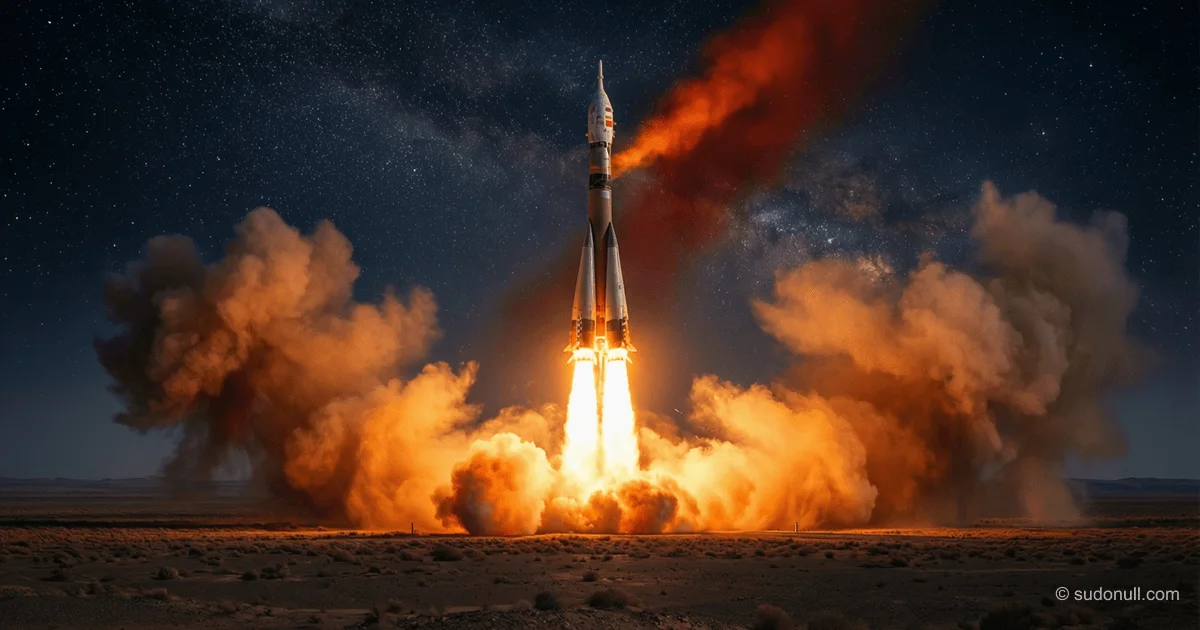
Russia Launches Soyuz-5 Rocket with World's Most Powerful Liquid Engine and New 'Brain'
A new rocket equipped with an eco-friendly kerosene engine successfully launched from Baikonur. Ural engineers developed its onboard computer, which controls the trajectory in real time and provides emergency protection.
Soyuz-5: Why the Launch of the Most Powerful Liquid Rocket Is a Tactical Success with an Unclear Strategy
Introduction
On the evening of April 30, 2026, the Soyuz-5 rocket, also known as Irtysh and the Kazakh Sunkar, launched from Site 45 of the Baikonur Cosmodrome. Both stages operated nominally for 9.5 minutes, and a mass-dimensional payload mockup was inserted into the planned suborbital trajectory. Roscosmos head Dmitry Bakanov called the event "historic" and emphasized that "our colleagues from Kazakhstan on the Baiterek project have now also joined the club of space powers." However, behind the fanfare lies a complex picture: a rocket with a record-breaking engine and advanced control system is entering a market that has changed almost beyond recognition over the decade of its development.
Event Details and Timeline
The Soyuz-5's path to launch stretched over a decade—and that's before reaching regular operations. Development of the rocket by Samara's Progress Rocket Space Centre began in 2016 under the Phoenix project; production of the first vehicle started in 2019. The launch was postponed four times: initially from 2022, then from December 2025 to late March 2026, then to early and mid-April. The latest delays came after the state commission identified critical issues, and at Baikonur they stressed that "no one is trying to launch the rocket for a holiday date."
The technical specifications, however, are truly impressive. The heart of the first stage is the RD-171MV engine developed by NPO Energomash, which produces 806 tons-force of thrust in a vacuum. This is the world's most powerful liquid rocket engine: for comparison, the legendary RD-170 used on the Soviet super-heavy Energia rocket had a thrust of 740 tons-force. With a mass of about 10 tons, the thermal power of the unit is comparable to a large hydroelectric plant. The RD-171MV is the first Energomash engine created entirely in a 3D design environment, with digital models transmitted directly to CNC machines.
The second stage is equipped with the Voronezh-built RD-0124MS engine. Both stages run on a mixture of naphthyl (eco-friendly kerosene) and liquid oxygen—unlike the toxic fuel used in Protons. The Soyuz-5's payload capacity is up to 17 tons to low Earth orbit—roughly twice that of the Soyuz-2.1, and comparable to foreign medium-class launch vehicles. When equipped with the Fregat-SBU upper stage, the rocket can deliver up to 2.5 tons to geostationary orbit.
Special attention should be paid to the rocket's "brain." The Ural-based Academician Semikhatov NPO Avtomatiki developed a control system for the Soyuz-5 featuring a high-speed onboard computer that minimizes connections between the rocket and ground equipment and allows all test modes to be conducted directly onboard. For the first time in Russian rockets, an engine emergency protection system is used that can cyclically assess the engine's condition at intervals of a few milliseconds and, in the event of an anomaly, save the rocket and launch pad. On the second stage, the scheme provides for shutting down only the emergency chamber block while the others continue operating.
The project has an interstate nature: the rocket is being developed under the Russian-Kazakh Baiterek program, where Russia is responsible for the launch vehicle and Kazakhstan for the launch pad infrastructure. After a nine-year hiatus, Site 45 at Baikonur returned to service, with reconstruction following the Soviet concept of autonomous launch: from the moment the rocket is rolled out of the hangar until liftoff, no personnel are present at the pad.
Impact and Significance
The economic aspect is central to the Soyuz-5's positioning. According to stated data, the cost per kilogram to low orbit will be approximately 40% lower than on the Soyuz-2.1. In absolute terms, this means a reduction from about $5,500 to $3,300 per kilogram. Savings are achieved through a more efficient engine, lighter construction (using aluminum alloys and composites), and friction stir welding.
However, this is where the main problem begins. While the Soyuz-5 spent a decade going through design, approvals, and delays, the global launch market underwent a tectonic shift. SpaceX, with its reusable Falcon 9 rocket, offers a price of around $2,700 per kilogram—and that's without further reductions from stage recovery. The expendable Soyuz-5, with a target price of $3,300, ends up more expensive even at the start of commercial operations, which are planned no earlier than 2028. Analysts compare the situation to trying to catch a departing train: the rocket was designed for the economic realities of the mid-2010s, which ceased to exist by the time of launch.
From an environmental perspective, the Soyuz-5's advantages are undeniable: naphthyl and liquid oxygen leave no toxic trace in the atmosphere. However, in the commercial market, this factor rarely becomes decisive—customers vote with their dollars for price and reliability.
Geopolitically, the project strengthened Kazakhstan's position, which after the successful launch announced its intention to expand its presence in the global space services market. Chairman of Kazakhstan's Aerospace Committee Baubek Oralmagambetov called the launch "a new platform for new grand projects."
Reactions of Key Players
All significant statements came from official figures. Roscosmos Director General Dmitry Bakanov emphasized that the new rocket "will significantly reduce the specific cost of payload delivery, which will have a positive impact on the economics of spacecraft launches," and promised to "improve the rocket's characteristics so that it can deliver the maximum number of payloads to orbit." Samara Region Governor Vyacheslav Fedorishchev called the launch "an event that has already gone down in the history of astronautics."
NPO Avtomatiki Director General Mikhail Izyumov highlighted the innovativeness of the control system: "The use of a high-speed, high-performance onboard computer will minimize connections between the rocket and the equipment of the technical and launch complexes."
Notably, Western analytical publications and industry observers barely reacted to the launch—unlike Falcon 9 launches or Starship tests, which attract global press. The market's silence speaks louder than words: the Soyuz-5 is still perceived more as a regional event than as a shift in the balance of power in global spaceflight.
Forecast and Conclusions
The Soyuz-5 launch is an undeniable tactical success: Russia has put into service a rocket created entirely in the post-Soviet period, with the world's most powerful liquid engine and an advanced digital control system. For domestic tasks—launching heavy military satellites, supporting the crewed program (the rocket is considered a backup vehicle for the Oryol spacecraft), and launching scientific payloads—the launch vehicle is more than adequate.
However, the strategic niche of the Soyuz-5 remains unclear. The test program includes two more launches (October 2026 and 2027), after which the rocket will be certified for regular operations. Earlier plans suggested at least two launches per year until 2036, but these plans may be adjusted. In the commercial market, an expendable rocket at $3,300 per kilogram will face reusable competitors whose prices continue to drop. The Soyuz-5's first stage was originally designed with an eye toward use in the super-heavy Yenisei launch vehicle—but the fate of that project remains uncertain.
The story of the Soyuz-5 illustrates a fundamental dilemma of modern spaceflight: you can create a technically perfect product, but if it is designed for the economic model of the previous decade, its commercial future is in question even before its first launch. The next two to three years will show whether the Soyuz-5 becomes the workhorse of Russian space or remains a monument to engineering excellence that missed the market train.
— Editorial Team









No comments yet.