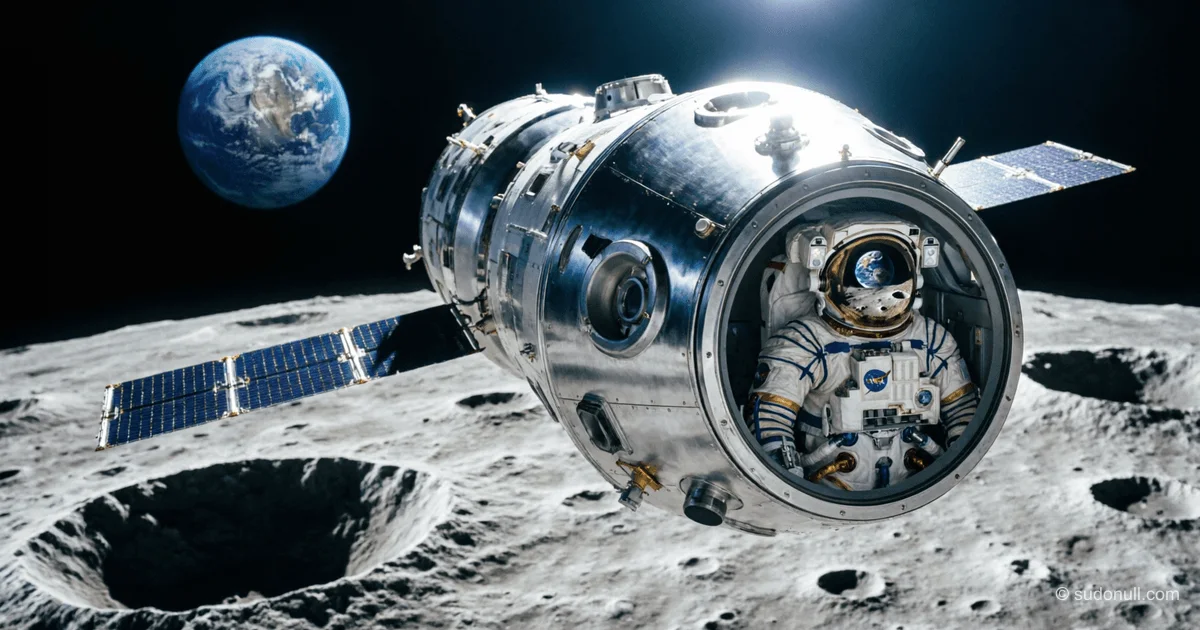
China Develops Crewed Spacecraft for Lunar Missions
The China Aerospace Science and Technology Corporation is developing a next-generation crewed spacecraft for lunar missions, part of the program to land taikonauts on the Moon by 2030.
Moon Race 2.0: Why China's New Spacecraft Is Shifting the Balance of Power in Space
Introduction
On April 24, 2026, China's Space Day, the Fifth Research Institute of the China Aerospace Science and Technology Corporation made a landmark announcement: the new crewed lunar spacecraft is in an active development phase. This is more than just another technical news item — it is official confirmation that Beijing is firmly committed to its goal of landing taikonauts on the lunar surface by 2030, despite technical challenges and tight international timelines.
While the American Artemis program faces delays (the landing has been pushed back to mid-2027 due to Orion's heat shield issues), China's lunar program is demonstrating methodical schedule adherence. The Mengzhou spacecraft (meaning "Dream Voyage") and the Lanyue lander ("Lunar Radiance") are becoming symbols of a new phase in the space race — a race not for a flag, but for resources and a permanent presence at the Moon's South Pole.
Event Details and Timeline
The new Mengzhou crewed spacecraft is a key element of China's lunar strategy. Unlike its predecessors used for low Earth orbit flights, Mengzhou is designed for deep space. As Shao Limin, a representative of the Fifth Research Institute, stated, this platform will create a "fresh platform for flights from Earth into extraterrestrial space," underscoring its versatility and focus on long-term objectives.
The preparation timeline is impressively packed:
- October 2025: The China Manned Space Agency (CMSA) officially announced that prototyping of key flight equipment was complete. This list included the Changzheng-10 (CZ-10) launch vehicle, the Mengzhou spacecraft, the Lanyue lander, the Wangyu lunar spacesuit, and the Tansuo crewed lunar rover.
- 2025 – Series of Tests: Successful hot-fire tests of the Changzheng-10 second-stage engines, zero-altitude launch escape system tests for Mengzhou, and comprehensive checks of the Lanyue module's takeoff and landing characteristics took place.
- Summer–Autumn 2026: Launch of the Chang'e-7 robotic station, tasked with prospecting for water ice in the craters of the lunar South Pole. It will carry the Russian scientific instrument "Lunar Dust Monitoring."
- 2030: The target date for the first crewed landing.
Commenting on the progress, CMSA representative Zhang Jingbo acknowledged that the "volume of work ahead is enormous," especially given the high-quality standards and tight flight test deadlines. However, he emphasized that the schedule remains unchanged.
Impact and Significance
The development of the (partially) reusable Mengzhou spacecraft and associated infrastructure has far-reaching consequences, extending well beyond the Wenchang Space Launch Site.
For the space industry and geopolitics, the emergence of China's lunar spacecraft signals the end of the US–Russia monopoly on crewed deep space exploration. Notably, Mengzhou is not just for the Moon: it will also be capable of supplying China's space station in low Earth orbit, making it analogous to the American Orion — a vehicle able to operate in different environments. This dual-use design demonstrates the pragmatism of China's program.
Furthermore, an international alliance is forming. Together with Russia, China is building the International Lunar Research Station (ILRS). According to plans, the surface base will be a joint Russian-Chinese venture, with its "heart" being the Russian compact nuclear power plant "Selena," whose assembly on the Moon is planned for 2032. Thus, Mengzhou becomes not merely a transport vehicle, but a link in the chain of creating a permanent lunar infrastructure.
For society and science, the significance of this race lies in access to resources. The Chang'e-7 mission, preceding the human landing, is aimed at searching for water ice in the permanently shadowed craters of the South Pole. Water is for drinking, oxygen, and, most importantly, hydrogen fuel. Whoever first establishes water extraction on the Moon will hold the key to further exploration of the Solar System.
Reaction from Key Players
The official US reaction has been restrained but telling. While NASA publicly welcomes the "peaceful use of outer space," notes of concern about the pace of China's program are increasingly heard in the agency's reports. The Artemis II delay and the Orion heat shield issue contrast sharply with the Chinese approach, which NEWS.ru experts characterize as "more deliberate" and less susceptible to political haste.
Russia, for its part, has adopted a pragmatic partnership stance. Involvement in Chang'e-7 and plans to integrate nuclear technologies into the ILRS indicate that Moscow is betting on an eastern vector in crewed space exploration, while its own lunar projects (Luna-26, the Yenisei rocket) are targeted for the 2030s.
Domestically, the news triggered a wave of patriotic enthusiasm. At the Space Day celebration, Shao Limin stated directly: "In the near future, everyone will see Chinese people leave their footprints on the surface of Earth's natural satellite." This narrative is a crucial part of the domestic political agenda and the mobilization of scientific and technical potential.
Forecast and Conclusions
China is on the home stretch in preparing for a crewed lunar landing. Beijing's technical strategy rests on three pillars: a heavy-lift launcher (Changzheng-10 capable of delivering 27 tonnes to a lunar transfer trajectory), specialized modules (Mengzhou and Lanyue), and robotic reconnaissance (Chang'e-7 and Chang'e-8).
However, the "human factor" and the testing of deep-space life support systems remain open questions. Will there be uncrewed flights in 2027–2028 to verify docking in lunar orbit? Most likely, yes.
In the medium term, the most probable scenario is that by 2030 we will see two lunar programs simultaneously in an active phase: the American Artemis with its international coalition and the Chinese one with Russian partners. This is not just a "new race"; it is the emergence of the Moon as an independent geopolitical region. And the new Mengzhou spacecraft is a clear indicator that China is ready to take a leading position in this region on an equal footing with the USA.
— Editorial Team









No comments yet.