China Begins Testing World's First Mobile Nuclear Reactor on a Truck to Power Data Centers
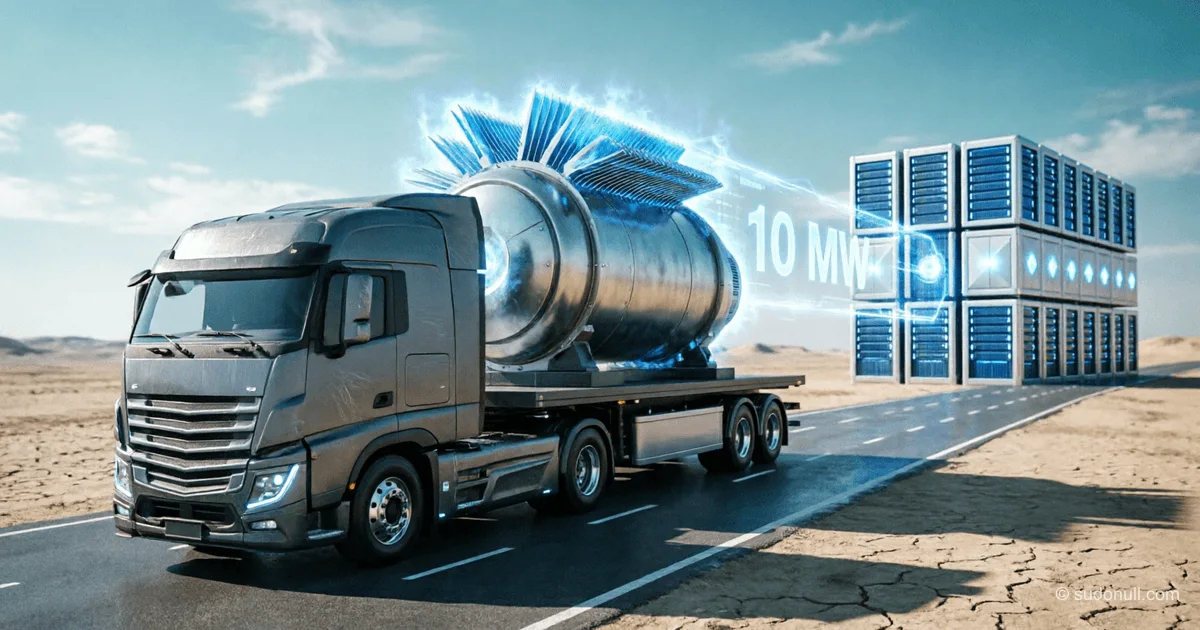
Chinese scientists have started testing a 10-megawatt nuclear reactor mounted on a truck chassis. The device could power data centers, remote settlements, or military bases for decades, solving the energy supply problem for AI infrastructure.
China's 'Nuclear Power Bank' on Wheels: How a Mobile Reactor Will Transform Energy for AI and Beyond
Introduction
While the world discusses the rapid growth of computing power for artificial intelligence, a much more fundamental problem is brewing behind the scenes: where to get all that electricity? Modern data centers serving neural networks consume enormous amounts of energy, and traditional power grids are increasingly unable to handle peak loads. Against this backdrop, news from China sounds like science fiction: a team of scientists led by Academician Wu Yican has created and begun testing the world's first mobile nuclear reactor with a capacity of 10 megawatts, mounted on a standard truck chassis.
The installation has already been dubbed a 'nuclear power bank' — and this name surprisingly accurately reflects its essence. The reactor is not tied to stationary infrastructure, can be delivered to any location, and according to the developers, can operate for decades without refueling. This development is not just a technological curiosity but a potential answer to one of the main challenges of the digital age.
Event Details and Timeline
The project is backed by the consortium 'Feng Lin He' (Frontier Development of Science, FDS) and personally by Academician Wu Yican of the Chinese Academy of Sciences, a renowned nuclear physicist who heads the Institute of Nuclear Energy Safety at the Hefei Institutes of Physical Sciences. The development took several years, and by the end of April 2026, the team officially announced the creation of a full-scale engineering prototype.
"Our team has created the world's first engineering prototype of a 10 MW mobile nuclear power plant, and we are now promoting its use in demonstration pilot projects," Wu Yican stated in an interview with Science and Technology Daily.
What is the installation technically? It is a small modular reactor using liquid metal as a coolant. Its dimensions allow the entire structure to be placed on a standard truck chassis and transported on public roads. The service life is claimed to be 30–60 years, with the reactor capable of operating for 10 to 30 years on a single fuel load. In other words, this is a virtually autonomous energy source that requires neither constant maintenance nor fuel delivery.
The 10 MW capacity is not arbitrary. According to the developers, this is enough to power an average data center handling AI tasks. For comparison, it is about 10,000 times more than a typical household consumes. At the same time, the installation remains compact enough not to require major construction at the deployment site.
The project is currently in the engineering testing and safety assessment phase. The team is actively seeking sites for demonstration pilot projects to confirm the claimed characteristics in real operating conditions.
Impact and Significance
The significance of this development extends far beyond a single invention. On a global scale, it touches three key areas: energy security, AI infrastructure development, and the geopolitical balance in the nuclear industry.
Energy for AI. Data center electricity consumption is growing exponentially. Major tech companies are already facing situations where energy availability becomes the main limiting factor for scaling computing power. The mobile reactor offers a fundamentally different solution: instead of connecting to overloaded grids, the data center gets its own autonomous source independent of external infrastructure. This is especially relevant for countries with vast territories and underdeveloped grid infrastructure.
Remote Regions and Emergency Situations. Beyond the AI sector, the development opens new opportunities for powering isolated territories — islands, Arctic settlements, mining complexes. The reactor can be quickly delivered to disaster zones for emergency power supply to hospitals and critical infrastructure. Given that the cost of building power lines to remote areas can reach hundreds of thousands of dollars per kilometer (converted from national currencies), the mobile reactor becomes an economically viable alternative.
Maritime and Space Potential. Developers have already stated the possibility of adapting the technology for ship power plants and space systems. Commercial shipping, which accounts for about 3% of global CO₂ emissions, could gain a carbon-neutral energy source. And for lunar bases or Mars missions, a compact reactor independent of sunlight is virtually irreplaceable.
Geopolitical Context. China is consistently expanding its nuclear capabilities. According to the China Nuclear Energy Association, the country operates 59 commercial nuclear power units, with another 35 under construction — making China the world leader in this indicator for the 19th consecutive year. Total generation in 2025 reached 467.7 billion kWh, about 5% of the country's total energy consumption. The mobile reactor fits into this strategy as a logical next step: from stationary giants to flexible, scalable solutions.
Reactions of Key Players
Official reactions from Western regulators and the nuclear community are still cautious. The project remains in the testing phase and is far from obtaining international safety certifications. However, experts are already drawing parallels with Western counterparts, and the comparison is not in their favor.
American Westinghouse is developing the eVinci microreactor with a capacity of about 5 MW — half that of the Chinese counterpart. It is positioned as transportable in a container but is not mobile in the sense that the Chinese truck-chassis project is. The Russian project 'Elena' from OKBM has a capacity of only about 100 kW — two orders of magnitude smaller. The stationary NuScale SMR at 77 MW is not designed for relocation after installation.
Thus, the Chinese reactor occupies a unique niche: it is simultaneously powerful enough for industrial use and compact enough for real mobility. None of the Western competitors have yet reached the stage of full-scale field testing at a comparable level.
From an investment attractiveness perspective, the project is also interesting. Defense and energy contracts in the nuclear sector amount to hundreds of billions of dollars, and a technology that promises to reduce the cost of deploying power capacity in remote areas by several times will inevitably attract attention from both government and private customers. Converting local costs into hard currency shows that savings on infrastructure construction for a single data center could reach tens of millions of dollars.
Academician Wu Yican specifically emphasized the symbiotic relationship between nuclear energy and AI: "Nuclear energy is an important driving mechanism that fuels the development of AI... in turn, AI is changing the research paradigm in the nuclear field." This two-way interaction — nuclear energy powers computing, and AI optimizes reactor design — creates a self-sustaining cycle of accelerating progress in both fields.
Forecast and Conclusions
The Chinese mobile reactor project is not a single technological breakthrough but a symptom of a fundamental shift in the energy paradigm. The AI revolution requires a rethinking of the entire chain of electricity generation and distribution, and miniaturization of nuclear sources looks like the most promising direction.
In the short term (1–3 years), we can expect the completion of tests and the emergence of the first pilot implementations — likely at isolated facilities such as island territories or military bases, where safety issues are easier to control and the benefits of autonomy are maximized. Commercial data centers will be the next step, but this will require lengthy licensing procedures.
In the medium term (5–10 years), the technology could significantly change the economics of cloud computing. If a data center no longer depends on geographic proximity to power grids, operators gain unprecedented freedom in choosing locations. This could lead to the emergence of 'nomadic' computing clusters and a new architecture for internet infrastructure.
Serious challenges remain. Transporting nuclear materials on public roads requires an unprecedented level of safety and international regulation. Public perception of a 'nuclear truck,' especially after past accidents, will be wary. Finally, the claimed characteristics must be confirmed in real conditions — so far, all data is based on developers' statements.
Nevertheless, the direction is set: energy is ceasing to be stationary infrastructure and becoming a mobile resource. The 'nuclear power bank' from Hefei is the first step toward a world where electricity moves not through wires but on wheels, and where the question 'where to plug in a data center' is solved by a single truck trip.
— Editorial Team









No comments yet.