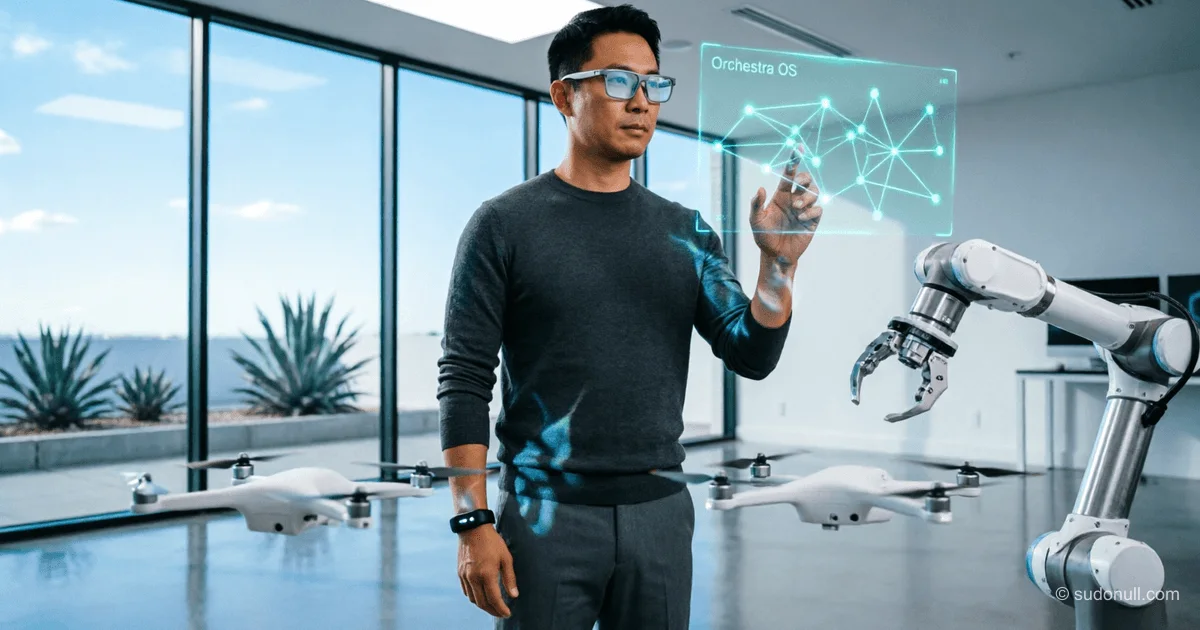
Wetour Robotics Announces Debut of Orchestra Operating System for Controlling Robots and Drones with the Power of Thought
Wetour Robotics is set to launch the Orchestra operating system on May 28, which can integrate smart glasses, bracelets, and drones. The platform reads gestures and neural signals to control devices.
Silent Conversation with Machines: How Orchestra Turns Gestures and Neural Signals into a Universal Language for Robot Control
Introduction
On May 28, 2026, in Austin, Texas, Wetour Robotics will host an event that could change our understanding of human interaction with the physical world. This is not about another gadget—smart glasses, a bracelet, or a drone. It's about Orchestra—an operating system that promises to unite all these devices into a single ecosystem and control them not through screens and apps, but through gestures, gaze, and neuromuscular signals. If the smartphone era connected people to information, Orchestra aims to connect people directly to physical objects—robots, drones, exoskeletons, and smart homes—without intermediaries like keyboards and touchscreens.
Event Details and Timeline
Wetour Robotics is a publicly traded company on NASDAQ (ticker: WETO), based in Austin, and until recently known as Webus International Limited. In March 2026, the company raised $5.16 million through a private placement of 60 million common shares at $0.086 per share. By the end of April, the company had already demonstrated the first technical milestones of the platform.
On April 29, 2026, four key demonstrations of Orchestra's capabilities were revealed. The first is VisionLink: a chest-mounted camera recognizes user gestures and sends commands to a connected exoskeleton, which can operate at three speeds or stop. The same system works in reverse: if someone approaches the user, Orchestra translates direction and distance information into tactile feedback—the closer the person, the stronger the vibration.
The second demonstration is Conductor: a bracelet reads surface electromyography (sEMG) signals from forearm muscles, and a virtual 3D hand model replicates the user's movements in real time—vertical, horizontal, and rotational. The hand does not need to be in the camera's field of view, which fundamentally distinguishes the system from optical tracking.
The third is spatial localization, still under development: combining data on the user's position in space with visual context and gestural intent into a single control layer.
All these technologies operate entirely on edge computing, without cloud access. Wetour calls this set of capabilities Spatial Intent Fusion and positions Orchestra not as a new product, but as a new application layer for the era of Physical AI.
Impact and Significance
To understand why Orchestra deserves attention, one must grasp the scale of the problem it aims to solve. Today's world is filled with smart devices that cannot communicate with each other. Smartwatches cannot control a robotic arm. A camera cannot coordinate with a wheelchair. A bracelet cannot directly interact with a drone. Each new device adds another remote, another app, another isolated "island," and humans are forced to act as living integrators.
Orchestra offers an alternative: a unified protocol called Orchestra Connect, which allows a wristband, an indoor camera, and a robotic device to work as one system. Wetour does not manufacture wearables or end devices—it develops a platform layer that makes them work together. This is the "Intel Inside" strategy of the 90s, but for robotics.
The range of potential applications is unusually broad: assistive mobility for people with disabilities, industrial safety, spatial navigation, assistance for the visually impaired, warehouse logistics, sports training, smart home control, and consumer drones. All these scenarios are united by one idea: real-time operation, no cloud latency, and coordination based on human intent, not programmable scripts.
Of particular note is the architectural decision to use edge processing. Avoiding the cloud means the system continues to work even without an internet connection, and the user's neuromuscular data never leaves the device—a significant argument in an era of total biometric surveillance.
Reactions from Key Players
Wetour Robotics CEO Nan Zheng articulated the company's vision in a press statement: "For ten years, every new wearable and every new connected device made the world smarter and the user more confused. Orchestra is our answer. On May 28, we will demonstrate our approach, where wearables on your body and devices in your environment speak the same language."
The company positions Orchestra not as a product, but as an application layer for the Physical AI era, similar to how smartphone operating systems became the layer between users and mobile services. Wetour is already hiring engineers—in April, the company posted a job opening for a Machine Learning Engineer Intern with the task of building a neural map that translates raw muscle signals in real time into hand intent for a live demonstration at the event.
Financial analysts note that Wetour has consistently used the U.S. capital market—registration statements and PIPE deals in March 2026 provided the flexibility needed for a technological leap from AI mobility to Physical AI infrastructure. However, the company's market capitalization remains modest compared to competitors like Apple, which is actively developing smart glasses and robots—making Orchestra an asymmetric bet: either the platform takes off and Wetour stakes out a new market, or giants with their resources absorb the niche.
Forecast and Conclusions
Orchestra is at a point where ambition meets reality. Less than a month remains until the official launch, and the demonstrations already conducted show working prototypes, not conceptual slides. However, the platform's success will depend on three factors, each of which remains uncertain.
First is developer adoption. Wetour promises openness and independence from specific hardware manufacturers, but without a critical mass of partners producing devices compatible with Orchestra Connect, the platform will remain an elegant demonstration rather than an industry standard.
Second is the accuracy of the neural interface in real-world conditions. Lab demonstrations with a developer who knows exactly which gestures the system registers are one thing. A mass user, whose muscle signals vary from person to person, is quite another.
Third is competition. Apple with its Vision Pro and patents on smart glasses, Meta with investments in neural interfaces, Elon Musk's Neuralink—all are moving toward contactless human-machine interaction. Wetour is betting on openness and platformization, which could be both an advantage (rapid ecosystem deployment) and a disadvantage (limited resources for marketing and standard lobbying).
The May 28 event in Austin will provide the first public answer to the main question: can Orchestra truly turn disparate devices into an orchestra controlled by thought and gesture? If the Spatial Intent Fusion demonstration succeeds and viewers see a person controlling a drone, lights, and a robotic arm simultaneously without pressing a single button—this will be not just a product presentation, but a moment when the concept of Physical AI gets a working operating system. And then the question will no longer be "is it possible," but "how quickly will it become ubiquitous."
— Editorial Team










No comments yet.